
A company store isn’t a fulfillment strategy by itself. The right corporate swag kitting and fulfillment model depends on your needs: store software manages ordering, in-house fulfillment keeps packing under your team’s control, a fulfillment partner handles storage and shipping, and a merchandise partner can coordinate the wider program. Each approach solves a different part of the work.
It’s easy to focus on the items and overlook what happens after they’re chosen. Yet inventory, assembly, packaging, and delivery shape the experience just as much as the merchandise.
This guide explains what fulfillment involves and compares four approaches, including where each works well and where it can add coordination. You’ll learn how to choose between store software, physical fulfillment, and a partner that brings merchandise planning and logistics together, so the system supports your team instead of adding another layer to manage.
Key Takeaways
- Fulfillment is more than shipping: inventory control, kit assembly, quality checks, packaging, and delivery all shape the recipient’s experience.
- A company store manages ordering, while physical fulfillment handles merchandise. Separate the software decision from the storage and shipping decision.
- Kitting brings selected items together as one ready-to-send package, making it useful for programs where presentation and consistency matter.
- Match the operating model to order frequency, inventory needs, and the complexity of coordinating shipments across recipients or locations.
- Evaluate fulfillment as part of the broader merchandise experience, not just as a way to move products from a warehouse to a doorstep.
The Warehouse Is Not the Whole Story: What Does Branded Merchandise Fulfillment Include?
Branded merchandise fulfillment involves more than storing products and sending parcels. It connects warehouse inventory, order information, quality checks, packaging, and delivery, helping teams plan merchandise around real business needs.
Warehousing and Inventory Management
Warehousing keeps branded merchandise in organized storage, while inventory management tracks what is on hand and where it is located. The distinction matters: a warehouse holds items, but useful inventory records help teams determine what can support upcoming programs.
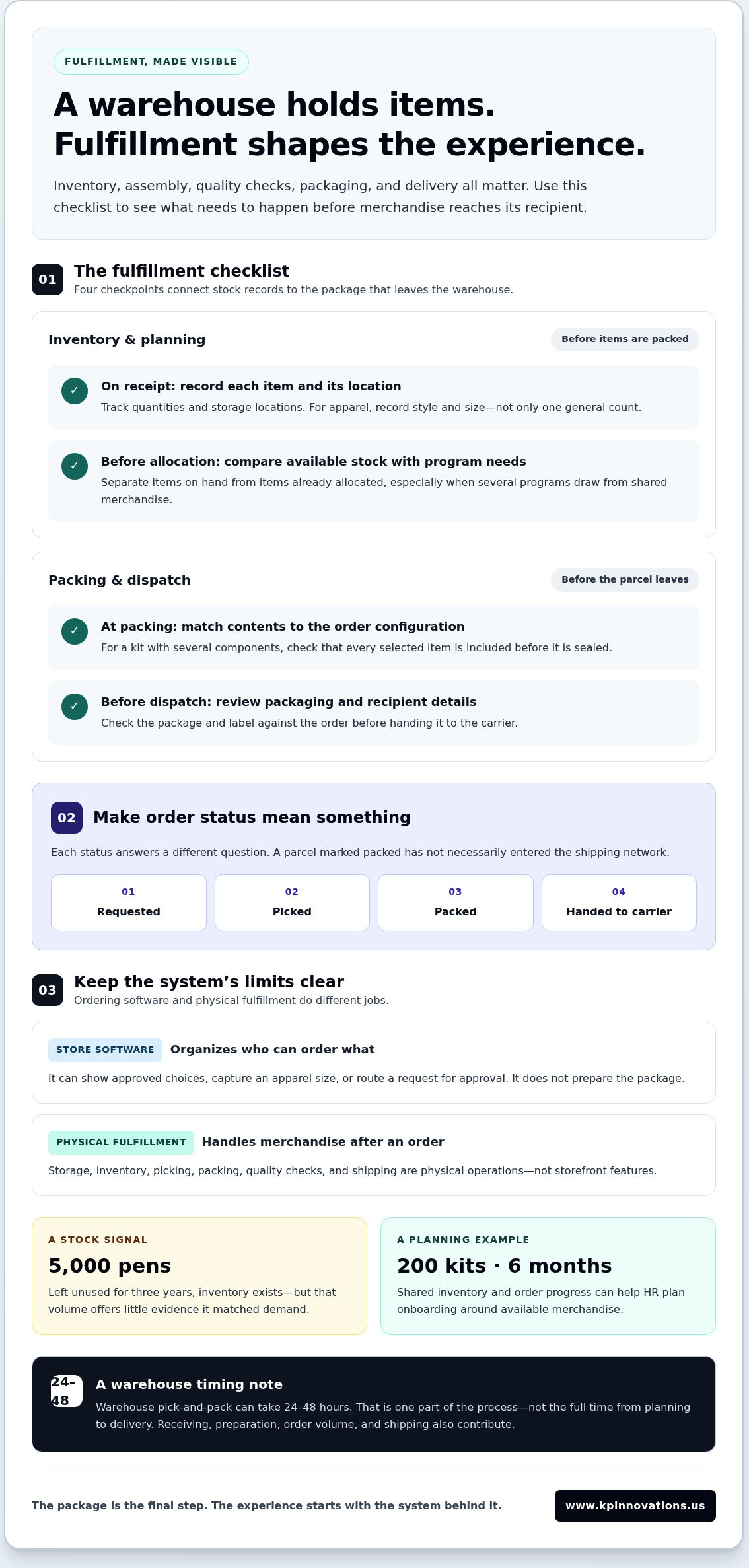
When products arrive, teams can record quantities and storage locations, then update stock as items are allocated or shipped. For example, tracking apparel by style and size gives a clearer picture than keeping one general count. That detail helps teams plan distributions around actual needs.
Inventory decisions also affect how effectively merchandise supports the brand. A marketing department that buys 5,000 pens and leaves them unused for three years has stock, but little evidence that the volume matched demand. Reviewing planned programs and past usage can help guide future purchasing.
Warehouse pick-and-pack can take 24-48 hours. That describes one part of the process, not the complete time from planning to delivery. Receiving, preparation, order volume, and shipping all contribute to the operational timeline.
Inventory and Order Visibility
Inventory and order visibility bring stock information together with the progress of individual orders. This helps teams distinguish available items from products already allocated, which matters when several programs draw from shared merchandise.
Records can connect each item to its quantity, storage location, and order activity. If a welcome kit includes apparel and printed materials, tracking each component separately helps teams identify what needs replenishment before it disrupts preparation.
Order status should distinguish between a request being placed, picked, packed, and handed to a carrier. Each step answers a different question. A packed parcel, for example, has not necessarily entered the shipping network.
For a program sending 200 new-hire kits over six months, a shared view of inventory and order progress can help HR coordinate onboarding plans with available merchandise. It also gives operations a clearer basis for allocating stock across requests.
Quality control connects the recorded order to the package leaving the warehouse. Teams can compare the packed contents with the order configuration and check labels before dispatch. For a kit with several components, that final review can catch a missing item before it reaches the recipient.
- On receipt: record each item and its storage location.
- Before allocation: compare available quantities with program needs.
- At packing: match package contents to the order configuration.
- Before dispatch: review packaging and recipient details.
These records make storage and order activity more useful for planning. A fulfillment and logistics service can connect warehousing and shipment coordination within a merchandise program.
A Storefront Can’t Ship the Order: Company Swag Store Software versus Physical Fulfillment
A company store and a warehouse solve different business problems. Software organizes who can order what; physical fulfillment handles the merchandise after an order is placed.
Swag Store Software and Ordering Options
A company swag store is an online interface for ordering approved merchandise. Its value depends on how well the ordering experience fits the program: unclear choices or approval steps can make purchasing harder for employees.
For example, a team might use a store to offer approved apparel for a uniform program, while managers follow a separate purchasing process for event materials. Self-service ordering lets employees choose from available options; a procurement portal can organize departmental requests and approvals.
These tools manage access to orders, not the physical work. A store can capture an apparel size or route an order for approval, but it doesn’t prepare the package. This distinction matters when teams expect software alone to manage the entire merchandise operation.
Uniform programs also need a consistent way to present approved styles and support repeat ordering. A clear store experience helps employees find the right option, while the distribution process determines how selected items are prepared and delivered.
Physical Fulfillment Partner Types
A general third-party logistics provider typically handles storage and order operations, while a merchandise specialist understands merchandise-specific workflows. The choice matters when a program’s needs go beyond standard product storage and parcel handling.
A general provider may suit straightforward orders with consistent items. A specialist may be a better fit for varied merchandise, campaign packaging, or kits that change by audience. Compare the work involved instead of assuming one provider type fits every program.
A wrong-SKU rate above 1% can indicate that a company has outgrown its generic 3PL. This is a useful operational signal: item identifiers, picking instructions, and order configurations may need closer alignment. The threshold doesn’t explain the cause by itself, but it highlights a process worth examining.
Software and physical operations can work together, but they are not interchangeable. The store captures selections and routes orders; the fulfillment operation acts on them. For a uniform program, both sides need to align approved products, size choices, and the process for preparing each order.
Assess the model against the program’s actual needs:
- Recurring employee orders: make approved options and repeat purchasing easy to navigate.
- Campaign-specific kits: account for changing contents and presentation requirements.
- Multiple programs: consider how separate orders and inventory needs will be coordinated.
Product choices influence how the program operates. Strategic merchandise sourcing can connect selection decisions with the needs of the ordering and fulfillment model.
A Shipment Is Only the Last Mile: What Fulfillment Solutions Really Coordinate
Fulfillment is more than sending a box. It connects order instructions, merchandise handling, kit configuration, and destination planning in one workable operation.
Kitting and Order Processing
Order processing turns a request into clear instructions for gathering and preparing the right merchandise. This matters because vague kit definitions can lead to inconsistent packages, even when the correct products are in stock.
A useful order record identifies the kit version, recipient, and any choices that change its contents. A packer can then follow the configuration rather than infer what belongs in the package. An experienced packer can assemble a 12-piece welcome kit in 90 seconds, but clear instructions remain essential to accuracy.
For a program with several kit versions, separate configuration records help prevent one audience from receiving another group’s materials. Order information should follow the work through preparation and packing.
Shipping and Regional Production
Regional production prepares merchandise closer to recipients, while centralized production coordinates the work through a shared location. The choice matters when a program serves teams in different regions and needs to balance consistency with distribution requirements.
A single production location can simplify oversight of a shared design, while regional production may reduce how far merchandise travels before distribution. Consider where items are made, where they’re assembled, and whether every destination needs the same package.
International shipments require coordination for each destination. For a company distributing to teams across countries, shipment details and production plans need to align before dispatch. Treating each destination as a separate routing requirement helps avoid applying one location’s assumptions to every recipient.
Storage, Packaging, and Shipping Options
Storage, packaging, and shipping options determine how a kit is held, protected, and routed. Coordinating them matters because the merchandise’s physical format affects handling and the package prepared for its destination.
For example, a soft apparel item and a rigid printed display piece may need different packing arrangements. A kit containing both should be planned around the more sensitive component, rather than packed as if every item can be handled the same way.
Storage decisions also affect how easily teams can access kit components. Grouping items by program or configuration can make preparation more orderly, while clear handling notes help packers distinguish packages with different contents.
Consider the operating model as a connected chain:
- Order information: identifies the contents and destination.
- Production planning: establishes where merchandise is prepared.
- Packaging: protects and presents the selected items.
- Shipment routing: directs each completed package to its recipient.
When these decisions are coordinated, fulfillment supports the intended experience instead of treating the package as an afterthought.
Fulfillment partner selection and operational pitfalls
A fulfillment partner should match the actual needs of your merchandise program. Compare capacity, accuracy, timelines, and how orders reach employees or customers.
Evaluating Fulfillment Partners
Evaluate a fulfillment partner by comparing its processes with your order patterns, kit requirements, and delivery footprint. A provider suited to routine parcels, for example, may not fit complex employee onboarding shipments.
Review accuracy against client-supplied kit configurations; an average kit accuracy rate should be at least 99.5%. Ask how the operation tracks rejections and errors, and how it corrects them. For a distributed workforce, assess whether it can split shipments across 50 branch locations simultaneously.
Capacity also needs to reflect peak demand. Order volume can rise 5-10× above baseline during busy periods, so compare peak staffing and warehouse capacity with your campaign schedule. An onboarding ramp typically takes 1-3 weeks, which should be included in launch planning.
- Accuracy: compare packed kits with the approved configuration.
- Reach: map recipient locations, including a 50-branch distribution.
- Capacity: plan for 5-10× baseline volume during peaks.
- Setup: account for a 1-3 week onboarding ramp.
Operational Pitfalls
Operational pitfalls arise when a partner’s stated capabilities don’t match the demands of daily fulfillment. They matter because late kits can disrupt employee onboarding, while incorrect contents create extra work for HR and operations.
Hiring more than 5-10 new employees per month may make welcome-kit fulfillment burdensome to handle in-house. If a kit must arrive before an employee’s first day, align ordering, assembly, and shipping schedules with onboarding dates. A process that treats every request as a standard parcel may miss that timing.
Global distribution adds coordination demands. A company serving employees or partners in 20 countries may otherwise manage 20 separate shipping relationships. Compare how the partner coordinates destinations and shipment information, rather than focusing only on the warehouse handoff.
Production constraints can also disrupt plans. Six-week lead times and minimum order quantities of 500 units per SKU may limit flexibility when designs change or demand is uncertain. Map those constraints against campaign dates and expected use before relying on replenishment.
Finally, define who owns order data and configuration changes, and who handles escalation when a shipment is wrong. A documented process lets HR identify the correct welcome-kit version, while operations can trace the affected order and resolve the issue. Clear ownership helps the fulfillment partner support a consistent arrival experience.
What are the inventory, packaging, and shipping options for employee and customer swag kits?
Choose inventory, packaging, and shipping based on how often kits go out, where they’re headed, and how recipients will use them. A one-time employee meeting and an ongoing welcome program call for different approaches, even if both include apparel.
Inventory Options: Bulk, Stored, or Assembled to Order
A bulk order can fit a one-time distribution. For example, an organization distributing 200 shirts at one employee meeting may need the product order, not ongoing fulfillment. The team receives the apparel, sorts it for the meeting, and distributes it there.
Recurring programs bring different needs. Storing components lets teams assemble kits as orders arrive, while pre-assembled kits keep complete packages ready for dispatch. The choice depends on how often the kit changes, how predictable demand is, and whether components serve other programs.
For U.S. companies shipping fewer than 100 outbound shipments per month, packing kits in-house may cost less than outsourcing fulfillment. That comparison depends on the work involved, including storage, picking, assembly, and the staff time required for each shipment.
Packaging That Fits the Recipient and Purpose
Packaging affects both protection and presentation. A trade show shipment containing 10 boxes of loose items may suit a venue where staff arrange materials onsite. By contrast, a coordinated shipment of 200 boxes to 200 conference attendees calls for individual packages prepared for each recipient.
Employee kits may combine apparel, printed materials, and other items. Match the package to its contents, then check that the format keeps everything together during handling. Customer gifts may call for a more considered opening experience, while uniform distributions often prioritize sorting by recipient or size.
Shipping for Individual or Group Distribution
Ship kits individually when recipients are spread across locations; send consolidated cartons when one team can distribute them. A technology startup shipping welcome kits across 12 states, for example, needs recipient-level addressing and a process that connects each package to the right employee.
For example, an operations manager estimated three weeks to ship welcome kits to remote employees. Planning depends on order readiness, packing capacity, and how widely recipients are spread. Set the target arrival date first, then work backward through assembly and dispatch.
- One-time event: consider bulk product delivery and onsite distribution.
- Recurring kits: compare stored components with pre-assembled inventory.
- Direct-to-recipient: organize individual addresses and package-level contents.
Align product choices with the packaging and distribution model. Plan merchandise sourcing around kit requirements so each item suits its intended recipient and shipment.
KP Innovations: Promotional Products
KP Innovations helps organizations connect merchandise choices with the experience they want employees and customers to have. Its Promotional Products, Custom Apparel, Awards & Recognition Items, and Print & Display Materials can support different moments, from welcoming a new employee to recognizing a team achievement.
That approach reflects “Merch Is Media™”: merchandise is more than an item to order. It carries your brand into workplaces, events, and customer relationships. When inventory, packaging, and delivery need to work together, coordinated fulfillment can make the recipient experience part of the program design.
Consider KP Innovations when merchandise needs to serve a clear role across a broader company program, rather than sit as a one-off purchase. To discuss your merchandise needs, contact KP Innovations or visit KP Innovations online.
Make Merchandise Part of the Experience You Design
Use your next merchandise decision to define the experience you want to create. Start with the moment that matters, such as welcoming a new employee, recognizing meaningful work, or strengthening a customer relationship. Then choose items and an operating model that support that purpose.
A corporate swag kitting and fulfillment program delivers more value when it connects to a larger purpose. Promotional Products, Custom Apparel, and Awards & Recognition Items can each support different moments, but the goal should guide the choice. Consider how recipients will use each item and what you want them to remember about your brand.
KP Innovations can help connect merchandise selection to the program’s purpose. Explore merchandise sourcing with KP Innovations as you shape the next step. Thoughtful choices can turn everyday brand interactions into experiences people remember.
Frequently Asked Questions
As a business concept, what is kitting all about?
Kitting groups separate items into one planned package for a specific business purpose. For example, a recognition kit might pair an award with a note and presentation materials. The value comes from making the items feel intentional and useful, rather than treating each product as a separate purchase. A clear kit specification also gives purchasing, packing, and receiving teams the same expectations.
How does the kitting process work?
Kitting starts with a defined contents list and instructions for each package. The team gathers the listed items, checks them against the specification, assembles them, and prepares the completed kit for its destination. For a new-hire package, that could mean matching the right apparel size with welcome materials. A final check against the kit list helps catch omissions before dispatch.
How long does it take to launch swag store fulfillment?
Launch timing depends on the work required to prepare the store and fulfillment process. Teams select the assortment, approve product details, configure ordering and approvals, align inventory, and test a sample order before opening access. Production or unresolved approvals can extend the schedule, while ready-to-order products and finalized store content keep work moving. The key planning task is identifying which dependencies determine the launch date.
What Exactly Is Kitting in Corporate Swag?
In corporate swag programs, kitting means preparing a selected group of branded items as one package for a defined audience or occasion. A conference speaker kit, for instance, could combine event materials with items selected for presenters. The contents should reflect the kit’s purpose and recipient. A documented configuration helps teams repeat the intended experience, even when different people prepare orders.
What Is Kitting and Fulfillment in Corporate Merchandise?
Kitting is the assembly of items into a planned package; fulfillment is the wider operation that gets merchandise to recipients. A recognition program may need award kits prepared for selected employees, then routed to the right office or home address. Considering both connects package design with how it will be ordered, prepared, and delivered, rather than treating assembly as an isolated task.
What services are included in corporate swag kitting and fulfillment?
Corporate swag kitting and fulfillment can include merchandise storage, inventory handling, order preparation, kit assembly, quality checks, packaging, and shipment coordination. The workflow depends on how recipients place orders and how kits are configured. For example, a program with several approved kit versions needs clear instructions to distinguish them. That alignment connects the requested package with the right items and destination.
How does corporate swag kitting and fulfillment work step by step?
The process moves from a defined kit plan to delivery. First, set the contents and identify any recipient-specific choices, such as apparel size. Next, make items available for orders, gather the correct components, assemble and inspect each kit, then package and route it. For a distributed team, connect accurate recipient details to each completed package before dispatch.
What does corporate swag fulfillment cost per kit, order, or shipment in the United States?
There isn’t one standard charge per kit, order, or shipment because the work varies by program. The price depends on the case and is provided after a quote request. Key factors include item count, assembly complexity, storage duration, packaging requirements, shipment size, and destination. Separate product expenses from operational work when assessing a program, so the estimate reflects both what’s inside each kit and how it reaches recipients.