
Your team wears your brand’s most expensive media placement every single day, yet you’re likely managing that investment from a cluttered office closet. It’s a common operational trap. Most corporate uniform suppliers act as simple vendors, leaving you to juggle inconsistent logo quality and the logistical nightmare of high employee turnover. You’re not just buying shirts; you’re attempting to manage a global brand identity with tools designed for a local print shop.
We understand that the friction of manual ordering and inventory tracking can turn a culture-building initiative into a daily headache. You deserve a partner that views apparel through the lens of our Merch is Media™ philosophy. This guide will teach you how to transition from a transactional relationship to a strategic, managed uniform program that scales with your business. We’ll examine why the global uniform market has surged to nearly $90 billion in 2026 and how you can leverage dedicated online stores to achieve consistent brand representation across every location without ever touching a shipping box again.
Key Takeaways
- Shift your perspective from buying clothes to managing a high-frequency media channel that builds deep-rooted brand culture and employee loyalty.
- Learn to evaluate corporate uniform suppliers based on their strategic partnership capabilities rather than just unit costs or catalog variety.
- Replace the “office closet” fulfillment model with custom online stores that automate ordering and ensure brand consistency across all global locations.
- Discover how the “Chief Swag Officer” model provides a dedicated team to manage your entire apparel system, from creative design to international logistics.
The Vendor Trap: Why Most Corporate Uniform Programs Fail to Deliver
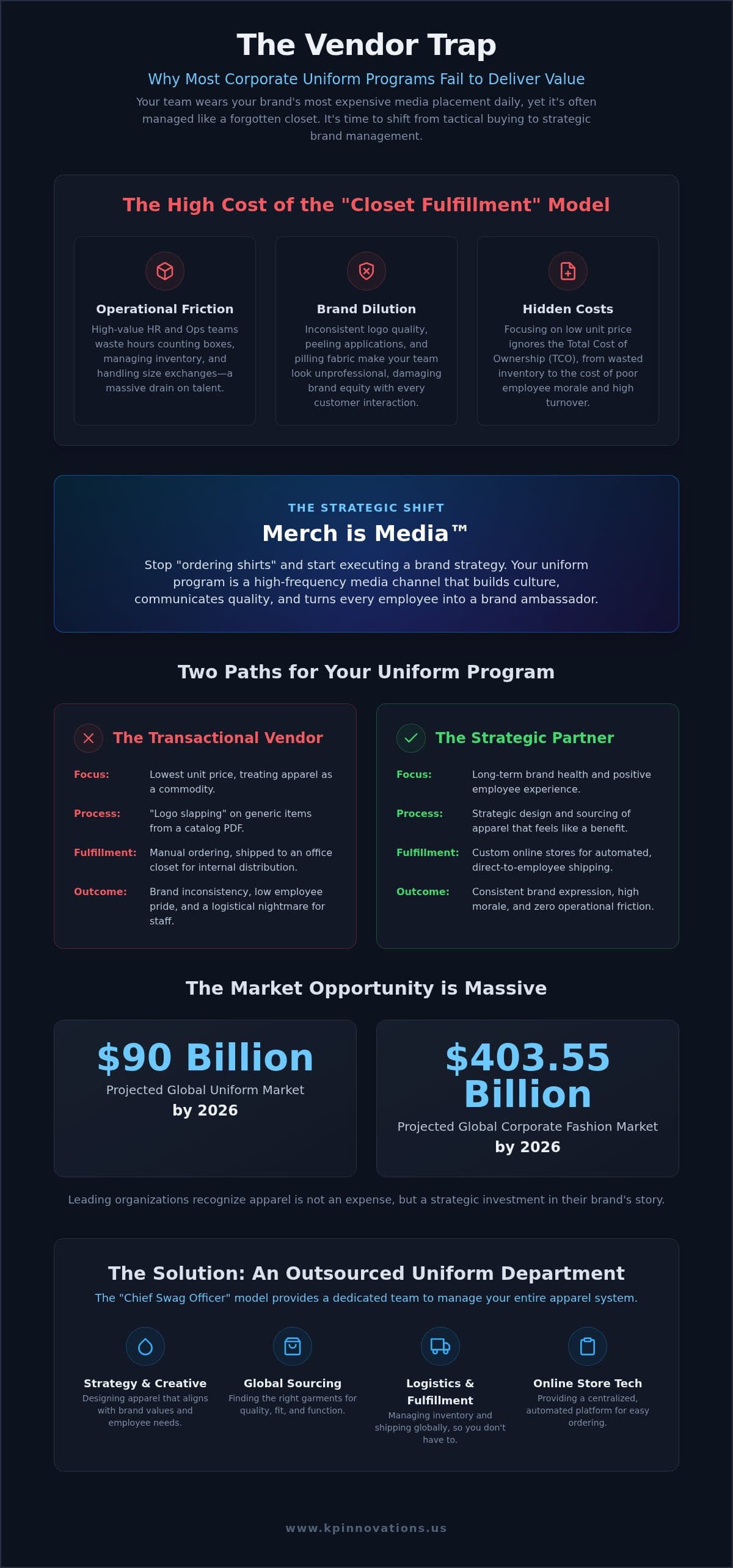
Many businesses treat their apparel program as a series of one-off transactions. They look for corporate uniform suppliers who offer the lowest unit price, assuming a shirt is just a shirt. This is the “Vendor Trap.” It occurs when organizations prioritize short-term procurement savings over long-term brand health. When you focus solely on unit cost, you ignore the Total Cost of Ownership (TCO). You might save fifty cents on a polo, but you lose thousands in brand equity when that logo peels after three washes or the fabric pilling makes your team look unprofessional. Treating your apparel as a commodity leads to brand dilution and a fragmented identity that confuses your customers.
The shift required is fundamental. You must stop “ordering shirts” and start executing a brand strategy. Historically, corporate and work uniforms were designed for utility alone; however, in 2026, they serve as your most frequent brand touchpoint. A catalog-first approach, where you simply pick items from a generic PDF, ensures your brand looks like everyone else’s. It lacks the intentionality needed to build a cohesive culture. High-growth companies realize that their uniform programs are actually a media channel that communicates quality and stability to the market.
The Problem with Commodity Thinking
Choosing the cheapest supplier often results in garments that employees simply refuse to wear. If a shirt is itchy, poorly fitted, or uncomfortable in a specific climate, your team won’t feel proud to represent the company. This dissatisfaction translates directly to the customer experience. In customer-facing roles, poor quality apparel signals a lack of attention to detail. “Logo slapping” on generic blanks isn’t a strategy; it’s a shortcut that tells your employees they are an afterthought. Strategic apparel should feel like a benefit, not a burden, which is why it is essential to source from experts like B-BAM! Inc. who provide high-quality custom branded merchandise designed for long-term wearability.
Most companies suffer from the “Closet Problem.” This happens when your HR or Operations team is forced to act as a fulfillment department. They spend hours counting boxes, managing size exchanges, and trying to find space for inventory in a cramped supply room. It’s a massive drain on high-value talent. Fragmented ordering across different branches creates an accounting nightmare and leads to inconsistent logo applications. When ordering is manual, errors are inevitable. You end up with boxes of extra-small jackets that nobody needs while your new hires wait weeks for their gear. This operational friction is the hidden cost of a vendor-based model that lacks a centralized system.
Merch is Media™: Framing Your Uniform Strategy as a Brand Experience
In 2026, the global corporate fashion market is projected to reach $403.55 billion. This massive investment proves that leading organizations no longer view apparel as a simple line item expense. Instead, they recognize it as a high-frequency media channel. Most corporate uniform suppliers treat your logo as an afterthought; we treat it as the headline. When your team wears a cohesive, well-designed uniform, they’re broadcasting your brand’s story to every person they encounter. This isn’t just a dress code. It’s a strategic brand experience that influences how customers perceive your reliability and how employees perceive their own value within the company.
The psychological impact of apparel is well-documented. Academic research on The Power of Professional Dress suggests that attire directly affects employee performance and confidence levels. When a team member feels they look professional, they act with more authority. This internal shift translates into better customer service and higher productivity. By aligning your uniform strategy with your 2026 marketing goals, you turn every employee into a brand ambassador who embodies your corporate narrative through every interaction.
Uniforms as Culture-Building Tools
We often distinguish between “work clothes” and “brand armor.” Work clothes are functional but uninspired. Brand armor is apparel that creates a sense of belonging and pride. A premium uniform program can be a powerful tool for reducing turnover. When employees are given high-quality gear that reflects their professional status, morale increases. This investment signals that the company values their contribution. You can learn more about the Merch is Media™ philosophy to understand how physical items drive internal culture and external loyalty.
Private Label vs. Off-the-Shelf
For organizations looking for inspiration on how to build a brand ethos through clothing, the approach used by Urban Spirit highlights how meaningful design and quality materials can create a lasting lifestyle connection.
While many corporate uniform suppliers rely on generic catalogs, high-tier brands are increasingly moving toward private label clothing. This approach offers total brand alignment. You aren’t limited to the color palettes of a third-party manufacturer. Instead, you can specify custom fabrics, trims, and technical features. In fact, over 60% of new uniforms introduced in 2023-2024 featured advanced technical elements like moisture-wicking or antimicrobial finishes. Creating a custom line ensures your team stands out with a look that is unique to your organization. The long-term ROI is found in apparel that employees genuinely enjoy wearing, even outside of working hours. If your current options feel generic, it might be time to explore strategic apparel sourcing to build a truly proprietary brand image.
Evaluating Corporate Uniform Suppliers: A Strategic Framework
Choosing between corporate uniform suppliers shouldn’t feel like a trip to a wholesale warehouse. If your evaluation process starts and ends with a price sheet, you’re already behind. A modern apparel strategy requires a partner who understands that uniforms are a logistical system, not a retail purchase. You need to assess how a supplier manages the complexities of a decentralized workforce and whether their technology can simplify your life. In 2024, more than 35% of uniform orders were processed through e-commerce platforms. By 2026, this digital integration is mandatory for maintaining brand consistency across international borders.
Vendor vs. Strategic Partner Comparison
The difference between a transactional vendor and a strategic partner is the difference between an order-taker and an architect. A vendor waits for you to tell them what you need from a generic catalog. A partner proactively builds a custom system designed to solve your specific operational challenges. You can explore our strategic services to see how we move beyond the catalog to build proprietary programs that prioritize brand impact and total cost of ownership. A true partner should own the entire ecosystem, from initial creative development to the final delivery at a remote employee’s doorstep.
- Transactional Vendor: Focuses on unit price, offers generic catalogs, and relies on passive order-taking.
- Strategic Partner: Focuses on brand ROI, provides custom-built designs, and offers proactive program management.
The Sourcing and Production Management Gap
Strategic production management is where brand promises meet reality. Most corporate uniform suppliers outsource the heavy lifting to third parties without maintaining oversight. A partner ensures that every garment adheres to strict quality control standards and ethical sourcing practices. This “white-glove” approach is essential for scaling. Without it, you’re left managing errors and inconsistent logo applications across different regions. Global logistics capabilities are no longer a luxury; they’re a requirement for maintaining a unified brand presence in a hybrid world. By managing the entire production cycle, a strategic partner protects your brand from the risks of fragmented supply chains and ensures that every piece of apparel meets your exact specifications.
The Closet Is Not a Fulfillment Strategy: Solving the Logistics Nightmare
Stop using your HR department as a shipping and receiving team. When you rely on a physical closet to manage apparel, you’re creating a massive operational bottleneck. High-value employees shouldn’t spend their afternoons counting polo shirts or tracking down missing size mediums. Most corporate uniform suppliers leave the hard part, the actual distribution, to you. This leads to the “forgotten box” syndrome. Capital is tied up in inventory that sits in a dark room until it’s outdated or damaged. It’s an inefficient use of resources that turns a brand asset into a logistical liability.
The operational reality of 2026 requires a hands-off approach. You need a system that treats uniforms as a managed service rather than a series of bulk shipments. By leveraging data and real-time reporting, you can track program health and inventory levels without ever touching a box. This transition allows your team to focus on their actual roles while ensuring that every employee has the gear they need to represent the brand effectively.
Modernizing the Employee Ordering Experience
Employees now expect a consumer-grade experience. They want to order their gear the same way they buy shoes online. Custom online company stores eliminate the friction of manual spreadsheets and fragmented emails. By implementing allowance-based systems, you can automate how often team members receive new apparel. Tiered access ensures that different departments see only the items relevant to their roles. New hires can receive a curated kit the moment they sign their offer letter. This automated onboarding ensures they feel like part of the culture from day one, with brand armor that fits perfectly.
Warehousing and Global Distribution
For companies with more than 50 employees, professional fulfillment services are a necessity. In 2024, e-commerce platforms handled over 35% of all uniform orders. Today, that number has grown as organizations prioritize speed and accuracy across decentralized teams. Professional warehousing ensures your brand remains consistent across all locations, whether your team is in a central office or working remotely. You don’t need to add internal headcount to scale your program. Instead, you leverage a system that tracks inventory levels in real-time. This professional management eliminates the mess of internal storage and ensures that your brand impact is measured with the same rigor as any other marketing investment. If your current logistics feel like a nightmare, it’s time to rethink your apparel sourcing and distribution strategy to reclaim your team’s time.
The Chief Swag Officer Model: Your Outsourced Uniform Department
High-ambition brands recognize that managing multiple corporate uniform suppliers is an inefficient use of executive time. You shouldn’t have to be an expert in fabric weights, embroidery stitch counts, or international shipping regulations. This is why we developed the Chief Swag Officer model. We act as your outsourced merchandise department, taking full ownership of the entire system. From the first creative concept to global fulfillment, we manage every detail so you can focus on your core business objectives. You’re not just hiring a vendor; you’re gaining a strategic partner that treats your apparel as a vital media channel.
The KP Innovations Process
Our methodology is structured to eliminate the operational friction discussed in previous sections. It starts with a Strategy & Brand Audit. We analyze your current apparel usage and identify where brand dilution is occurring. We align your uniform choices with your 2026 sustainability goals and cultural values. Next, our Creative & Sourcing phase moves beyond generic blanks. We design proprietary items that your team will actually want to wear outside of work. By leveraging our deep-level customization and private label capabilities, we ensure your brand looks and feels premium. Finally, Program Management takes over the logistics. We own the system, from inventory forecasting to white-glove fulfillment, ensuring your program scales effortlessly as you grow.
Real Results: Transforming Brand Perception
The outcome of a managed uniform program is a cohesive brand image that requires zero internal maintenance. When your apparel strategy is executed with precision, your employees naturally become brand ambassadors. They feel a sense of belonging and professional pride that is impossible to achieve with low-quality, “logo-slapped” gear. We treat your merchandise as a strategic marketing asset, measuring its impact with the same rigor as any other marketing investment. This approach ensures that your brand’s most visible media placement is always working in your favor. Ready to stop being a vendor-manager? Connect with a Chief Swag Officer today.
Scaling Your Brand Through Strategic Apparel Management
The shift from transactional purchasing to a managed apparel system is the key to protecting your brand’s integrity in 2026. You’ve seen that relying on traditional corporate uniform suppliers often leads to the “closet problem” and inconsistent quality. By adopting the Merch is Media™ philosophy, you transform every team member into a high-impact brand ambassador. You don’t need to manage boxes. You need to manage a media channel.
Strategic growth requires a partner who takes full ownership of the ecosystem. With white-glove project management and access to over 1.2 million strategic products, we ensure your uniform program scales without increasing your internal workload. It’s time to stop acting as a warehouse manager and start leading your brand experience. We’re here to help you turn physical assets into strategic growth tools.
Schedule a Consultation with a Chief Swag Officer to redefine your apparel strategy today. We look forward to building a professional, cohesive image that drives your culture and loyalty forward.
Frequently Asked Questions
What should I look for in a corporate uniform supplier in 2026?
Focus on strategic partnership, global fulfillment, and technology integration. You need a partner that manages the entire lifecycle, from design to delivery, rather than a vendor that just processes orders. In 2026, the most effective corporate uniform suppliers provide managed services that include inventory forecasting and automated e-commerce solutions. This ensures your brand remains consistent across all touchpoints while removing the logistical burden from your internal teams.
How do online company stores improve uniform program management?
Online stores centralize the ordering process and eliminate the need for manual tracking. They provide a consumer-grade experience for employees while giving administrators real-time visibility into inventory levels and spending. By automating the distribution of apparel, these portals solve the “closet problem” and ensure brand consistency across decentralized locations. This digital approach reduces errors and provides valuable data to measure the ROI of your apparel investment effectively.
Is it better to use off-the-shelf brands or private label for uniforms?
The choice depends on your brand’s ambition and the level of differentiation you require. Off-the-shelf brands provide speed and familiarity, but private label apparel offers total brand alignment. With private label, you control custom colors, technical fabrics, and unique trims that aren’t available in standard catalogs. This level of customization ensures your team stands out with proprietary gear that feels like a benefit rather than just a requirement.
How do I manage uniform distribution for a global or remote workforce?
Managing a global workforce requires a partner with international logistics expertise and a robust digital infrastructure. You should utilize a centralized online store that supports tiered access and department-specific allowances. Professional corporate uniform suppliers handle warehousing and individual shipping to employee residences or branch offices. This system ensures every team member receives their gear on time, regardless of their location, maintaining a unified brand culture worldwide.
Why is internal fulfillment considered a hidden cost for businesses?
Internal fulfillment drains high-value human resources and ties up capital in unmanaged inventory. When HR or Operations teams spend hours counting shirts or managing exchanges, they aren’t focusing on strategic initiatives. These hidden costs include lost productivity, storage space expenses, and the financial waste of obsolete stock. Professional fulfillment services eliminate these inefficiencies by providing a hands-off, managed solution for your entire apparel program.
What is the difference between a promotional product vendor and a merchandise agency?
A vendor is transactional and focuses on selling products at a specific unit price. A merchandise agency, like KP Innovations, is a strategic partner that owns the entire brand experience. We focus on the Merch is Media™ philosophy, managing everything from creative development and ethical sourcing to global logistics. Our goal is to solve operational problems and build company culture, rather than just filling an order for branded items.
Can I implement a uniform program with no minimum order requirements?
While many vendors require bulk purchases, a managed program often utilizes on-demand fulfillment or strategic warehousing to accommodate smaller needs. This allows for flexible ordering as your team grows or roles change. By partnering with a strategic agency, you can set up a system where inventory is managed proactively. This ensures that even single orders for new hires are processed efficiently without the need for you to store excess stock internally.
How does a Chief Swag Officer help with uniform strategy?
A Chief Swag Officer acts as your outsourced merchandise department, managing the complexities of your apparel program. They provide white-glove project management, ensuring that every garment aligns with your brand values and marketing goals. By taking ownership of strategy, sourcing, and fulfillment, they remove the operational burden from your leadership team. This partnership allows you to treat uniforms as a strategic asset that builds culture and scales with your business.