
What if the best way to create brand ambassadors isn’t to ask people to promote your company, but to give them apparel they’re proud to wear? A logo alone doesn’t create belonging. Creating brand ambassadors with apparel starts with a meaningful experience, not a giveaway.
Branded clothing can build visibility, but only when people want to wear it. If it’s uncomfortable, poorly suited to the wearer, or distributed inconsistently, it may stay in the closet. Apparel works harder when it fits the moment, whether that’s onboarding, recognition, uniforms, or a customer relationship. When someone chooses to wear it, the apparel can become a personal expression of their connection to your brand.
This guide explains how to build an apparel program that supports authentic advocacy without treating clothing as the whole strategy. You’ll learn how to choose an approach for employees and customers, create a repeatable program across teams and locations, and connect decisions to broader business goals. Because Merch Is Media™, each apparel choice can help shape the brand experience.
Key Takeaways
- Branded apparel doesn’t create advocacy on its own. People need to feel connected to the experience behind it.
- Map how relevant apparel can support voluntary wear, conversation, and sharing around meaningful brand moments.
- Choose between employee, customer, and influencer approaches based on the audience, purpose, and relationship you want to build.
- To create brand ambassadors with apparel, define the audience and intended outcome before choosing products. Then manage delivery and learn from the program.
- A strategic merchandise partner can coordinate the program from planning and creative through sourcing, fulfillment, and ongoing management.
Why creating brand ambassadors with apparel starts with the experience
Creating brand ambassadors with apparel isn’t about turning every recipient into a spokesperson. An apparel ambassador is someone who chooses to represent a brand through a credible, real-world connection to it. They might wear a company layer to work, bring a branded cap to a community event, or mention a useful item in conversation. Advocacy comes from the relationship, not the garment alone.
Receiving or wearing branded clothing doesn’t automatically make someone an advocate. Fit, comfort, usefulness, personal style, and the reason the apparel was given all affect whether it feels welcome or obligatory. Drawing inspiration from consumer fashion boutiques like lovedelina.com can help teams understand the emphasis on cut, comfort, and aesthetic appeal that encourages people to wear clothing regularly. A one-off giveaway may create a brief moment of visibility. An intentional program starts with a specific audience and purpose, then makes apparel part of an experience that supports both.
What makes apparel advocacy feel authentic?
Start with relevance. Apparel should make sense for the wearer’s role, preferences, and daily context. A uniform for regular work use has a different purpose from clothing given to recognize a team milestone or welcome a new employee. In each case, the wearer should understand why the apparel belongs in that moment.
A logo can identify an organization, but it can’t explain the purpose. The experience around the apparel does that through thoughtful selection, clear communication, and a real connection to the brand. This reflects Merch Is Media™: physical items help express how a brand treats people and what it values. Let employees and customers share honest experiences in their own words. Scripted endorsements can make a genuine relationship feel transactional.
Who can become an apparel brand ambassador?
Different audiences have different relationships with a brand. Design the apparel program around those differences rather than treating every recipient as the same kind of advocate.
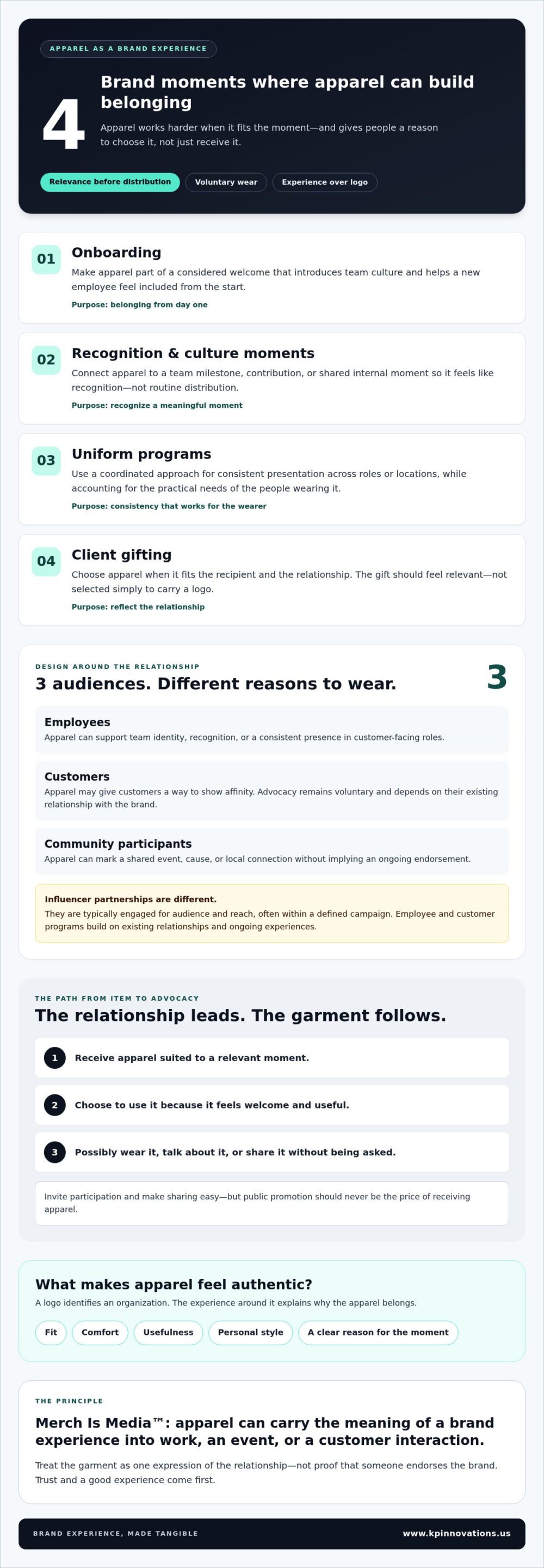
- Employees experience the brand from within. Relevant apparel can support team identity, recognition, or a consistent presence in customer-facing roles.
- Customers bring their own experience with the company. Apparel may give them a way to show affinity, but advocacy is voluntary and depends on the relationship they already have with the brand.
- Community participants may connect with a brand through a shared event, cause, or local relationship. Apparel can mark that connection without implying an ongoing endorsement.
An influencer partnership is different. Influencers are typically engaged for their audience and reach, often within a defined campaign. Employee and customer apparel programs build on existing relationships and ongoing experiences. The broader concept of a brand ambassador has evolved to include many kinds of people who represent a brand, beyond celebrity endorsements. The key distinction is the basis of the relationship.
Apparel can support advocacy, but it can’t substitute for trust or a good experience. Treat the garment as one expression of the relationship, not proof that someone endorses the brand. That shift turns distribution from a giveaway into a purposeful brand experience.
How apparel can build belonging and brand advocacy over time
Belonging grows through repeated, meaningful experiences. Apparel can mark a person’s place in a team or relationship, then become part of how they show up in everyday settings. The path is gradual: someone receives apparel suited to a relevant moment, chooses to use it, and may later wear it, talk about it, or share it without being asked. Each step reflects the relationship, not a posting requirement.
This is the thinking behind Merch Is Media™. Apparel is more than a surface for a logo. It can carry the meaning of an experience into work, an event, or a customer interaction. But the experience has to earn that role. A company can invite participation and make sharing easy, but public promotion shouldn’t be the price of receiving apparel.
Which brand moments can apparel support?
The strongest moments give apparel a purpose beyond distribution. Consider where it can reinforce a relationship or make a brand experience more coherent:
- Onboarding: Include apparel in a considered welcome that introduces team culture and helps a new employee feel included from the start.
- Recognition and culture drops: Connect apparel to a team milestone, contribution, or shared internal moment so it feels like recognition rather than routine distribution.
- Uniform programs: Use a coordinated approach to support consistent presentation across roles or locations, while accounting for the practical needs of the people wearing it.
- Client gifting: Choose apparel when it fits the relationship and recipient. A thoughtful gift should feel relevant to the connection, not selected simply to carry a logo.
These moments can create continuity. An employee might first receive apparel during onboarding, then see it used again for a team milestone. A customer-facing team might wear coordinated apparel during interactions where a consistent presentation matters. The details vary, but the principle stays the same: connect the item to a real experience, then let people decide how they want to engage with it.
How should a company measure an apparel ambassador program?
Start with the purpose, then decide what to observe. If the goal is to improve participation in an employee program, review whether people take part and what they say about the experience. If the goal is consistent presentation, consider whether the program serves the teams and locations it was designed for.
Separate distribution from engagement. The number of items delivered shows program activity, not whether apparel is valued or advocacy is growing. Depending on the objective, useful indicators may include participation, repeat engagement, requests for future program opportunities, qualitative feedback, or voluntary mentions and photos. Make it easy to give honest feedback about comfort, relevance, and whether the apparel suits its intended use.
Activity metrics show what a program delivered; business outcomes show whether it advanced the purpose. Review both, then use what you learn to refine future moments, communication, and product decisions. When product selection affects how well apparel serves its audience, Product Sourcing can connect those choices to the intended experience.
Employee apparel, customer advocacy, or influencer partnerships: choose the right path
Choose a program based on the relationship you want to support, not simply on who might wear the apparel. Employees, customers, and creators have different motivations and expectations. Use this comparison to clarify the right starting point before planning the experience.
Employees
Audience: People who work for the organization.
Purpose: Support culture, team identity, recognition, or consistent presentation.
Apparel’s role: Part of the employee experience, from onboarding to uniforms.
Relationship: Ongoing and rooted in daily work.
Program ownership: Typically coordinated across HR, operations, and brand teams.
Customers
Audience: Existing customers or a defined community.
Purpose: Recognize a relationship or create a shared experience.
Apparel’s role: A relevant gift or expression of connection, not an assumed endorsement.
Relationship: Based on customer experience and personal choice.
Program ownership: Often coordinated by teams responsible for customer relationships and merchandise.
Creators or influencers
Audience: A creator’s followers and wider audience.
Purpose: Develop content and reach through a defined partnership.
Apparel’s role: A subject or element in planned content.
Relationship: A campaign or partnership, often with agreed deliverables.
Program ownership: Requires clear coordination of content, audience, timing, and expectations.
When does an employee apparel program make sense?
Employee apparel makes sense when it supports a deliberate part of the work experience. Employee Programs can connect onboarding kits, culture drops, and engagement merch to defined internal moments. For roles where coordinated clothing is part of the job, Uniform Programs address practical program needs such as sizing, reorders, and store integration. Multi-location organizations should also plan how choices and distribution will be coordinated across teams, while accounting for differences in role and use.
The decision isn’t simply whether everyone should receive the same item. Consider who will wear it, where it will be used, and what the apparel is meant to communicate. Those answers help HR, operations, and brand teams align around a useful employee experience. Uniform Programs can bring structure to recurring apparel needs while keeping the experience of the people wearing it in view.
When should a brand consider customer or creator advocacy?
Customer apparel fits best when it marks a relevant relationship moment, such as a shared event or meaningful customer milestone. Distribution alone doesn’t create advocacy, and receiving apparel shouldn’t imply that a customer has agreed to promote the brand. For creators, the central questions are different: what content will be developed, who is it intended to reach, and how does apparel contribute to that story? This calls for a distinct content and audience strategy, not an employee or customer program.
Creating brand ambassadors with apparel requires choosing the right relationship before choosing the channel. A company can support employee culture, deepen customer experiences, or work with creators, but these are separate program designs. Apparel can play a role in each. Match the purpose, ownership, and measures of progress to the audience.
How to create an apparel ambassador program in five practical steps
Creating brand ambassadors with apparel takes more than choosing a garment and arranging distribution. A repeatable program connects a clear purpose to the right audience, a considered experience, and the operations that make it work. Follow these steps in order, keeping product selection downstream of decisions about people and purpose.
- Define the outcome. Start with the business or experience goal. Are you welcoming new employees, recognizing a team milestone, supporting consistent presentation, or strengthening a customer relationship? Write down what you want people to experience, then identify voluntary signs of engagement, such as participation, repeat use, or candid feedback. Make the outcome specific enough to guide later decisions.
- Choose the audience. Identify who the program is for and what the apparel needs to do in their context. Employees in customer-facing roles may need a different approach from new hires or customers receiving a relationship-based gift. Consider roles, locations, preferences, and how people will use the apparel. This helps avoid applying one design or distribution plan where it doesn’t fit.
- Design the experience. Decide how the program should feel before settling on products. Invite wearer input during creative development, and consider fit, use, branding, and the moment of presentation together. A welcome experience, a recognition moment, and a uniform program call for different choices. The apparel should support the intended experience, not carry its entire meaning by itself.
- Manage delivery. Connect Product Sourcing, Production Management, and Program Management so product decisions, production, and coordination support the same plan. Build operational questions into the design: how will sizing be handled, how will apparel reach each team or location, how will reorders work, and how will consistency be maintained? Fulfillment can include warehousing, kitting, shipping, and tracking, depending on the program’s needs. Company Stores can support programs that use self-serve ordering, budgeting, and reporting.
- Learn and adjust. After delivery, review participation and feedback against the outcome you set at the start. Look for friction points such as confusing ordering, sizing challenges, uneven distribution, or apparel that doesn’t suit its intended use. Use those observations to refine the next cycle’s experience, product choices, communication, or fulfillment plan. The aim is a program that improves through deliberate learning, not repetition for its own sake.
Product Sourcing works best as part of a full program, with apparel choices connected to audience, purpose, and execution. Explore Product Sourcing for your apparel program as you plan the next step.
Make apparel advocacy part of a managed merchandise strategy
A product vendor can source and deliver apparel. A strategic partner takes responsibility for how apparel fits into a larger program: why it’s being used, who it serves, how it’s developed, and what happens after delivery. That distinction matters because a strong apparel experience depends on decisions across teams, not on the garment alone.
For organizations managing employee, customer, and brand needs at once, disconnected ownership can lead to inconsistent choices and uneven execution. The outsourced Chief Swag Officer model provides a single point of ownership across the merchandise lifecycle. Instead of coordinating separate handoffs without an overarching plan, teams can connect a program’s purpose to its creative, operational, and fulfillment decisions.
What does an outsourced Chief Swag Officer manage?
The model brings together Merchandise Strategy, Creative Development, Product Sourcing, Production Management, Program Management, and Fulfillment. Each responsibility has a distinct role, but the value comes from connecting them. Strategy sets direction. Creative Development translates it into a relevant experience. Product Sourcing and Production Management support product decisions and the path to completion. Program Management and Fulfillment coordinate the ongoing work of getting the program to its audience.
Connected ownership can reduce fragmentation. HR may define an employee experience, operations may need practical consistency, and marketing may care about brand expression. With one partner managing the merchandise system, those needs can be considered together rather than handled as unrelated requests. The partner owns the system; apparel supports the experience the organization wants to create.
How can apparel fit into a broader merchandise program?
Apparel can serve different purposes within a wider program. It may accompany employee recognition, contribute to onboarding or engagement through Employee Programs, support daily use through Uniform Programs, or fit into Client Gifting when it makes sense for the relationship. The right role depends on the audience and objective. Other merchandise may suit a particular moment better, so apparel shouldn’t be treated as the default answer.
Client examples show how apparel can be one part of a broader brand experience. Chad Sierer of McLaren Philadelphia referenced duffle bags, polos, hats, and private-label apparel. Mike Noce of RDS Automotive Group referenced custom polos, hats, and charity event apparel. These examples illustrate specific apparel uses; they don’t mean the items alone create advocacy or guarantee a business result.
Creating brand ambassadors with apparel is ultimately a program decision, not just a product decision. The scope can be shaped around your company’s objectives, audience, and operational needs, with apparel playing the role that best supports the experience. Product Sourcing can connect apparel choices to the broader merchandise plan.
Turn your apparel program into a deliberate next step
Use your next apparel decision to make the program more intentional. Choose an upcoming moment, identify the decision-makers who need to be involved, and agree on what you’ll review afterward. A clear starting point makes it easier to learn and improve without assuming one approach will fit every audience.
Creating brand ambassadors with apparel is a long-term effort, built through choices that respect people’s needs and earn their participation. Make the next decision a thoughtful one, and let what you learn inform the work that follows.
Apparel planning is more effective when Product Sourcing connects to the wider merchandise strategy and the experience you want to create.
Frequently Asked Questions
Can apparel turn employees into brand ambassadors?
Apparel can give employees a visible way to identify with their organization, but it can’t create advocacy by itself. Make the program useful to the employee experience first. For example, managers can explain the purpose of an apparel initiative during a team meeting and invite private feedback afterward. That gives employees a way to share their perspective without treating clothing, or wearing it, as a measure of commitment.
How do you create a brand ambassador program with apparel?
Document the program before making purchasing decisions. A short charter can name the internal sponsor, the people responsible for decisions, the intended audience, and how participation will work. It can also clarify what the program won’t ask of participants, such as producing content. This shared reference helps HR, marketing, and operations make consistent decisions as the program moves from planning into day-to-day management.
Do employees have to post on social media to be brand ambassadors?
No. Set expectations explicitly so employees understand that receiving or wearing apparel doesn’t require a post, photo, or endorsement. If someone independently chooses to share a work-related experience, keep the organization’s guidance clear and avoid supplying a script that presents personal opinions as company-approved statements. Explain what participation does and doesn’t involve before apparel is distributed.
What apparel works best for a brand ambassador program?
The right choice depends on the intended use, so compare options against the conditions people will encounter. Consider whether the apparel is for work, an event, or use outside work, and whether the design feels appropriate in that setting. In active or athletic environments, exploring collections from specialized stockists like The Fight Club shows how prioritizing premium materials and ergonomic cuts ensures gear is worn repeatedly. Before finalizing a choice, gather wearer feedback on design and fit. That input can reveal concerns a brand team may not spot from a mockup alone.
How can a company measure an apparel ambassador program?
Decide how feedback will be gathered before the program begins. A short follow-up can ask recipients whether the apparel suited its intended use and what they would change. Review those responses alongside participation records, then compare both with the original objective. If you’re assessing a broader business indicator, note other factors that may affect it so you don’t attribute a change to apparel without evidence.
Can a company use apparel for both employee and customer ambassadors?
Yes, but give each group a distinct experience plan. Employee apparel may be handled through an internal program, while a customer initiative may be connected to a specific relationship touchpoint. Separate audience lists and communications can help prevent messages intended for one group from reaching the other. Review feedback independently, too. Employees and customers may respond to different details, even if the apparel is part of the same broader brand effort.
What is the difference between a brand ambassador and an influencer?
A useful planning distinction is what the organization expects from the relationship. An employee or customer may represent a brand through an ongoing connection, without any planned content deliverable. A creator partnership is usually built around content and an audience, so the brief should define the intended format, message boundaries, and where the content is meant to appear. Keeping these expectations distinct helps teams plan the relationship and evaluate it appropriately.
How can a company manage apparel programs across multiple locations?
Give each location a clear route for raising questions and reporting exceptions, while keeping core program decisions centrally documented. A shared record can capture approved apparel choices, local contacts, sizing questions, and reorder requests. Reviewing the record across locations can reveal where instructions are unclear or needs differ. This makes it easier to adjust the program deliberately instead of relying on scattered email threads or informal local workarounds.
Work with KP Innovations to connect Product Sourcing to a managed apparel program, built around your audience, objectives, and brand experience.