
A screen print has no universal lifespan. How long it looks good depends on the print, the shirt, and how the garment is washed and worn. A thoughtful custom company t-shirt design starts with more than artwork: consider how and where people will use the shirt.
It’s reasonable to want a clear answer before ordering shirts for a team, event, or workplace. This guide explains what affects screen-print durability, how to design a shirt, and how to choose a style and quantity that fit its purpose.
You’ll also learn what can affect order timing and how to plan around a deadline. The goal is to make choices that work together: a recognizable design, a garment suited to its use, and an order plan that supports the experience you want to create.
Key Takeaways
- Plan order timing around the production method, artwork readiness, quantities, and delivery needs.
- Build a single-shirt design by clarifying its purpose, choosing a garment, and preparing artwork that suits the print area.
- Compare screen printing, direct-to-garment, and heat transfer by considering the design and how the shirt will be used.
- Choose shirt styles and quantities based on wearer comfort, intended use, and how the order will be distributed.
- Treat company shirts as part of the brand experience, not just apparel, and align the design with the message people should carry.
How fast can I receive my custom t-shirt order?
Turnaround depends on the production method, artwork, garment choice, order quantity, and delivery plan. For screen printing, settle the design and shirt details before production begins. Delayed approval or a late size count can shift the schedule, even when the print itself is straightforward. Set the in-hand date first, then work backward through artwork approval, size collection, production, and shipping.
When comparing websites for custom company t-shirt printing, look for clear details about print methods, minimum quantities, garment options, artwork requirements, and shipping timelines. Information about proofs and approvals also helps teams plan orders and avoid surprises.
Screen-printing minimums vary by printer and order setup. The screen, design complexity, number of ink colors, and garment choice all affect production planning. Printing a one-color logo on matching shirts is a simpler setup than preparing separate artwork for several shirt colors. Ask how the minimum applies to the full order, including whether sizes and colors can be grouped.
Ordering without a minimum can suit a sample, replacement shirt, or small team test. Screen printing may be less practical for a single garment because it requires screen preparation. Depending on the design and garment, other print methods can work better for small runs. A sample also lets the team review fit, color, and placement before ordering more.
- Reduce avoidable costs: use one approved design across the order, limit unnecessary color changes, and consolidate sizes when possible.
- Protect the schedule: finalize artwork and garment choices before submitting the order.
- Control rework: review a proof for spelling, logo placement, and color before approving production.
For employee orders, collect sizes in one shared form and set a firm response deadline. A team lead can group responses by garment size before placing the order. If shirts are shipping individually, keep a separate record of each employee’s size and delivery location. This reduces sorting confusion and helps ensure there’s a clear distribution plan.
Before uploading artwork, check that the file meets the printer’s format requirements and uses the final logo. Name files by design and placement, such as “team-logo-left-chest,” so reviewers can identify how each should be used. Confirm the shirt color, print location, and quantity together. A complete order brief gives the production team the details needed to plan the work and schedule.
How do I design a single custom t-shirt?
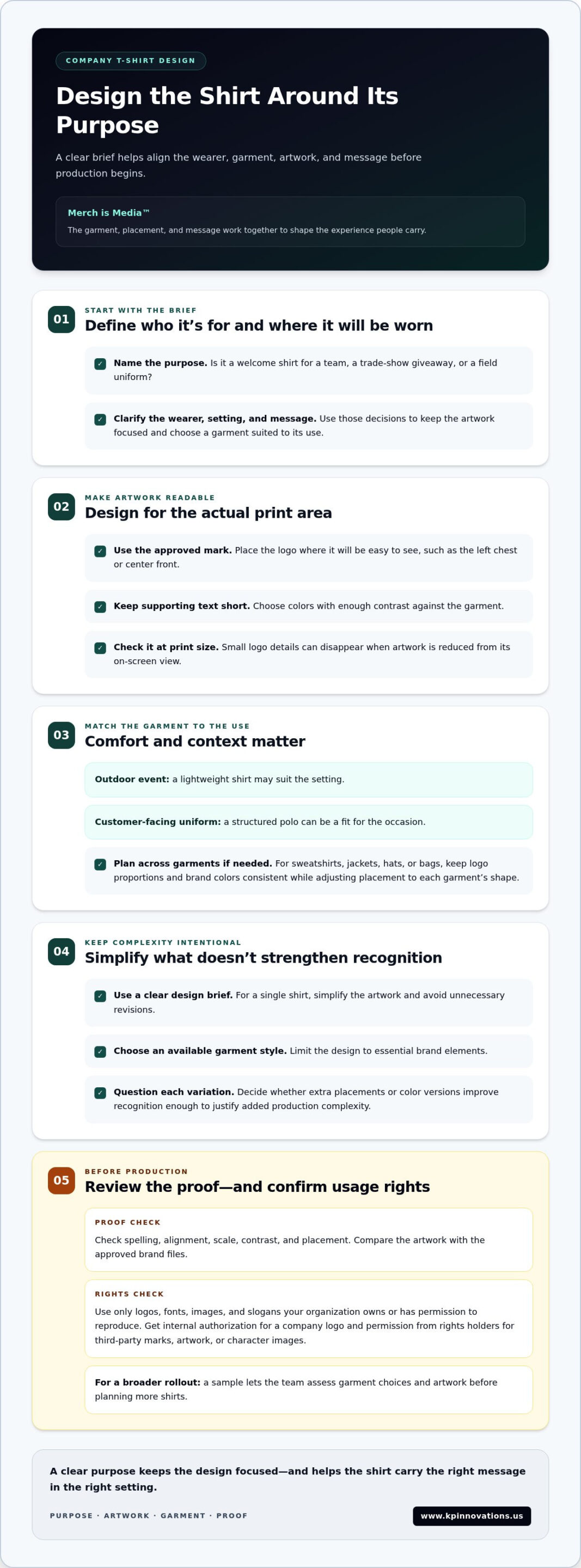
Start with the shirt’s purpose. A welcome shirt for a team, a trade-show giveaway, and a field uniform call for different choices. For a sample, define the wearer, setting, and message before opening a design tool. A custom company t-shirt design should have a clear purpose before you choose artwork or a garment. That brief keeps the artwork focused and helps you select a shirt suited to its use.
To design a company shirt with a logo, place the approved mark where it will be easy to see, such as the left chest or center front. Keep supporting text short, and choose colors with enough contrast against the garment. Review the artwork at its intended print size, not just enlarged on a screen. Small logo details can disappear when reduced.
Use only logos, fonts, images, and slogans your organization owns or has permission to reproduce. A company logo may be protected as a trademark, so get internal authorization before printing. Obtain permission from the rights holder before using third-party marks, artwork, or character images.
Match apparel to the wearer and occasion. A lightweight shirt may suit an outdoor event, while a structured polo can work for a customer-facing uniform. Consider related items such as sweatshirts, jackets, hats, and bags if the design needs to work across multiple products. Keep logo proportions and brand colors consistent, adjusting placement to suit each garment’s shape.
Control costs with a clear design brief, not just a smaller logo. For a single shirt, simplify the artwork and avoid unnecessary revisions. Choose an available garment style and limit the design to essential brand elements. If you’re considering multiple placements or color variations, decide whether each change improves recognition enough to justify added production complexity. A sample lets you assess the choices before planning a broader rollout.
- Define the purpose: Identify whether the shirt is for staff, an event, or a customer interaction.
- Prepare the artwork: Use an approved logo file and specify placement, garment color, and any text.
- Review a proof: Check spelling, alignment, scale, and contrast before production.
For companies building apparel across teams, sourcing choices affect consistency as much as design does. A coordinated approach can align garment selection, brand requirements, and intended use. Explore apparel sourcing considerations when comparing options for a shirt program.
How long does screen printing last on custom t-shirts?
Screen printing has no fixed lifespan. Durability depends on how the ink is applied and cured, the garment fabric, and how the shirt is cared for. A well-made print can remain wearable through repeated use, while rough laundering and frequent friction can wear it sooner. For a company shirt used during physical work, fabric and care matter as much as the print method.
Before approving a custom t-shirt proof, check spelling, logo proportions, placement, garment color, and contrast. Review the artwork at its intended print size, then compare every detail with the approved brand files. A clear proof helps catch mistakes before production.
Each printing method suits different artwork and order needs. Screen printing pushes ink through a prepared screen, making it practical for repeat designs and larger runs. Direct-to-garment printing applies ink directly to fabric and can reproduce detailed, multicolor artwork. Direct-to-film printing transfers artwork from film onto the garment. Heat transfer uses heat to bond a design to fabric. Choose a method based on the design, garment, quantity, and intended use.
Embroidery creates a stitched design rather than a printed surface. It can suit polos, hats, and uniforms when a textured logo fits the brand experience. Ordering without a minimum may suit a sample or replacement garment, while screen printing often works better for a consistent group order. Choose the method to fit the real use case rather than letting it dictate the whole program.
Care matters for every printed shirt. Follow the garment’s care label and turn the shirt inside out before washing. Use a gentle cycle when suitable for the fabric, and avoid high heat that can stress the print. Don’t iron directly over the artwork. These steps help limit abrasion and heat exposure, both avoidable sources of wear.
- Inspect the proof: Check artwork, spelling, scale, color, and placement before approval.
- Match method to design: Consider detail, garment fabric, order size, and expected wear.
- Protect the print: Follow care-label directions and avoid direct ironing over artwork.
In-house printing can give a production team direct control over setup and inspection. Useful quality checks include comparing the finished print with the approved proof, checking placement across garments, and looking for smudges, gaps, or uneven coverage. The same checkpoints clarify expectations for outsourced production. A precise proof and consistent inspection process help maintain the intended brand presentation across printed apparel.
Choosing shirt brands, styles, and quantities
Choose a shirt for its role, not just the space available for a logo. Compare feel, fit, color, and how easily you can reorder the same style.
Shirt Brands and Product Selection
Start with the wearer and use, then compare brands against those needs. Examples include Gildan Heavy Cotton, Comfort Colors Heavyweight, Next Level Cotton Blend, A4 Moisture Wicking, and Bella + Canvas Tri-Blend shirts. Product names indicate different design priorities, but a sample helps assess the actual fit and feel. For a new arrival, consider whether future orders can maintain the same look and brand consistency.
Styles and Color Choices
Choose a style that suits the setting: a classic crew neck for an event or a polo for customer-facing work. Cotton can suit everyday wear, while moisture-wicking fabric may fit active settings. Compare garment colors with the logo and artwork. A dark logo can disappear on a dark shirt, so review the contrast before approving production. Keep color choices manageable when teams need a consistent look.
Choosing Order Quantities
Build quantities from a roster, event plan, or distribution forecast rather than guessing. For an employee order, collect each person’s preferred size and include a clear deadline. For a 50-shirt order, estimate the size mix from actual participants, then account for planned distribution needs. Separate quantities by garment style and color so the final count reflects what people will receive, not just a total across unlike items.
Brand and product selection affect consistency. If a shirt will be part of a uniform or recurring event, record its brand, style, color, and artwork placement. That reference makes future orders easier to match. A newly featured style may look appealing, but compare its intended use and consistency with existing choices before adopting it as the program standard.
- For everyday teams: prioritize comfort, repeatability, and an easy-to-coordinate color.
- For events: match garment style and artwork contrast to the setting.
- For repeat orders: document the selected brand, style, color, and size mix.
Connect quantities to delivery and distribution. One shipment to an office needs a different plan from shirts sorted for several locations. Group counts by destination and recipient before placing the order. This helps operations teams receive, sort, and distribute garments while keeping track of sizes and colors.
Custom T-shirt design for businesses and groups
A company shirt works best when it serves a clear moment in the employee or customer experience. For an event team, the goal may be quick recognition; for a service crew, uniforms should help customers identify staff. Define the audience, setting, and intended message before choosing artwork. That brief gives every later decision a shared purpose.
Personalized apparel can help a distributed group feel connected, but a logo alone rarely creates that feeling. Consider what people should recognize or remember when wearing the shirt. A detailed design may suit an internal milestone, while a simpler mark can work better for daily uniforms. Treat the garment as a brand touchpoint, not just a surface for printing.
Build a consistent system across garments. A staff shirt, hoodie, and event tee can share a logo and color palette while adapting placement to each item. For example, a small chest mark may suit a uniform, while a larger back design can identify event staff from a distance. A sleeve detail can add a secondary message without competing with the main logo.
Before production, assign decisions to the people responsible for them. Marketing approves brand use, HR reviews employee needs, and operations plans distribution. One approved artwork file and a written placement guide help prevent conflicting versions. For group orders, collect sizes through one process and organize quantities by team or destination. This connects the design to the experience of receiving and wearing the shirts.
- For employees: align garment choice with daily tasks and workplace expectations.
- For events: make staff easy to identify while keeping the message readable.
- For customers: choose a design people would feel comfortable wearing beyond the event.
Consistency matters when a program covers several locations or departments. Document the approved logo, colors, garment choices, and placement so future orders follow the same standards. If one group uses a Gildan shirt, record its exact style alongside the design. That reference helps prevent unintended changes in later orders.
Start by mapping the audience, use, artwork, garment, and distribution plan. Then align sourcing with those decisions rather than choosing apparel in isolation. Plan apparel sourcing around your team’s needs to connect product choices with the intended brand experience.
KP Innovations: Promotional Products
KP Innovations helps businesses connect apparel choices to the experience they want employees and customers to have. A shirt can do more than display a logo: it can reinforce belonging, identify teams, or give an event a shared visual identity. That’s the idea behind “Merch Is Media™.”
For a company apparel program, KP Innovations brings together Custom Apparel with related Promotional Products, Awards & Recognition Items, and Print & Display Materials. This is a natural next step when needs extend beyond one shirt, such as coordinating apparel across teams or aligning merchandise with a broader brand experience.
Contact KP Innovations to discuss how apparel and merchandise can support your organization’s goals.
Make the Next Shirt Part of a Bigger Experience
A company shirt can be a one-off project or the starting point for a more intentional merchandise program. The difference is whether each choice supports a consistent experience for employees, customers, and brand representatives. A custom company t-shirt design has more impact when it fits a wider plan for how your organization shows up.
KP Innovations connects apparel decisions with Promotional Products, Custom Apparel, and Awards & Recognition Items. This helps teams consider how each item contributes to culture, recognition, and relationships, rather than treating a shirt as an isolated purchase.
Have a team, event, or uniform project taking shape? Talk with KP Innovations about sourcing apparel for your project and take the next step toward a more considered brand experience.
Frequently Asked Questions
How can I make my order more cost effective?
To manage the project’s total cost, look beyond the garment’s unit price. Decoration, packaging, shipping, and storage can all affect the overall budget. For example, compare one consolidated shipment with deliveries to separate locations. Order only what the program can use, since leftover inventory can become outdated when a logo, uniform standard, or team changes.
Can I print my logo, artwork or design onto the T-shirts?
Yes, shirts can feature a company logo or original artwork when you have the rights to use those assets. For a team order, use current, approved brand files rather than an image copied from an old presentation. If the design includes a partner logo or another creator’s artwork, obtain permission before production. Keep a record of approved versions so future orders stay consistent.
How much do custom company t-shirts cost per shirt?
There’s no single per-shirt price for every project. Pricing depends on the project and is provided after a quote request. Key factors include garment selection, print method, artwork complexity, order quantity, and delivery requirements. For a useful comparison, define the same shirt, decoration, and shipping plan for each option. This makes it easier to evaluate the total order, not just the unit price.
What is the minimum order quantity for custom business t-shirts?
Minimum quantities vary by production method and order setup. Ask whether the minimum applies to the complete design or separately to each garment style, color, or print configuration. That distinction matters when departments want different shirts in one company order. For a sample or replacement, an option without a minimum may suit better than a screen-printed run.
Which t-shirt printing method is best: screen printing, DTG, or embroidery?
The right method depends on the artwork and garment. Screen printing often suits a consistent design across a group; direct-to-garment printing can reproduce detailed artwork on a single shirt. Embroidery adds stitched texture and may suit a small logo on a polo or cap. Consider the visual effect you want, then match the decoration to the fabric and intended use.
What t-shirt fabrics and styles are best for company uniforms and events?
Choose fabric and style based on where people will wear the shirt. Cotton tees can suit casual events, while performance-oriented fabric may work better for active roles. For customer-facing uniforms, consider a polo or another structured style. Compare the garment with the actual work setting, expected movement, and dress standards rather than choosing from a product image alone.
How do I prepare a company logo file for t-shirt printing?
Start with the original logo file from your brand team, ideally in a vector format such as AI, EPS, or SVG. If you only have a raster image, use a clear, high-resolution file with a transparent background when needed. Include the intended garment color and placement in your instructions. Keep alternate logo versions separate and label them clearly to avoid using an outdated mark.
What are the best practices for choosing colors, fonts, and placement for a company t-shirt design?
Use approved brand colors and typefaces, then check that text is readable against the shirt color. Keep the main logo prominent without crowding it with extra copy. A chest placement can suit everyday uniforms, while a larger back graphic may help identify event staff. Review the design at its intended size and consider how it looks from a few steps away.