
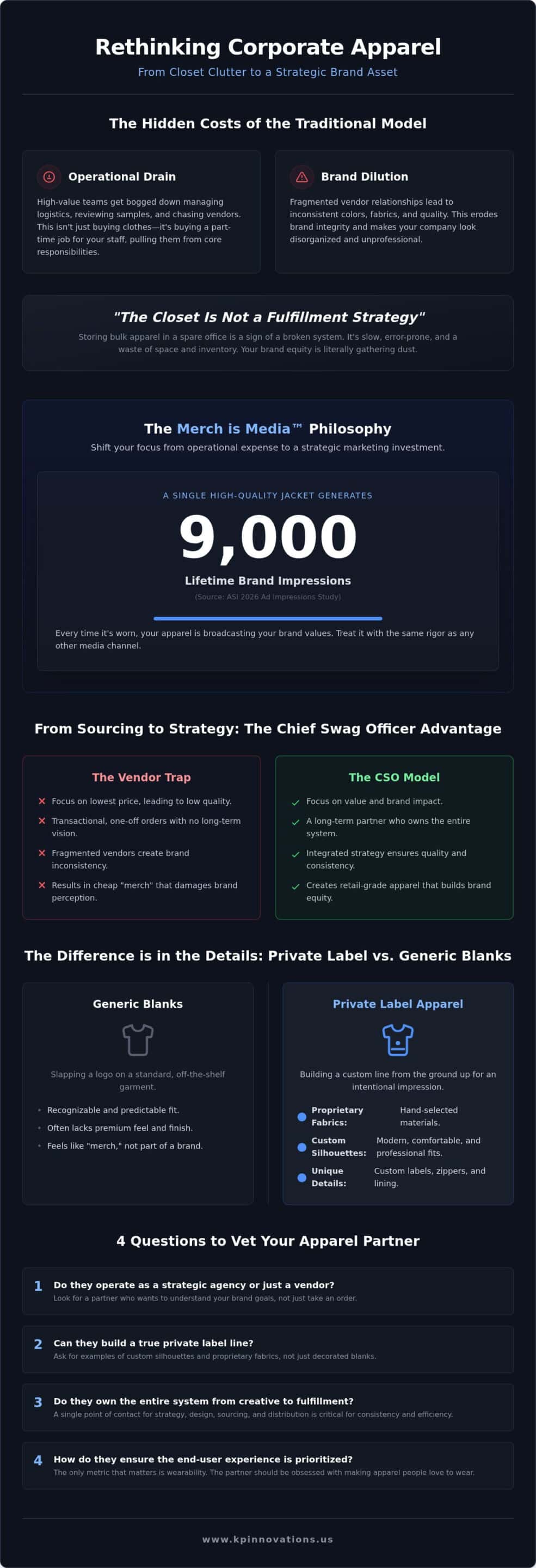
Your corporate closet is likely where brand equity goes to die. It’s a familiar scene: stacks of boxes filled with stiff, off-brand shirts that employees only wear on laundry day. When you treat custom corporate apparel programs as a series of one-off transactions, you aren’t just wasting budget; you’re missing a massive opportunity to influence your brand culture. According to the ASI 2026 Ad Impressions Study, a single high-quality jacket can generate 9,000 lifetime impressions. If that garment stays in a box because the quality is poor or the logistics are messy, those 9,000 touchpoints simply vanish.
We know that managing multiple vendors and chasing tracking numbers is an operational nightmare. You deserve a streamlined system where the clothing is retail-grade and the fulfillment is handled by experts. This article will show you how to move beyond basic garment sourcing toward a strategic apparel program that builds real brand equity. We’ll preview how a “Chief Swag Officer” model transforms your merch into a strategic asset and solves the distribution headaches that keep your team from focusing on their actual jobs.
Key Takeaways
- Identify why managing internal logistics like tech packs and shipping is a hidden resource drain that distracts your team from high-level goals.
- Discover how the Merch is Media™ philosophy turns custom corporate apparel programs into strategic assets that influence company culture and customer loyalty.
- Learn the critical difference between a simple clothing factory and a merchandise strategy agency that operates as your “Chief Swag Officer.”
- Uncover the specific questions to ask potential partners to ensure they possess the operational rigor and strategic capability needed for 2026.
- Explore how an outsourced apparel department manages the entire lifecycle of your program, from creative development to global fulfillment.
The Hidden Operational Cost of the Vendor-First Manufacturing Model
Many leaders think building custom corporate apparel programs is as simple as finding a factory and sending over a logo. This transactional mindset creates a massive operational bottleneck. Instead of focusing on high-level brand strategy, your marketing or HR team ends up managing tech packs, reviewing dozens of samples, and chasing down shipping logistics. It’s a resource drain that pulls high-value employees away from their core responsibilities. When you manage a program this way, you aren’t just buying clothes; you’re buying a part-time job for your staff.
Fragmented vendor relationships also dilute your brand. One vendor might get the color right but the fabric wrong, while another uses a different embroidery technique. This inconsistency makes your brand look disorganized. When you manage custom corporate apparel programs through a fragmented vendor model, you lose control over the final product. Shifting to a strategic partnership model means offloading this complexity to experts who own the entire system from concept to delivery.
The Closet is Not a Fulfillment Strategy
Storing bulk apparel in a spare office or a hallway closet isn’t just an eyesore. It’s a sign of a broken system. Manual distribution is slow and prone to errors. You lose track of inventory, and items sit gathering dust instead of being worn by your team. Professional fulfillment and logistics ensure your apparel is distributed strategically and efficiently. This transition frees up physical space and mental energy, allowing your brand to grow without the weight of unmanaged inventory. It turns a cluttered storage room into a streamlined, automated process.
The Fragmentation of Traditional Apparel Sourcing
Traditional sourcing often separates design from the end-user experience. Promotional merchandise is frequently treated as a commodity, leading to the “vendor trap.” This is a cycle where you chase the lowest price only to receive low-quality output that damages your brand reputation. Cheap manufacturing usually results in high-cost brand damage because people won’t wear uncomfortable or poorly made clothing. A strategic approach integrates design, manufacturing, and distribution into one cohesive flow. This ensures that the final garment actually represents your brand’s standards and meets the needs of the wearer.
Merch is Media™: Why Your Apparel is a Strategic Asset
At KP Innovations, we believe that merchandise is more than just physical goods. We view it as a powerful communication channel. Our Merch is Media™ philosophy shifts the focus from the product to the impression it leaves. Every time an employee wears your jacket or a client uses your bag, they are broadcasting your brand values. This makes custom corporate apparel programs a strategic marketing investment rather than an operational expense. Most marketing channels have a high cost per impression. Branded apparel is different. According to the ASI 2026 Ad Impressions Study, a single high-quality jacket can generate 9,000 impressions over its lifetime. You wouldn’t run a digital ad campaign without tracking impressions and engagement. Your apparel line should be held to that same standard of rigor.
Private Label vs. Generic Blanks
There is a profound difference between slapping a logo on a generic blank and building a private label line from the ground up. Generic blanks often feel like “merch.” They are recognizable, predictable, and frequently lack the fit or finish of retail clothing. When you invest in deep-level customization, you create a lasting brand impression that feels intentional. This requires a strategic approach to design and manufacturing. Consider these elements of a custom line:
- Proprietary Fabrics: Selecting materials that align with your brand’s specific touch and feel.
- Custom Silhouettes: Designing fits that are modern, professional, and comfortable.
- Unique Details: Adding custom labels, zippers, or lining that standard suppliers can’t offer.
This approach ensures that your clothing line stands out in a crowded market. It provides a level of quality and control that goes beyond standard off-the-shelf suppliers, turning a simple shirt into a premium brand asset.
Designing for the End-User Experience
Wearability is the only metric that truly matters in apparel. If a garment stays in a drawer, its media value is zero. We move away from disposable items and focus on pieces people actually want to integrate into their daily wardrobes. This requires high-level creative development to ensure the design is both functional and fashionable. When your team loves what they wear, they become natural brand ambassadors. This organic influence is why successful custom corporate apparel programs prioritize the wearer’s comfort over the lowest possible unit cost. High-quality apparel builds culture by making employees feel valued, which in turn influences how they represent your brand to the world.
To achieve this level of impact, you need a partner who understands strategy-first sourcing rather than just flipping through a catalog.
Sourcing vs. Strategy: The Chief Swag Officer Advantage
Most businesses think they need a vendor. In reality, they need an outsourced merchandise department. A clothing factory focuses on the physical garment, whereas a merchandise strategy agency focuses on the business outcome. This is the core of our Chief Swag Officer model. We remove the operational burden from your marketing team by owning the entire lifecycle of your custom corporate apparel programs. We don’t just flip through catalogs; we build systems.
Established brands don’t have time to manage individual orders for recognition programs or uniform programs. They need a partner who understands the nuances of brand guidelines and global logistics. By acting as your dedicated apparel department, we ensure every piece of clothing serves a specific strategic purpose. This shift from transactional sourcing to long-term strategy protects your brand equity and ensures a consistent experience for every employee and customer.
The Managed Manufacturing Process
Effective production management is about more than just checking a box. It involves vetting factories for ethical standards and quality consistency before a single stitch is made. We provide white-glove project management that eliminates client micromanagement. You shouldn’t have to worry about color matching or hemline durability. Our team manages those details so the final product exceeds expectations every time. This level of oversight ensures that your custom corporate apparel programs maintain a premium market position and avoid the quality dips common with unmanaged vendors.
Scaling with Custom Company Stores
Scaling an apparel program manually is impossible for growing organizations. Digital company stores solve this by automating the distribution process. They eliminate the “one-off” order headache that often plagues HR and operations teams. Instead of manually collecting sizes and shipping addresses, the store handles the data. We integrate manufacturing directly with on-demand fulfillment. This creates a scalable system where employees can order what they need, when they need it, without creating more work for your internal staff. It turns a chaotic process into a predictable, managed system that grows with your company.
Vetting Custom Clothing Manufacturers for 2026
Selecting a manufacturer is a high-stakes decision that defines the quality of your brand’s physical presence. When evaluating partners for custom corporate apparel programs, you must look beyond the initial price tag. Ask about their contingency plans for supply chain disruptions. Inquire about their ability to maintain consistency across 10,000 units versus a single sample. What specific technology do they use for pattern making? How do they handle communication across different time zones? Geography is part of the puzzle; domestic factories offer speed, while global partners provide specialized techniques. The goal is a balanced approach that prioritizes reliability and quality. For a deeper dive, read our guide on Choosing the Right Apparel Factory.
Beyond the Sample: Evaluating Reliability
A sample often represents a factory’s best day, not their everyday performance. True reliability is found in operational rigor. This means having multi-point quality control systems that catch errors before garments ship. You need to assess a manufacturer’s sourcing and supply chain transparency to ensure long-term success. If a partner can’t explain where their raw materials originate, they can’t guarantee consistency. Operational rigor is the invisible force that prevents brand damage. It ensures that the medium-sized hoodie produced in March feels and fits exactly like the one produced in November. Scalable custom corporate apparel programs require a partner that treats every production run with the same precision as the first prototype.
Ethical and Sustainable Manufacturing Standards
Brand safety starts on the factory floor. In 2026, sustainability is no longer a trend; it’s a baseline requirement for any serious organization. The Global Recycled Standard (GRS) certification is now a market access requirement for products in North America and Europe. Evaluating a factory’s social responsibility is essential to protecting your brand’s reputation. Consumers are increasingly savvy about greenwashing. They want to see proof of recycled polyester (rPET) usage or organic cotton certifications. When your apparel aligns with these standards, it strengthens the Merch is Media™ narrative. It shows your audience that your brand values quality and ethics at every touchpoint. Partner with a team that prioritizes strategy-first sourcing to ensure your program meets these rigorous standards.
Building Your Apparel System with KP Innovations
Top-tier brands don’t have time to manage the minutiae of garment production or the logistics of global shipping. They need an expert partner to own the process from end to end. At KP Innovations, we act as your outsourced merchandise department. Our approach to program management is built on the belief that your apparel is a high-value media asset. We manage the entire system so your marketing and operations teams can focus on their core objectives. This isn’t just about buying clothes; it’s about building a sustainable, scalable brand experience that influences culture and loyalty.
We’ve moved beyond the traditional distributor model to provide a high-touch service that manages every detail. By integrating strategy, creative, and logistics, we ensure that your custom corporate apparel programs are executed with precision. Our team takes pride in being a strategic partner that understands the long-term impact of quality merchandise. We treat your brand with the same rigor you apply to your other major marketing investments, ensuring every garment reflects your premium market position.
From Concept to Fulfillment
Our collaborative journey begins with a deep dive into your brand’s specific needs and goals. During the creative development phase, we work together to design private label pieces that your team will actually want to wear. We don’t settle for generic blanks. Instead, we focus on proprietary fabrics and modern silhouettes that stand out. From our headquarters in Horsham, PA, we manage the complexities of global fulfillment and logistics. Whether you are distributing uniforms to a local franchise or sending recognition gifts to a global workforce, we handle the tracking, storage, and delivery. We measure the outcome of your apparel investment through brand equity and the lasting impressions your team makes in the field.
Getting Started: Challenging Your Current Approach
Transitioning from a vendor-first mindset to a managed system requires a shift in perspective. It starts with auditing your current apparel spend and identifying the operational leaks that are costing you time and money. We help you move away from unmanaged inventory and fragmented sourcing cycles. The first step is to stop viewing apparel as a commodity and start seeing it as a strategic tool for brand elevation. If you’re ready to stop managing closets and start managing a professional apparel system, we’re ready to help. You can request a quote for custom apparel manufacturing to begin your strategic audit and transform your custom corporate apparel programs today.
Elevate Your Brand from the Closet to the Culture
Transitioning your custom corporate apparel programs from a series of scattered transactions to a managed system is the difference between storage clutter and brand equity. You’ve seen how the vendor trap creates operational bottlenecks and how the Merch is Media™ philosophy turns every garment into a strategic touchpoint. It’s time to stop chasing tracking numbers. Start building a private label line that your team is proud to wear. Clothing shouldn’t just sit in a box; it should actively influence your brand’s reach and reputation.
At KP Innovations, our Horsham, PA based agency acts as your outsourced merchandise department. We manage everything from creative development to global fulfillment, ensuring your brand standards remain consistent across every production run. By adopting the Chief Swag Officer model, you gain a partner dedicated to your long-term success. We believe your merchandise deserves the same strategic rigor as any other marketing investment. Partner with a Chief Swag Officer for your custom apparel and transform your merchandise into a high-impact media channel today. You have the vision; we have the system to deliver it.
Frequently Asked Questions
How do I find a reliable custom clothing manufacturer for my brand?
Finding a reliable partner requires looking past the catalog. You need to vet for operational rigor and supply chain transparency. A strategic agency manages the complexities of production so you don’t have to micromanage the factory. Look for a team that treats your merchandise as a media asset. This ensures your brand standards are met consistently across every production run. Reliability isn’t just about the first sample; it’s about the thousandth unit delivered on time.
What is the difference between private label and white label clothing?
White label clothing involves adding your branding to pre-made, generic garments. It’s a transactional approach. Private label clothing is built from the ground up. This includes custom fabrics, modern silhouettes, and unique finishing details like custom zippers or labels. Private label allows you to create a retail-grade experience that people actually want to wear. It moves your brand away from generic products and toward a professional, proprietary clothing line that builds real equity.
What are the typical minimum order quantities (MOQs) for custom apparel?
Minimum order quantities depend on the level of customization you choose. Basic embroidery on pre-made blanks often has very low minimums. However, deep-level custom manufacturing usually requires higher volumes to offset the setup costs for unique fabrics and patterns. Strategic custom corporate apparel programs help you balance these requirements. We work to align your production volume with your actual distribution needs, ensuring you don’t end up with dead inventory sitting in a storage room.
Why should I choose a US-based partner for global clothing manufacturing?
A US-based strategic partner provides the white-glove project management and brand alignment you can’t get from a factory halfway across the world. While production might happen globally to leverage scale and specialized techniques, your strategy lead remains accessible. This model ensures that your brand guidelines are never lost in translation. It combines local accountability with global reach, giving you a dedicated team to manage the complexities of international logistics and quality control from a domestic headquarters.
How does a managed apparel program solve fulfillment and storage issues?
Managed custom corporate apparel programs replace the office closet with professional logistics. Instead of your HR team manually packing boxes, garments are stored in a dedicated facility and distributed through an automated system. This solves the “one-off” order headache by integrating your inventory with a digital storefront. Every shipment is tracked and managed by experts. This transition frees up your physical office space and allows your team to focus on high-level strategy instead of shipping logistics.
What is “cut and sew” manufacturing and is it right for my brand?
Cut and sew manufacturing means your garments are created from raw fabric rather than using pre-made blanks. This process allows for total control over the fit, fabric weight, and design details. It’s right for your brand if you want to move beyond generic apparel and create something truly unique. While it requires more lead time and higher MOQs, the result is a premium product that reinforces your brand’s commitment to quality and detail-oriented design.
How do I ensure ethical standards in my clothing supply chain?
Ensuring ethical standards requires deep-level vetting of the factory floor. You should look for manufacturers that hold recognized certifications like the Global Recycled Standard (GRS). These standards verify social responsibility and environmental impact. We take a strategy-first approach to sourcing, prioritizing partners who demonstrate transparency in their raw material supply chains. Brand safety is non-negotiable. By choosing a partner that audits production facilities, you protect your reputation and ensure your apparel aligns with your corporate values.
How can I automate my employee uniform or recognition program?
You can automate your uniform or recognition programs by launching a custom company store. This digital platform allows employees to select their sizes and styles directly. The system then integrates with on-demand fulfillment to ship items without internal intervention. This eliminates the need for manual spreadsheets and size collection. Automation ensures that your team receives their apparel quickly and accurately. It turns a chaotic operational task into a streamlined, professional experience that scales effortlessly as your company grows.