
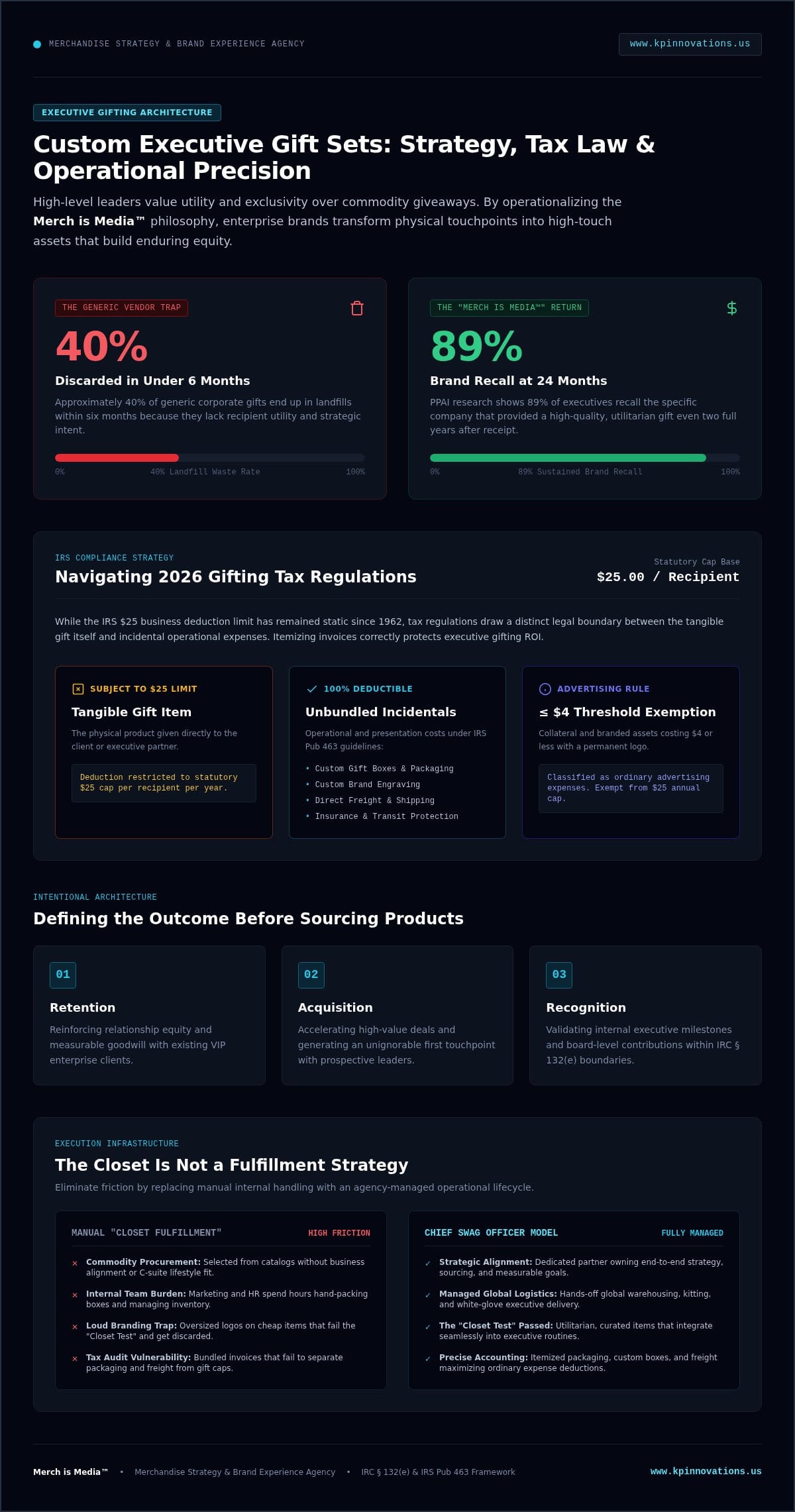
Approximately 40% of generic corporate gifts end up in a landfill within six months because they lack utility or strategic intent. You likely already recognize that sending uninspired merchandise to a C-suite executive is a wasted investment that can damage your brand’s reputation. It’s a common frustration to balance the desire for high-impact reach with the fear of IRS audits or the operational friction of global fulfillment.
This guide teaches you how to leverage custom executive gift sets as a sophisticated brand asset. You’ll learn how to navigate 2026 tax regulations, including how to properly unbundle incidental costs like custom packaging and shipping to maximize your deductions beyond the $25 cap. We will explore a strategic approach that treats merchandise as a vital media channel, ensuring every kit influences loyalty and culture. By the end of this article, you will understand how to transition from a manual, error-prone process to a fully managed, hands-off gifting strategy that delivers measurable results and long-term brand equity.
Key Takeaways
- Adopt a “Merch is Media™” philosophy to transform physical assets from simple giveaways into high-touch brand impressions that drive long-term loyalty.
- Protect your bottom line by learning to unbundle packaging, kitting, and logistics costs to maximize tax deductions while navigating the IRS $25 gift limit.
- Apply the “Closet Test” when curating custom executive gift sets to ensure every item provides genuine utility and avoids the 40% waste rate common in the industry.
- Eliminate operational friction by moving away from “closet fulfillment” and leveraging a managed global logistics system for seamless executive delivery.
- Utilize the “Chief Swag Officer” model to outsource your entire merchandise program, allowing your team to focus on strategy while experts handle the execution.
Beyond the Catalog: Why Executive Gifting is a Strategic Brand Asset
Most executive gifts are destined for the trash. This happens because traditional vendors treat physical products as commodities, focusing on speed and price rather than brand impact or recipient utility. When you send custom executive gift sets that lack curation, you’re signaling to your most valuable partners that you don’t understand their world. At the C-suite level, a generic item isn’t just a waste of budget. It’s a missed opportunity to build equity.
We believe that Merch is Media™. This philosophy shifts the focus from “stuff” to the brand experience. Physical assets are a high-touch media channel that occupies a unique space in your recipient’s daily life. Unlike a digital ad that disappears in a second, a well-chosen physical item stays on a desk or in a bag for years. According to research from the Promotional Products Association International (PPAI), 89% of executives can recall the company that gave them a high-quality, utilitarian gift two years after receiving it. This is why every gift must be viewed as a strategic touchpoint that influences culture and long-term loyalty.
The Shift from Transactional to Strategic Gifting
High-level leaders value exclusivity and utility over loud logos. They don’t need another plastic pen. They appreciate items that solve a specific problem or fit seamlessly into their lifestyle. This is why the industry is moving away from the standard distributor model toward a Brand Experience Agency approach. Understanding the history of promotional merchandise and corporate gifting shows that while the tools have evolved, the core goal remains building meaningful connections. We treat every asset as a strategic investment rather than a procurement task.
Defining Your Gifting Objective
Before selecting a product, you must define the business outcome. Are you trying to accelerate a high-value deal, celebrate a milestone with long-term employees, or reward board members? Without a clear objective, you’re just spending budget without a return. This is where the Chief Swag Officer model becomes essential. Instead of tasking an internal team with “finding something cool,” you have a dedicated partner who owns the strategy, sourcing, and fulfillment. This ensures your custom executive gift sets align perfectly with your corporate goals and deliver a measurable impact on your relationships.
- Retention: Reinforcing value to existing VIP clients.
- Acquisition: Creating a memorable first impression for prospects.
- Recognition: Validating the contributions of internal leadership teams.
Navigating the Tax Implications of Corporate Gifting
Finance teams often view high-end gifting with skepticism because of perceived tax risks. However, understanding the specific boundaries of the Internal Revenue Code allows you to execute a premium strategy without creating an audit trail. Compliance isn’t just about following rules; it’s about maximizing the ROI of every dollar spent on your custom executive gift sets. When you treat merchandise as a strategic asset, you must also treat the accounting with the same level of precision.
The $25 Rule: Myth vs. Reality in 2026
The IRS $25 rule limits the business deduction to twenty-five dollars per recipient per year, regardless of the total amount spent on the gift. While this statutory cap has remained frozen since 1962, it only applies to the cost of the tangible gift itself. According to IRS Publication 463 guidelines for business gifts, incidental costs do not count toward this threshold. This is a critical distinction for luxury gifting.
Incidental costs include custom packaging, gift boxes, custom engraving, insurance, and direct shipping or freight. These expenses are 100% deductible as ordinary operating costs when they don’t add substantial independent value to the gift. By properly itemizing your invoices to separate the product value from the presentation and logistics, you can deliver a high-value experience while remaining fully compliant. Additionally, items costing $4 or less that feature your permanent logo are classified as advertising expenses and don’t count against the $25 annual limit.
Tax Treatment of Employee Recognition
Gifting strategies for staff require a different framework than client-facing programs. Under IRC § 132(e), occasional, low-value tangible personal property qualifies as a non-taxable de minimis fringe benefit. This allows you to provide custom executive gift sets for internal milestones without triggering payroll taxes. However, you must avoid cash equivalents. Prepaid cards and branded gift certificates are always treated as taxable wages subject to federal withholding, regardless of their value.
For a deeper look at how to structure these internal touchpoints, see our Employee Appreciation Day Guide. Navigating these nuances requires a strategic sourcing partner who understands both the creative and the financial side of merchandise management. By unbundling the product value from the fulfillment and logistics, we help your finance department maintain a clear and defensible audit trail.
Curation Strategy: Designing Custom Executive Gift Sets That Resonate
Every item you send must pass the “Closet Test.” This is the ultimate filter for executive gifting. If an object doesn’t provide immediate utility or aesthetic value, it will end up in the closet of forgotten merchandise. To avoid this, we move beyond the limited catalogs of standard distributors. Our agency model provides access to 1.2 million products, allowing us to find the 1% of items that truly matter to a high-level leader. True exclusivity comes from finding tools that fit into an executive’s daily workflow rather than just adding more clutter to their desk.
Packaging serves as the first impression and a vital part of the media experience. In our “Merch is Media™” framework, the unboxing process is as important as the items inside. High-end custom executive gift sets should feel like a curated event. This means using custom-engineered inserts, tactile materials, and subtle branding that prioritizes the recipient’s experience over the company’s logo size. The goal is to create a sensory experience that builds anticipation and reinforces the premium nature of the relationship.
Selecting High-Utility ‘Hero’ Products
A “Hero” product is a high-value item that anchors the entire set. We often balance recognizable retail brands with deep-level customization to create something that feels bespoke. Tech and drinkware remain staples because of their high utility, but only when executed with strategic intent. Curation must respect the IRC Section 274 business gift deduction rules while maximizing perceived value. For a deeper understanding of how these physical assets function within a broader strategy, read our guide on what are promotional products?
The Role of Private Label and Custom Apparel
Generic polos and mass-produced jackets fail the executive standard. High-level leaders expect apparel that fits perfectly and uses premium fabrics. We specialize in manufacturing from the ground up, creating private label pieces that serve as a unique brand signature. This approach allows for subtle, sophisticated branding like tone-on-tone embroidery or custom woven labels. By designing custom executive gift sets with apparel that people actually want to wear, you turn your brand into a part of their lifestyle. You can explore our methodology for this in our Private Label Clothing Guide.
Solving the Operational Friction of High-End Gifting
Most organizations treat gifting as a side project rather than a strategic function. They store premium merchandise in an office closet and task a marketing coordinator with packing boxes. This is exactly where high-impact strategies fail. We often say that “The Closet Is Not a Fulfillment Strategy.” When you rely on a DIY approach, you risk damaged packaging, inconsistent presentation, and massive time loss for your team. High-level executives expect perfection; a dented box or a missing note can undermine the entire investment.
Managing custom executive gift sets at scale requires a professionalized supply chain. It’s not just about putting items in a box. It is about maintaining a “just-in-time” inventory system so you can trigger recognition the moment a milestone occurs. Whether it’s an M&A announcement or a key contract renewal, the impact of the gift is tied to its timing. A managed fulfillment system ensures that your brand experience is executed flawlessly every single time, without burdening your internal staff.
Global Fulfillment and Distribution
International gifting adds layers of complexity that can quickly derail a program. You don’t just worry about transit times; you have to navigate duties, VAT, and customs clearance for every specific region. These hidden costs often surprise teams that aren’t prepared for global logistics. A centralized partner manages these hurdles, ensuring brand consistency across North America, Europe, and Asia. This level of control protects the recipient from the frustration of unexpected customs fees and ensures the unboxing experience remains premium, regardless of the destination.
Automation and Company Stores
To truly scale your impact, you must remove the “admin tax” from your marketing and HR leaders. By leveraging company stores, you can automate the request process. These platforms can integrate directly into your existing CRM or HRIS workflows, allowing a sales leader to trigger a gift set with a single click after a deal closes. This automation ensures that your custom executive gift sets are utilized strategically across the entire organization, rather than sitting idle in a warehouse.
If you’re ready to move beyond transactional vendors and build a managed merchandise program that drives real business outcomes, it’s time to partner with a strategic sourcing agency that owns the entire process from concept to doorstep.
The Chief Swag Officer Approach to Executive Sourcing
Executive gifting isn’t a task for your procurement team. It’s a high-stakes marketing investment. When you’re sending custom executive gift sets to your most important partners, you can’t afford a vendor who simply takes an order. You need a partner who owns the outcome. This is the core of the Chief Swag Officer model. We act as your outsourced merchandise department, managing everything from initial strategy to final delivery.
Sourcing is a strategic function. It’s not about browsing a catalog; it’s about finding the 1% of products that actually matter. With access to 1.2 million products, we filter out the noise to find the specific tools that resonate with your VIPs. Our white-glove process ensures that every detail, from the weight of the packaging to the precision of the engraving, is managed with absolute care. We don’t just find products. We manufacture experiences from the ground up.
Measuring the impact is vital. You should treat your gifting program with the same rigor as a digital media buy or an enterprise marketing campaign. Look at relationship retention, contract renewal rates, and high-value deal acceleration. When physical assets are used correctly, they don’t just sit on a desk. They build long-term brand equity and influence the culture of your partnerships. It’s about the return on relationship equity.
Outsourcing Your Merchandise Department
Marketing leaders shouldn’t spend their time tracking shipments or vetting dozens of suppliers. The Chief Swag Officer model allows you to delegate the entire lifecycle of your merchandise. We bring strategy, creative development, and production under one roof. This ensures that your Client Gifting Services are aligned with your broader brand objectives. You get a dedicated team that understands your brand voice and your business goals, reducing the stress on your internal operations.
Take the Next Step in Your Gifting Strategy
Stop being a vendor manager. Start being a brand strategist. If your current approach involves reactive orders and uninspired products, it’s time for a better perspective. You can move from transactional items to strategic media that influences loyalty. Initiating a project is simple. We help you design custom executive gift sets that serve as a lasting asset for your brand. Partner with KP Innovations for Strategic Sourcing and transform your physical touchpoints into a powerful competitive advantage that drives real business results.
Transforming Physical Assets Into Strategic Brand Equity
Transitioning from a transactional vendor model to a strategic partnership is the only way to ensure your merchandise drives real business outcomes. By adopting the “Merch is Media™” philosophy, you turn custom executive gift sets into high-touch brand impressions that influence culture and loyalty. You now have the framework to navigate 2026 tax regulations confidently while avoiding the operational friction of DIY fulfillment. It’s time to move beyond the closet and treat your physical touchpoints with the same rigor as any other marketing investment.
Our “Chief Swag Officer” model provides the oversight you need to manage the entire lifecycle of your program. With access to 1.2 million products and managed global fulfillment, we ensure your brand experience is consistent and impactful across every region. You don’t have to settle for generic items that end up discarded. Instead, you can provide curated tools that resonate with your most valuable VIPs.
Ready to redefine your approach? Elevate your brand with strategic sourcing and custom executive gift sets. We look forward to helping you build lasting relationships through superior merchandise strategy.
Frequently Asked Questions
What is the IRS limit for corporate gifts in 2026?
The IRS deduction limit for business gifts remains $25 per individual recipient per calendar year in 2026. This statutory cap applies specifically to the amount your company can deduct as a business expense. It’s not a legal restriction on what you can spend, but any amount exceeding this threshold is non-deductible. This limit has been frozen since 1962 and requires precise per-person tracking to maintain compliance during a tax audit.
Are custom executive gift sets tax-deductible for the business?
Yes, custom executive gift sets are deductible, but the deduction for the tangible product itself is capped at $25 per person. However, incidental costs such as custom engraving, high-end packaging, insurance, and shipping are 100% deductible as ordinary operating expenses. By itemizing these logistics and presentation fees separately from the product cost on your invoices, your finance team can maximize the total tax benefit while staying within federal guidelines.
Do employees have to pay taxes on high-end gift sets?
Employees generally don’t pay taxes on physical, tangible personal property given occasionally, as these qualify as de minimis fringe benefits under IRS rules. However, cash and cash equivalents like gift cards or branded certificates are always treated as taxable wages regardless of their value. To avoid triggering payroll taxes or FICA withholding for your staff, prioritize physical merchandise over anything that can be converted to cash, ensuring the recognition remains a net positive.
How do I avoid the $25 gift deduction limit?
You can’t legally avoid the limit, but you can leverage specific IRS exemptions to maximize your spend. You’re allowed to deduct 100% of incidental costs like kitting, custom unboxing design, and logistics. Additionally, items imprinted with your logo costing $4 or less are classified as advertising expenses rather than gifts. Gifts provided to a corporate entity for collective use by all employees are also classified as general business expenses and aren’t subject to the per-person cap.
What qualifies as a ‘de minimis’ fringe benefit for gifting?
A de minimis fringe benefit is any property provided to an employee that has so little value that accounting for it would be unreasonable. In the context of custom executive gift sets, this includes occasional tangible items like recognition awards or apparel. The IRS requires these benefits to be infrequent and not a disguised form of compensation. It’s important to remember that cash, no matter how small the amount, never qualifies for this tax-free status.
Can I ship custom executive gift sets internationally?
Yes, you can ship internationally by leveraging a managed fulfillment system that handles global logistics and customs clearance. Shipping high-end kits across borders requires precise documentation to manage duties, VAT, and local taxes for each specific region. We oversee the entire distribution process to ensure brand consistency and reduce executive stress. Our team navigates these complexities so your recipients receive their kits without the frustration of unexpected fees or delivery delays.
How long does it take to source and fulfill a custom gift set?
Lead times vary based on the level of customization and sourcing requirements for your project. While standard items might move quickly, manufacturing custom apparel or private label goods from the ground up requires more strategic planning. We recommend initiating your sourcing project well in advance of key milestones. This allows our team to manage the strategy, creative development, and production phases to ensure your custom executive gift sets are ready for just-in-time delivery.
What is the difference between a promotional product and an executive gift?
A promotional product is often a commodity focused on mass distribution, whereas an executive gift is a strategic brand asset. Executive gifts prioritize high utility, subtle branding, and premium retail quality. In our “Merch is Media™” framework, these sets are designed to pass the “Closet Test” by providing genuine value to the recipient’s daily life. They are curated touchpoints intended to influence loyalty and culture rather than just generic items with a large logo.