
Custom socks with company logos can carry a brand into everyday moments for businesses, sports teams, and organizations. The key design decision is how the logo appears: knit-in designs are built into the sock’s pattern, while printed designs are applied to the surface.
Socks can seem like a simple giveaway, but a thoughtful design makes them more relevant to the people receiving them. Once you know the audience and purpose, the next step is to create a design that suits the occasion and represents the brand clearly.
This guide explains who logo socks can work well for, what design decisions to consider, and how to compare knit-in and printed logos. Use the intended audience, artwork, and occasion to choose an approach that makes socks part of a considered brand experience, not just an item with a logo.
Key Takeaways
- Match sock designs to the audience and purpose, whether they’re for employees, teams, events, or gifts.
- Clarify the minimum order quantity and design-support scope early, then map the steps from artwork submission through delivery.
- Choose a sock style based on how it will be worn and the experience you want it to create.
- Prepare clear artwork and color references to help guide the design conversation.
- Compare knit-in and printed logos by considering how each method presents your artwork on the sock.
Who Are Custom Logo Socks For?
Custom socks with company logos can serve employees, sports teams, event guests, and business clients. Start with a clear audience and purpose. A company might include a pair in an employee welcome kit, a sports club could use team colors, and an event organizer might create a keepsake tied to the occasion. Client gifts can mark an ongoing business relationship.
Decide how recipients will use the socks. For team apparel, consider whether people will wear them during regular activities. For a conference gift, ask whether the design will still feel relevant after the event. For employee recognition, connect the item to a milestone or contribution rather than distributing it without context.
Minimum order quantity is the smallest quantity produced for a particular order. There is no universal minimum for every sock design. The quantity depends on factors such as construction, decoration method, and production setup. Confirm the minimum for your chosen design before finalizing the order, then consider whether it suits one event, a team, or a broader company program.
Build the quantity estimate around actual recipients:
- For an employee welcome kit, count the people included in the planned onboarding group.
- For a sports club, include players and consider whether staff need pairs.
- For a client event, estimate gifts based on expected attendees, not registrations alone.
For custom socks with company logo, pricing depends on the order details and is provided after a quote request. Quantity, sock construction, customization method, artwork needs, and delivery plan shape the quote. Compare pricing at your intended quantity and any other available quantity tier. Review both total spend and cost per pair. A lower unit cost at a larger quantity may not help if extra pairs remain unused.
Plan bulk quantities around actual use, not just a discount target. A company distributing gifts across offices could estimate each location’s needs before setting the combined quantity. Compare quoted tiers using the same sock style, logo treatment, and delivery plan. Evaluate the quote rather than assuming a larger order automatically means a discount.
Before ordering, match the recipient count to the distribution plan. A welcome gift for new hires may call for a different quantity strategy than athletic socks for a club. Decide who will receive the socks, where they’ll go, and how you’ll manage extras. These decisions help prevent shortages and unnecessary stock.
There is no single return or reprint policy for every order. If socks arrive defective or the logo differs from the approved proof, document the issue and review the order agreement, which sets out the applicable resolution.
Is design assistance free?
Design assistance isn’t automatically free. The scope may be included with an order or treated as separate creative work, so understand what support covers before approving the design.
Design Mockups and Assistance
A mockup shows how your artwork, colors, and text may look on a sock. Design assistance can help adapt a logo to the available layout, improve legibility, and arrange details such as a slogan or event name. Check the logo’s placement and scale as well as its colors. A mark that looks clear on screen may need adjustment to fit the sock’s shape.
Clarify what each design stage includes, such as artwork review, revisions, and the final approval image. A digital mockup and a physical sample serve different purposes: the mockup shows the proposed design, while a sample lets you assess the actual item before production when one is part of the project.
Online Design Tools and Previews
An online design tool can let you place text, choose colors, and position a logo on a sock template. A 3D preview can show the design from more than one angle, helping reveal how artwork wraps around the sock. Treat either preview as a planning aid, not a substitute for checking the final approved artwork.
Check the heel, toe, and sides in the preview. A logo near an edge, for example, may look different as the sock curves. Compare on-screen colors with your brand references and verify every personalized detail before approving the design.
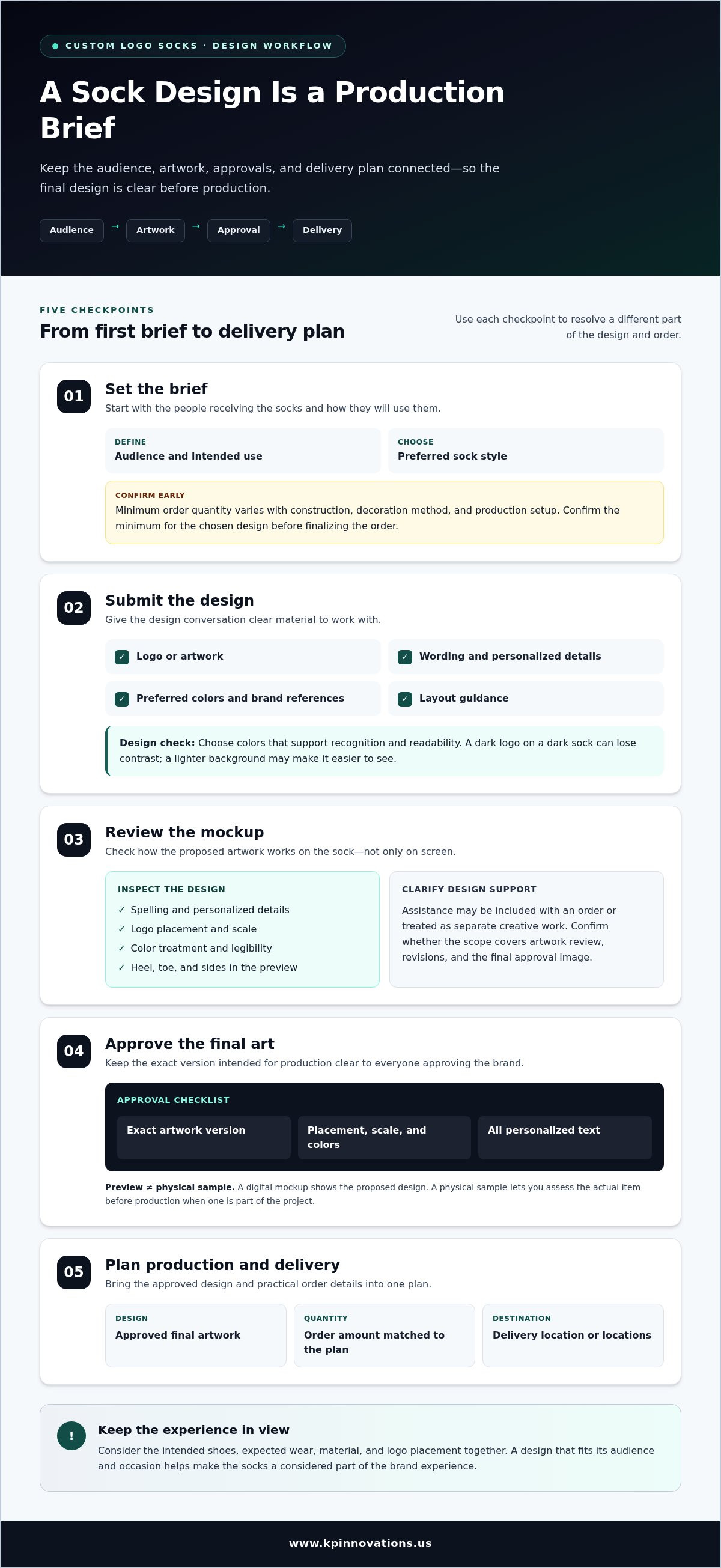
A clear order process helps prevent avoidable artwork changes. Keep design decisions connected to production and delivery by following a planned sequence:
- Set the brief. Define the audience, intended use, preferred sock style, and minimum order quantity.
- Submit the design. Provide the logo, wording, preferred colors, and any layout guidance.
- Review the mockup. Check spelling, placement, scale, and color treatment. Collect feedback from the people approving the brand.
- Approve the final art. Confirm the exact version intended for production, including any personalized text.
- Plan production and delivery. Align the approved design, order quantity, and delivery destination in the project plan.
Choose colors that support brand recognition and readability. A dark logo on a dark sock can lose contrast, while a lighter background may make it easier to see. Include material preferences, such as cotton, in the design brief, and consider material and decoration together. A sourcing plan can connect the artwork, product selection, and production requirements. Clear approvals keep the team aligned before the order moves forward.
Custom sock styles for business, sports, and gifting
Common options include crew, ankle, and longer athletic styles. Choose a style according to its intended use: a corporate gift, sports uniform, and event giveaway may each call for a different option.
Materials, Length, and Construction
Material, length, and construction affect how a sock feels and whether it suits its purpose. A crew style may suit a visible corporate design, while a lower-cut option can work with everyday footwear. Consider the intended shoes, expected wear, and logo placement. Check that the proposed construction supports those choices before approving the design.
Construction also affects how the artwork looks. A logo near the cuff serves a different visual purpose from a repeating pattern across the sock. For a retail-style gift, coordinated colors and a restrained mark can feel intentional. For a company event, a larger graphic or event wording can make the pair more closely tied to the occasion.
Athletic Materials and Durability
Choose athletic socks with the activity and wear pattern in mind. A team playing on a field may prioritize a secure fit inside its footwear, similar to how athletes choose grip socks for football uk to enhance traction, while a walking event may call for a different feel. Consider material and construction together, since neither alone describes the wearing experience. Think about how often recipients will use and wash the socks.
Durability is not determined by a material label alone. It depends on how the sock is made, worn, and cared for. For athletic use, match the design to the team’s routine rather than choosing a style for appearance alone. A practical choice encourages repeat wear and keeps the brand connected to real use.
Size planning matters for teams and company distribution. Use the sizing guidance for the specific sock and compare it with recipients’ usual footwear sizes. A single-size option may simplify a giveaway, while multiple sizes can better serve a group with varied needs. Don’t assume every brand’s sizing maps identically to US shoe sizes.
Quantity and design choices shape the order budget. Compare options with the same quantity, construction, and logo treatment so the figures are like-for-like. A more elaborate design or different material can change the quote. There is no reliable starting price that applies to every style, so assess the quote against the actual specification.
For business, sports, and gifting, choose a style based on its intended role:
- Corporate programs: Choose a versatile look for welcome kits or team wear.
- Sports: Match the sock to the activity, footwear, and team identity.
- Events and giveaways: Make the design memorable and easy to wear afterward.
Accepted artwork formats and color references
Artwork preparation affects how a logo, text, or repeating pattern translates onto a sock. Organize the original file and color references before approval, then review how each detail fits the chosen decoration method.
Jacquard Knitting and Color Limits
Jacquard knitting builds a design into the fabric using colored yarns. The artwork is part of the sock’s construction, not simply a surface graphic. Simple logos and bold patterns are easier to interpret than intricate details. Fine lines, tiny lettering, and subtle gradients may need simplifying to remain clear in knitted form.
Share the original artwork and a simplified version if some details may be difficult to reproduce. A vector file can retain clean edges when resized, while a high-resolution image can help communicate the intended look. Usable file formats and colors depend on the production workflow. Review the final design for legibility, contrast, and any details that have been simplified.
Woven Socks and Brand Colors
For a woven design, provide clear brand color references with the logo. Pantone references or documented color values can communicate the intended shade more clearly than a screen image, which may look different across devices. Separate primary colors from optional accents. For example, an employee gift might use two core brand colors, while a sports pattern could add a contrasting color for visibility.
Review colors in the proposed design, not only in a standalone logo file. A dark mark on a dark sock can lose definition, while a contrasting background can improve readability. Ask the design team to show how colors and patterns work together before production. A clear color hierarchy helps keep the design recognizable without overcrowding it.
Prepare a practical set of artwork files for review. Keep the original logo intact and include a transparent-background version when available. Vector artwork, such as an SVG or EPS, can be resized without rough edges. A PNG can display transparent artwork clearly, while a JPG may include a background. These are common examples, not a universal list of accepted formats.
Color references have limits. A HEX or RGB value describes a digital color, while a printed reference describes color differently. Yarn choices and decoration methods affect how the finished sock looks. Use a digital mockup as a guide and review the approved production artwork in context. Don’t assume an on-screen shade will reproduce identically in knitted material.
Odor resistance and colorfastness are separate performance considerations that artwork files cannot establish. A color reference communicates appearance, not how a sock performs after wear or washing. Keep performance questions separate from logo approval. For a sports design, prioritize a readable team mark and clear pattern, then assess the product’s performance against its intended use.
Before sign-off, use this artwork review sequence:
- Compare the logo with the supplied original.
- Check text, patterns, contrast, and placement.
- Review each color against the brand reference.
- Approve the final artwork version intended for production.
Knit-in and printed logo customization
Knit-in and printed logos create different visual results. Choose a method based on the artwork, sock design, and intended use. A simple emblem may suit knit-in treatment, while detailed personalized designs may call for printing.
How Knit-In Logos Work
A knit-in logo is formed with colored yarn as the sock is made. The design becomes part of the knitted pattern rather than being applied afterward. This approach naturally suits bold shapes, clear lettering, and repeating patterns. Fine lines and small details can be harder to interpret as stitches.
Keep the artwork legible at its size on the sock. A compact company mark, for example, may need fewer details than the standard logo file. Review the design at its actual placement size and consider how the chosen construction handles its colors and shapes. Don’t judge it only from a large screen preview.
How Printed Logos Work
Printing can be one way to add artwork to a sock. This approach can suit designs with details that are difficult to simplify for knitting. Review the logo’s size, placement, and contrast against the sock color. The material and production method affect how the artwork is applied, so assess the proposed design in context.
Compare both options using the same artwork. A company name in fine lettering, for example, may be easier to assess as a printed graphic, while a bold icon could translate well into a knit pattern. The choice isn’t simply about which method shows more detail. It’s about which version communicates the brand clearly on the finished item.
Neither method alone guarantees a particular level of durability. Wear, care, construction, and decoration all matter. If the socks are intended for repeated use, assess the product and decoration together. Consider how often recipients will wear them and whether the logo should be subtle or prominent.
Production timing depends on project details, including artwork approval, construction, and order requirements. Packaging and delivery planning also affect how the finished socks fit into a company program. If each pair is for a separate welcome kit or gift, define that need early. This connects the design decision to the experience recipients will have.
Before approving production, compare knit-in and printed proofs for readability, color contrast, and placement. Make sure the approved version matches the intended use, whether for an employee gift, event, or team. A sourcing plan can align the product choice with the design method and distribution needs. Plan sock sourcing around your logo and program needs to bring those decisions together.
KP Innovations: Promotional Products
KP Innovations partners with businesses through its outsourced “Chief Swag Officer” model, taking ownership of the merchandise program rather than treating each item as a separate transaction. Its “Merch Is Media™” philosophy recognizes that merchandise shapes how employees and customers experience a brand.
That approach connects Promotional Products, Custom Apparel, and Awards & Recognition Items to the moments they are meant to support. Merchandise Strategy, Creative Development, Product Sourcing, Production Management, Program Management, and Fulfillment work together across a program, helping organizations build consistency in their brand experiences.
For a business looking to make merchandise more intentional, KP Innovations can help manage the broader program. Contact KP Innovations to discuss how merchandise can serve your brand experience.
Make Your Next Merchandise Choice Count
A sock order can be a standalone gift or part of a broader brand experience. Before moving ahead, decide what you want recipients to remember and how the item will support that moment. That purpose can guide the design, distribution, and role of socks alongside other merchandise.
KP Innovations provides Promotional Products, Custom Apparel, and Awards & Recognition Items for business programs. If you’re planning custom socks with a company logo, connect the item to a broader goal rather than simply placing a logo on fabric.
Talk with KP Innovations about sourcing custom socks and shaping an approach that fits your audience and program. A considered merchandise choice can help create a more coherent experience for employees, teams, and clients. Take the next step when you’re ready to make that experience intentional.
Frequently Asked Questions
Can I get a physical sample?
A physical sample can help stakeholders assess the finished item before approving a broader program. Use the review to decide whether the sock suits the occasion, audience, and presentation, rather than reopening settled brand decisions. For example, compare it with other items in an employee kit to see whether the gift feels coherent. Include sample review in the project plan before setting internal approval dates.
Can you provide sock design templates?
Design templates help teams work within the layout of a particular sock. They’re most useful once you’ve chosen the product and know who will review the design. Assign one person to own the working file and gather comments from marketing, HR, or a team lead in one place. This avoids conflicting edits and makes the final design easier to approve.
How long does it take to get a design mockup?
Mockup timing depends on the project’s design workflow and the information available to the design team. Keep reviews moving by naming decision-makers before work begins and setting one deadline for feedback. If a department lead or event owner needs to approve the concept, include that review in the schedule rather than adding it after artwork is underway.
How many colors can be used per design?
The workable color count depends on the chosen construction and decoration process. Rather than starting with every color in the brand palette, identify those that will be most recognizable to the audience. A team gift might prioritize core brand colors; an internal recognition item might include a restrained accent tied to the milestone. This gives reviewers a clear basis for deciding whether extra colors add meaning.
Is the design knitted into the sock or printed on top?
Both knit-in and printed decoration are used for custom socks. Knit-in decoration forms the image with yarn, while printing applies it to the surface. Beyond the visual difference, consider how the logo should fit into the wearer’s experience. A subtle mark may suit a gift intended for regular wear, while a more prominent design can help identify a team or event item at a glance.
What are the minimum order quantities for custom logo socks?
There is no single minimum quantity for every sock design. Production setup and the selected construction affect the order quantity. For planning, separate the total audience from any design variations, then decide whether each variation is essential. One coordinated design may simplify distribution across departments; multiple versions need a clear allocation plan so each group receives the intended item.
How long does it take to design, produce, and ship custom company socks?
The overall schedule depends on design decisions, production planning, and delivery arrangements. Start with the date the socks need to be ready, then allow time for internal review and receiving. For an event, assign someone to accept and distribute the shipment. For a company program, decide where the order should arrive and how it will reach each team or location.
What file formats and logo artwork specifications do sock printers require?
Artwork requirements depend on the production process. Provide a clean master logo and note which elements must remain unchanged, such as the wordmark, proportions, or registered brand colors. Include approved alternate logo versions and identify which one is intended for the socks. Keep master artwork separate from mockups so reviewers can distinguish the official brand asset from the layout created for the project.