
A logo on a gift doesn’t make it meaningful. The moment does. The best customer loyalty gift ideas reflect what’s happening in the relationship, whether you’re welcoming a new customer, recognizing a milestone, or reconnecting after a quiet stretch. A generic gift can feel like another transaction, even when the intention is good.
A thoughtful gift doesn’t need to be extravagant. It should feel relevant to the recipient and consistent with the experience your brand wants to create. That takes more than picking an item. Connect each gesture to a real customer moment, then make the process manageable for your team.
This article explores ways to recognize customers without turning every interaction into a promotion. You’ll see how to match gifts to relationship stages, personalize the experience while maintaining brand consistency, and build a coordinated Client Gifting program. Merch is Media™, so each gift is a chance to shape how customers experience your brand, not a guarantee of loyalty.
Key Takeaways
- Define the relationship moment before choosing from customer loyalty gift ideas, so the gesture has a clear purpose.
- Organize gift options around customer needs and relationship stages, rather than choosing from an unstructured product list.
- Use a simple decision process: clarify the occasion, consider the recipient, choose a fitting gesture, and plan its delivery.
- Assign clear ownership for recipient records, approvals, messaging, sourcing, production, and fulfillment to keep gifting consistent.
- Connect Client Gifting to a broader merchandise strategy, treating each gift as a brand experience rather than a standalone item.
Why Customer Loyalty Gift Ideas Should Start With the Relationship
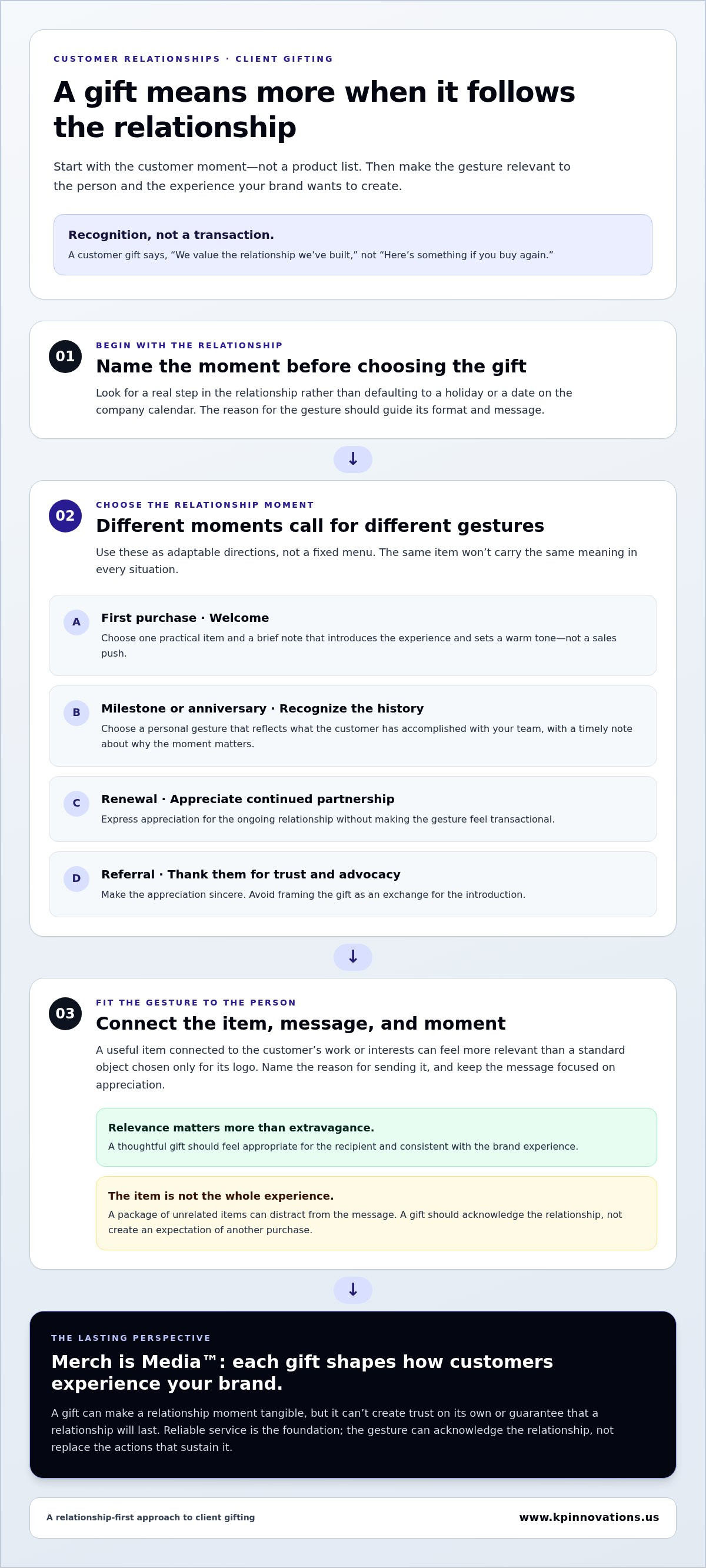
A customer loyalty gift is a deliberate gesture that recognizes an existing relationship. It’s different from a routine giveaway handed to anyone who walks by, and it isn’t simply an incentive to trigger another purchase. The purpose is recognition: “We value the relationship we’ve built,” not “Here’s something if you buy again.”
That distinction matters because customer loyalty involves more than repeat behavior. It can also include a customer’s positive attitude toward a business, as outlined in this overview of customer loyalty. A gift can contribute to a positive experience, but it can’t create trust on its own. Relevance, timing, and the recipient’s context matter more than the size or visibility of a logo.
A gift can make a relationship moment tangible, but it can’t guarantee the relationship will last. Strong customer loyalty gift ideas start with the person and the moment, then use merchandise to express appreciation in a way that fits the brand.
What makes a customer gift feel meaningful?
A meaningful gesture feels considered. It’s useful, appropriate for the recipient, and delivered at a moment that makes sense. An item connected to a customer’s work or interests, for example, may feel more relevant than a standard object chosen only because it carries a logo. The goal isn’t to prove how much branding can fit on an item. It’s to make the recipient feel recognized.
An item without context can be easy to overlook. Even a well-chosen gift, though, can’t compensate for a missed commitment or poor service. Reliable service is the foundation. A gift can acknowledge the relationship, but it can’t replace the actions that sustain it.
Which customer moments can gifting recognize?
Look for moments that reflect a real step in the relationship instead of defaulting to a holiday or a date on the company calendar. A gesture might acknowledge a customer’s first purchase, a meaningful anniversary, a renewal, a referral, or a milestone reached together. The same item won’t carry the same meaning in every situation, so connect the choice and message to why the moment matters.
- First purchase: Welcome the customer and set a thoughtful tone for what comes next.
- Milestone or anniversary: Recognize the history of the relationship with a personal, timely note.
- Renewal: Express appreciation for continued partnership without making the gesture feel transactional.
- Referral: Thank the customer for their trust and advocacy in a way that feels sincere.
For a wider view of how gifting can support different relationships and occasions, connect this customer-focused approach with the Corporate Gifting & Employee Appreciation Guide. KP Innovations’ Client Gifting approach ties gestures to relationship stages, helping brands create intentional experiences instead of sending items without context.
Customer Loyalty Gift Ideas for Different Relationship Moments
A gift feels more intentional when its format and message fit the reason for sending it. Instead of starting with a catalog, start with the customer moment. Are you welcoming someone, thanking them for a specific contribution, or recognizing a relationship that has grown over time? The same item may work for one audience and miss the mark for another.
Think of customer loyalty gift ideas as options to adapt, not a fixed menu. Useful drinkware, custom apparel, and carefully selected branded items can all support a thoughtful gesture. Their value comes from how well they fit the recipient and occasion, not from their category alone or the size of the logo.
Ideas for welcoming and thanking customers
For a new customer, choose a practical item that introduces your brand experience without making the welcome feel like a sales push. Useful drinkware or another considered branded item can be paired with a short note that welcomes the customer and sets a warm tone. Keep the gesture focused. A package of unrelated items can distract from the message.
A thank-you is strongest when it names the reason. After a productive project, for example, a concise note could recognize the customer’s collaboration, paired with an item suited to their workday. The recognition makes the gesture personal, while the item gives it a tangible form. A thank-you should express appreciation, not create an expectation of another purchase.
Ideas for milestones, renewals, and referrals
As a relationship develops, a gesture can reflect its history. For a milestone or anniversary, consider a personal choice that acknowledges what the customer has accomplished with your team—such as repurposing branded event shirts into a custom keepsake through justtshirtquilts.com. A renewal may call for a message of appreciation for continued partnership, while a post-project follow-up can recognize the work completed together. Make the message clear about why the moment matters to your company.
Referral appreciation deserves particular care. Thank the customer for placing trust in your brand and making an introduction without framing the gift as an exchange. That keeps the gesture sincere and avoids turning advocacy into a transaction. Not every recipient or occasion calls for the same format, so tailor the choice to the relationship and delivery context.
- Welcome: Select one useful item and a brief note that introduces the experience.
- Thank-you: Connect the message and gift to a specific interaction or contribution.
- Milestone: Choose a personal gesture that reflects the relationship’s history.
- Renewal or referral: Express appreciation directly, without making the gift feel conditional.
Tiered Client Gifting can help a team plan gestures around relationship stages while leaving room to personalize each moment. A clear Product Sourcing approach connects the intended experience to a fitting item, rather than letting product selection drive the strategy. The aim is consistency in how the brand shows up, not identical gifts for every customer.
How to Choose Customer Loyalty Gifts That Fit the Recipient
A thoughtful choice starts with the recipient, not a product trend or logo placement. A more expensive gift isn’t automatically more meaningful, and a larger logo won’t make an unsuitable item feel personal. The best fit reflects the recipient and the relationship moment.
Use this sequence to make the decision practical:
- Clarify the moment. Identify what the gesture should acknowledge, such as a completed project or an established partnership.
- Understand the recipient. Consider their role, what you know about their work, and the history of your relationship.
- Choose the gesture. Select a useful format and message that fit both the person and your brand.
- Check the delivery context. Confirm that recipient and destination details are appropriate, and that the timing supports the intended message.
This process keeps customer loyalty gift ideas grounded in purpose. It also helps teams explain why an item belongs in the program, rather than choosing it because it is novel or easy to order.
Match the gift to customer context
Start with what you know respectfully. A recipient’s role can suggest whether an item is likely to be useful at work, while relationship history can guide the tone and level of personalization. Avoid guessing at personal tastes or relying on sensitive details. When context is limited, choose a broadly useful format and let the message carry the specific recognition.
Fit includes the interaction itself. A polished, understated gesture may suit a formal business relationship. A more expressive choice may make sense when it reflects an established brand experience—such as offering themed keepsakes from Just Posh Masks for an exclusive client gala or celebratory milestone. The item should feel natural in that setting, not like an attempt to impose a personality on the recipient.
Balance personalization with brand consistency
Personalization doesn’t require a different visual identity for every customer. A tailored note, a reference to shared work, or a detail connected to the occasion can make a gesture specific. Consistent design choices help the item feel like part of the same brand, even when its format changes.
Promotional products cover a broad range of branded item categories, but branding should support the experience rather than dominate it. A thoughtful mark, placement, or message can keep the connection clear without making the item feel like an advertisement. The existing guide to promotional products can provide wider context for those categories.
For teams that need to align recipient fit with brand standards, Merchandise Strategy can establish a clear decision framework. That gives each choice a purpose while leaving room to adapt the gesture to the person, occasion, and delivery context.
How to Make a Customer Gifting Program Consistent and Useful
A gifting program becomes difficult to manage when every team chooses items, writes messages, and arranges delivery independently. A repeatable process gives each gesture a clear purpose and keeps the customer experience coherent. It also makes it easier to learn from the program and adjust it over time.
Build the workflow around a few defined decisions:
- Set the purpose. Document which relationship moments the program recognizes and what each gesture should communicate.
- Identify recipients. Assign responsibility for maintaining recipient records and capturing relevant relationship context.
- Approve the experience. Establish who reviews the item, message, and brand presentation before anything moves forward.
- Coordinate execution. Align Product Sourcing, Production Management, and Fulfillment so the item, message, and delivery work together as one considered experience.
- Review and refine. Gather feedback and assess selected relationship indicators to guide future decisions.
Clear ownership matters at every handoff. If one person manages recipient details but no one owns message approval or delivery coordination, small gaps can make a thoughtful gesture feel impersonal. A named owner, supported by clear roles for each step, helps prevent duplicated effort and keeps the program connected to the customer experience.
Build a gifting process around clear ownership
Start by recording the relationship moments the program is designed to recognize. Then assign ownership for recipient records, approvals, messaging, sourcing, production, and fulfillment. Coordinate these steps rather than treating them as separate orders. KP Innovations’ Client Gifting program connects gifting to relationship stages, giving teams a structure for planning gestures without making every customer interaction identical.
That structure makes customer loyalty gift ideas easier to put into practice. Teams can follow consistent standards while adapting the item and message to the recipient and occasion. The result isn’t a promise of loyalty. It’s a more deliberate way to manage how the brand shows up at meaningful touchpoints.
Learn from each customer touchpoint
After delivery, invite relevant feedback through a suitable follow-up conversation or customer feedback process. Ask whether the gesture felt appropriate and useful, rather than treating a polite response as proof of business impact. Feedback can reveal when the timing, format, or message should change.
Teams can also review indicators they already use, such as repeat business or referrals. Look for patterns alongside other customer experience information, and avoid assuming that a gift caused a renewal or referral. The purpose is to build understanding, not manufacture a success claim. Use what you learn to improve future recipient selection and program choices.
For a gifting program that connects the right item to a clear purpose, explore strategic Product Sourcing as part of a coordinated process from selection through delivery.
Turn Customer Loyalty Gift Ideas Into a Strategic Brand Experience
A customer gift is more than an item with a logo. It’s a physical expression of how your brand treats people. KP Innovations’ guiding idea, Merch Is Media™, recognizes that merchandise can carry a brand experience into a customer’s day. The item, message, timing, and delivery all shape that experience, so each choice should serve a clear relationship purpose.
This takes more than placing a product order. A traditional vendor transaction often centers on selecting an item and completing the order. A strategic partner considers how gifting fits the wider customer experience, then coordinates the work required to deliver it consistently. Merchandise shouldn’t do the work of reliable service. Each gift should be a deliberate brand moment within the relationship.
From a product order to a managed gifting program
The Chief Swag Officer model gives a company an outsourced merchandise department with end-to-end program ownership. Instead of leaving teams to manage disconnected decisions, it connects Merchandise Strategy, Creative Development, Product Sourcing, Production Management, Program Management, and Fulfillment. Teams can see how each part contributes to the intended customer experience.
For gifting, Chief Swag Officer program ownership can connect:
- Merchandise Strategy to the purpose and relationship stage behind each gesture.
- Product Sourcing to item choices that support the planned experience.
- Program Management to the coordination of decisions, approvals, and execution.
- Fulfillment to getting the gift to its intended recipient.
Creative Development and Production Management also connect the concept to the finished item. When the program is managed as a whole, teams can maintain a recognizable brand experience while tailoring the gift to the moment. Customer loyalty gift ideas then become part of a managed approach, not isolated selections competing for attention.
Make every gift a deliberate brand moment
Before a gift goes out, check that its parts tell one coherent story. Does the item fit the customer and occasion? Does the note explain why you’re reaching out? Is the timing appropriate, and will delivery support the experience? These questions connect the physical item to the relationship instead of treating it as a standalone gesture.
Measurement matters, too, but it should support learning rather than imply that a gift caused loyalty. Teams can gather recipient feedback and review selected indicators, such as repeat business or referrals, alongside other customer experience information. Use those observations to refine future choices, messages, and program operations. Merchandise is a measurable brand asset when teams evaluate its contribution to the experience, not when they assign it credit for every business outcome.
A strategic gifting program links intent to execution and gives each customer touchpoint a clear role. Build a more intentional gifting program by connecting product choices to the brand experience you want customers to remember.
Make the Next Customer Moment Count
Choose one upcoming customer interaction and decide what you want the recipient to take away from it. That intention can guide your customer loyalty gift ideas and help your team make a gesture feel purposeful rather than automatic. Start with the experience you want to create, then shape the details around it.
As you plan, consider how the gifting process fits your team’s broader priorities. A focused approach makes it easier to review choices, keep the experience coherent, and learn what to refine next. The goal is a thoughtful customer touchpoint that feels true to your brand.
Give your next gifting decision a clear starting point. Build a more intentional customer gifting program by connecting product choices to the experience you want to create.
Frequently Asked Questions
Can customer loyalty gifts actually strengthen a customer relationship?
They can contribute to a positive experience, but a gift alone can’t secure loyalty or make up for dependable service. Before sending anything, coordinate with the person who manages the customer relationship. They can help ensure the gesture fits the account’s broader communication and doesn’t duplicate another team’s outreach. Afterward, continue the conversation through the customer’s usual contact, not a separate gift-driven follow-up.
Is it better to give customers a branded or unbranded gift?
Choose based on how the item will be used and the setting in which it will appear. For an item likely to be shared at work, a restrained brand mark can make the sender clear even if the note is separated. For something intended for personal use, keep the visual treatment subtle. Align the choice with your brand standards and consider whether the recipient’s organization has preferences about visible branding.
How can a small business recognize loyal customers without a large gifting program?
A small business can recognize customers without making merchandise the only option. A personal call from a familiar team member, an invitation to share feedback with leadership, or a handwritten note may suit a smaller milestone. Decide who can authorize and send each gesture, then keep a simple record so different employees don’t unknowingly recognize the same customer in conflicting ways. This keeps the effort personal and manageable.
What should a customer loyalty gift message say?
Use a simple three-part structure: name the contribution, explain why it mattered, and close with appreciation. For example: “Your team’s detailed feedback helped us clarify the project requirements. Thank you for making time to share it. We value the opportunity to work together.” Adapt the wording to sound like your company, and have it signed by someone who knows the relationship. That personal authorship makes the message feel considered.
Can customer loyalty gifts work for business-to-business customers?
Yes. For a business account involving several people, consider who contributed to the work before preparing a gesture. The account lead can help identify whether recognition should go to one contact or the wider project group, avoiding a mismatch between the message and recipient. A shared gesture can acknowledge collaboration across roles, while a note from the relationship owner keeps the communication connected to the account.
How do you keep customer gifting from feeling like a sales tactic?
Keep customer appreciation separate from sales materials. Don’t include a proposal, discount offer, or renewal document in the same package, and avoid scheduling the gesture solely to coincide with a purchase decision. Record the reason for sending it as recognition, not as a sales conversion activity. Those guardrails help preserve the intent of the gesture and make its purpose easier to explain.