
The lowest-cost garment can create the most expensive apparel program. The domestic vs overseas clothing production pros and cons go beyond a factory quote: production location can affect coordination, oversight, inventory decisions, and how consistently apparel represents your brand.
It makes sense to compare unit costs, but a lower quote may come with additional freight, longer planning cycles, or more coordination around communication and corrections. Domestic production may make close collaboration easier, while overseas production may suit larger, more predictable runs. The right fit depends on your volume, customization needs, and plans for reorders.
This guide offers a practical way to compare the trade-offs, from costs beyond the garment itself to production oversight, communication, and the wearer’s experience. It also explains how to make geography part of a managed apparel program, not a standalone sourcing decision. Because Merch Is Media™, apparel isn’t just something people wear. It’s a visible part of the brand experience.
Key Takeaways
- Choose production geography to fit the apparel program, not as a standalone unit-cost decision.
- Separate location-related trade-offs from challenges shaped by planning, clear specifications, and communication.
- Use the domestic vs overseas clothing production pros and cons to assess which model aligns with your program’s priorities.
- Distinguish one-time apparel needs from ongoing programs and reorders before settling on a production approach.
- Bring sourcing, production management, and program oversight together to support a consistent brand experience.
Domestic vs. Overseas Clothing Production: What Is the Real Decision?
Choosing where apparel is made isn’t simply a search for the lowest unit cost. The real decision is whether a production location fits the program’s goals: the garment’s purpose, expected volume, customization, oversight needs, delivery plan, and likelihood of repeat orders. A location that suits a large, planned run may not fit a time-sensitive launch or a program that needs frequent adjustments.
That’s the useful lens for weighing the domestic vs overseas clothing production pros and cons. Neither location guarantees quality, smooth communication, or a consistent result. Those depend on the production process, clear specifications, capable coordination, and how decisions are managed from development through delivery.
What does domestic versus overseas production mean?
Domestic production means manufacturing in the brand’s home country. Overseas production means manufacturing in another country. These terms describe geography, not a complete sourcing strategy or a promise about how a garment will turn out. The economic concept of offshoring manufacturing operations helps explain the shift of production activity abroad, but a brand’s practical decision also includes how that work is selected and managed.
Production location is one part of the system. Sourcing identifies an appropriate production path for the apparel goals; program management connects that choice to timelines, communication, delivery, and future needs. A brand may use one location for a recurring uniform program and another for a limited apparel initiative. The right fit can vary by purpose, not just by company.
Why the garment price is only one input
A unit quote gives you a price for a garment, but it doesn’t show all the work and decisions needed to deliver it. Compare the operational picture alongside the quote: who coordinates feedback, how samples and specifications are reviewed, how quality processes are handled, how shipments fit the distribution plan, and how a reorder will be managed.
A one-time apparel order, for example, may require a different level of coordination from an ongoing program that needs replenishment and consistent garments. In either case, unclear artwork, sizing details, approvals, or ownership of corrections can create friction regardless of where production takes place. Distance may change how teams communicate and oversee work, but a disciplined process matters in every location.
- Product goals: What role should the apparel play, and what customization does it require?
- Coordination: How will decisions, approvals, and revisions move between teams?
- Oversight: What quality checks and review points are built into production?
- Logistics: How does shipping fit the intended delivery and distribution plan?
- Repeatability: Can the process support consistent future orders?
Assess production location against the full program, not the garment quote alone. This keeps the focus on dependable execution and the experience the apparel creates. It also allows different production choices for different needs, rather than forcing every garment into one location strategy.
What Changes Across the Apparel Production Lifecycle?
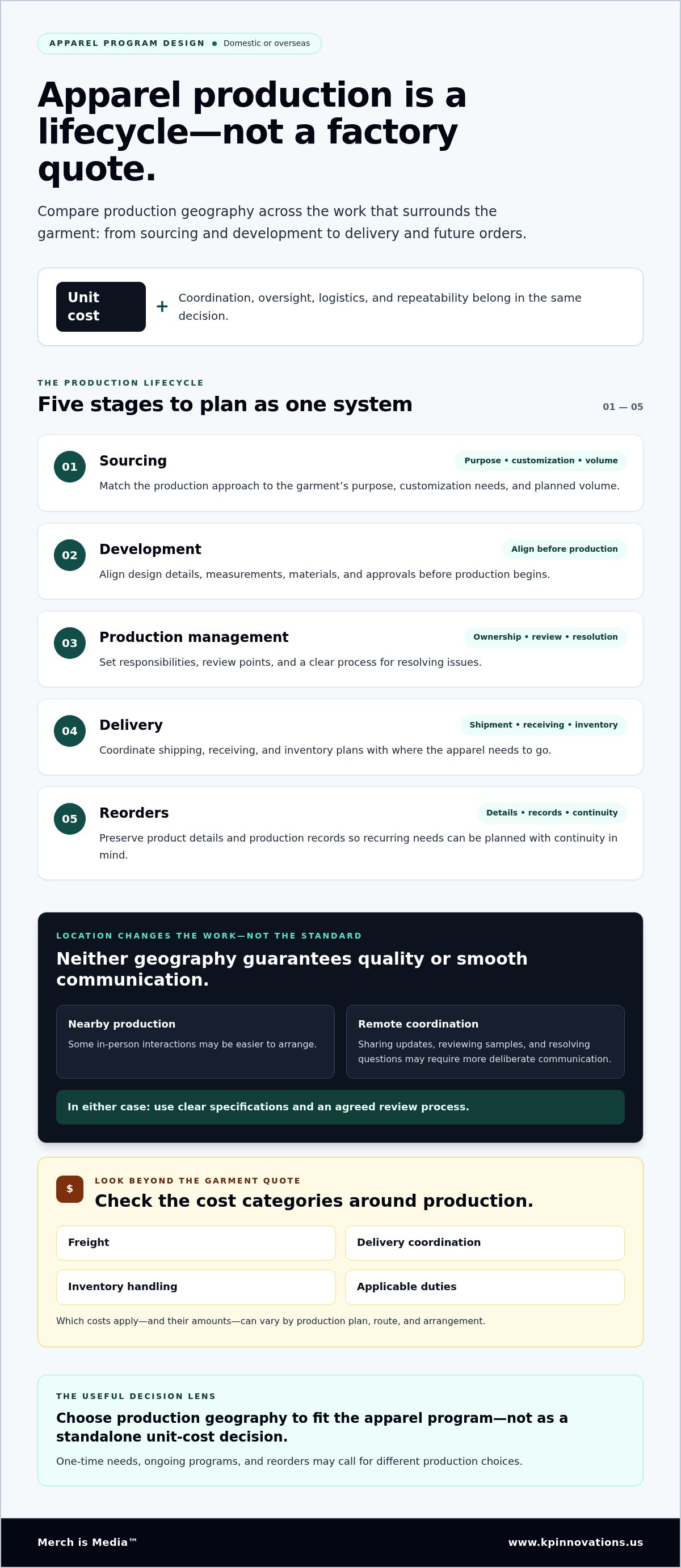
Production geography affects more than the factory stage. It shapes how a branded apparel program moves from sourcing and development to production oversight, delivery, and future orders. Looking at each stage helps separate location-related trade-offs from problems caused by unclear planning, incomplete specifications, or inconsistent communication.
Consider the lifecycle in sequence:
- Sourcing: Match the production approach to the garment’s purpose, customization, and planned volume.
- Development: Align design details, measurements, materials, and approvals before production begins.
- Production management: Set responsibilities, review points, and a clear process for resolving issues.
- Delivery: Coordinate shipment, receiving, and inventory plans with where apparel needs to go.
- Reorders: Preserve product details and production records so recurring needs can be planned with continuity in mind.
The domestic vs overseas clothing production pros and cons become easier to assess when you measure each option against these stages, rather than treating the decision as a simple comparison between two locations.
Coordination, visibility, and quality processes
Distance can affect how teams share updates, review samples, and resolve questions. Remote coordination may require more deliberate communication, while nearby production can make some in-person interactions easier to arrange. Neither automatically guarantees better oversight or garment quality. Clear specifications and an agreed review process matter in either case.
Before production, define who approves samples, how changes are documented, and which quality checks take place. If a logo’s placement or a garment’s fit needs adjustment, for example, teams should know how feedback is recorded and approved before the next stage. A structured process makes expectations visible and reduces reliance on assumptions.
Logistics, costs, and reorders
Compare the full set of cost categories, not just the quoted garment price. Depending on the production plan, these may include freight, delivery coordination, inventory handling, and applicable duties. The relevance and amount of each can vary by route and arrangement, so assess trade and compliance details using current authoritative sources rather than broad assumptions about a country or region.
Delivery planning also connects production to the people who need the apparel. A uniform program, for instance, may need new garments as teams grow or roles change. A reorder plan should account for timing, available inventory, and whether the original specifications can be carried forward consistently. Without that continuity, a low initial unit cost may not reflect the ongoing effort required to keep the program running.
Unit cost and total program demands are different measures. A useful sourcing decision weighs production, coordination, delivery, inventory, and repeat-order needs together. A considered sourcing approach can connect those factors to the apparel program’s purpose and operating needs.
Domestic vs. Overseas Clothing Production: Compare the Trade-Offs
Neither domestic nor overseas production is the automatic winner. Each can suit a different apparel program, and either can disappoint if the production plan doesn’t match the garment, volume, or brand experience required. Use this comparison to identify which trade-offs matter most, then assess the supplier, specifications, planning, and project requirements behind each option.
| Factor | Domestic production | Overseas production |
|---|---|---|
| Potential advantages | Production closer to the brand may support in-person visits, direct communication, and coordination. | Some options may offer production capacity or lower unit costs, depending on the project and sourcing plan. |
| Trade-offs to consider | Location alone doesn’t establish cost, capabilities, or fit for a particular product requirement. | Distance can add coordination needs and make shipping, oversight, and planning more involved. |
| May fit best when | Proximity and direct collaboration are priorities for development or production oversight. | Volume, specialized capabilities, or a broader sourcing plan align with the available production option. |
When overseas production may fit
Overseas production may suit a program with larger planned runs, a sourcing plan built around production capacity, or requirements that align with specialized capabilities available abroad. Weigh any possible unit-cost advantage against shipping, communication across distance, oversight, and the time needed to plan approvals and resolve changes. Make the comparison for the specific project, not from a blanket assumption about any country.
When domestic production may fit
Domestic production may be worth considering when proximity could make visits, feedback, or coordination more practical. A team developing a garment with several rounds of review, for example, may value closer access to production conversations. That proximity doesn’t guarantee better quality, lower cost, faster delivery, or a smaller environmental impact. Product requirements and the complete sourcing plan still determine whether the option fits.
Some programs may benefit from using different locations for different needs. A predictable core apparel order and a customized launch item may call for different production approaches, provided the brand can manage specifications, approvals, and consistency across both. That’s why the domestic vs overseas clothing production pros and cons should be assessed against your priorities, not treated as competing universal rules.
Before choosing, identify what the program needs most: capacity, close collaboration, flexibility, or a clear path to repeat orders. Then compare how each production option supports those priorities and what coordination it requires. The strongest choice is the one that fits the work from development through delivery while supporting apparel people can recognize as part of a consistent brand experience.
How to Choose a Clothing Production Model for Your Brand
There isn’t one production location that works for every apparel need. Start with the people who will wear the garments and the job the apparel needs to do. Then match sourcing choices to product requirements, ordering patterns, and the team responsible for keeping the program consistent.
Start with product goals and operating needs
Before comparing locations, define the apparel’s purpose and the standards it must meet. Separate essential requirements, such as a specific design or brand detail, from preferences that could allow flexibility in sourcing. Consider how garments will be distributed and who will approve decisions, manage updates, and own future orders.
- Define the use. Identify who will wear the apparel and in what context, such as a uniform program, employee initiative, or one-time event. Let the intended experience guide the product requirements.
- Set the specifications. Document design, fit, customization, and brand standards. Mark which details are non-negotiable and where alternatives may be considered without compromising the intended result.
- Map the order pattern. Decide whether this is a one-time need or a recurring program. For ongoing needs, consider how reorders, changing team needs, and product continuity will be managed.
- Plan distribution and ownership. Clarify where apparel must go, how it will reach wearers, and which internal team owns approvals, inventory decisions, and communication.
- Compare sourcing paths. Assess domestic and overseas options against the requirements above, including the coordination each approach calls for. Choose based on program fit, not on a location label alone.
Use this matrix to turn broad priorities into practical planning questions:
| Priority | Question for internal planning |
|---|---|
| Customization | Which design and brand details must remain consistent? |
| Coordination | Who will manage approvals, feedback, and production updates? |
| Recurring orders | How will specifications and product decisions carry forward to reorders? |
| Distribution | Where must apparel go, and how will teams coordinate delivery? |
| Flexibility | Which requirements can adapt if a different sourcing path better fits the program? |
The domestic vs overseas clothing production pros and cons are most useful when applied to a specific garment or program. A recurring uniform need may call for a different sourcing assessment than a single event order. A brand may use more than one production path, provided specifications, approvals, and ownership stay clear across decisions.
Documenting those standards gives the team a shared reference point as needs change. Explore Product Sourcing as part of a considered apparel program, with product requirements and operating needs at the center of each decision.
Make Production Geography Part of a Managed Apparel Program
A production location is one choice in a wider apparel system. Strategy defines what the apparel needs to accomplish. Creative Development translates brand standards into design direction. Product Sourcing aligns the product and production path with the program’s needs. Production Management supports coordination through manufacturing, while Fulfillment connects completed apparel to the people and places it needs to reach.
Treating geography as an isolated factory decision can leave gaps between those stages. A garment might meet its immediate brief but prove difficult to reorder consistently, distribute across teams, or connect to a broader employee or client experience. A managed approach keeps those needs in view as decisions are made.
From a factory decision to program ownership
A traditional vendor transaction often centers on selecting an item and completing an order. A strategic partner takes a wider view of the merchandise ecosystem: how decisions connect, who owns approvals, how production is managed, and how the program can support a coherent brand experience. That doesn’t mean one location must work for every need. It means each sourcing choice should fit within a clear plan.
Private-label apparel makes this especially tangible. A garment carries more than a logo; its design and use shape how employees or clients experience the brand. For a useful starting point on this apparel context, see Private Label Clothing: A Founder’s Starter Guide. KP Innovations supports apparel programs through Product Sourcing, Production Management, and Program Management, connecting sourcing decisions with coordinated execution rather than treating each order as a separate transaction.
Build the next step around your apparel goals
Before settling on a production model, bring the key considerations into one conversation: what the apparel needs to do, how teams will coordinate, what oversight is needed, how delivery fits the program, and whether repeat orders are expected. Clear ownership and documented specifications help teams maintain consistency, even when different apparel needs call for different sourcing decisions.
Apparel-related client work provides practical context. A testimonial from Chad Sierer of McLaren Philadelphia mentions duffle bags, polos, hats, and private-label apparel. It reflects experience with apparel and related merchandise, not a promise that one production location or sourcing model fits every brand.
That distinction matters because Merch Is Media™: apparel can be a visible part of how a brand is experienced by employees and clients. It can support culture and relationships, but the garment alone doesn’t guarantee a business outcome. A thoughtful program connects the item to its purpose, execution, and ongoing management.
Use your apparel goals to guide the discussion, then build sourcing around the program rather than defaulting to a location. Build a strategic sourcing approach with KP Innovations.
Build an Apparel Program That Can Adapt
A production decision doesn’t need to become a permanent rule for every garment. As your audience, brand standards, distribution needs, or ordering patterns change, the best-fit approach may change too. Revisit the decision when the program shifts, not only when a new order is due.
Give future teams a clear starting point. Keep a concise record of the apparel’s purpose, essential specifications, decision owner, and assumptions about repeat orders. That context helps colleagues understand why a sourcing path was chosen and what would justify reconsidering it. It also makes the domestic vs overseas clothing production pros and cons a practical framework for ongoing decisions, rather than a one-time debate about location.
The goal isn’t to choose a side and defend it forever. It’s to build an apparel program that can respond thoughtfully while preserving the experience your brand intends to create. Start with what your program needs now and how sourcing can support its next stage. Build a strategic sourcing approach with KP Innovations and move forward with clarity.
Frequently Asked Questions
What does nearshoring mean in clothing production?
Nearshoring means moving production to a country geographically closer to the brand’s home market than a more distant overseas location. It remains international production, not domestic manufacturing. The term describes relative distance, not a particular service level or delivery result. For planning, define what “closer” means for your program, such as easier travel for a team that expects to visit production partners.
Can a brand use both domestic and overseas clothing production?
Yes. A brand can maintain more than one production path, but doing so adds coordination responsibilities. Decide which team owns each product category, who keeps production records aligned, and how inventory is allocated across orders. If employees receive apparel from separate programs, for example, consistent naming and ordering instructions can help internal teams avoid confusion. Make the structure understandable to the people who operate it.
How much should a brand consider beyond the quoted garment cost?
There’s no universal percentage to add. Compare quotes using the same assumptions, then separate costs that occur once from those that recur with each order. A planning worksheet can distinguish development or setup expenses from ongoing production and distribution costs. Also consider what happens if demand differs from the forecast, including how remaining sizes or garments would be handled. This gives decision-makers a clearer view of budget exposure without relying on a markup rule.
Is domestic clothing production automatically better quality?
No location label can replace a clear way to evaluate the finished garment. Consider how it will perform in its intended setting, and gather feedback from people who will wear it before expanding an order. For a uniform, that might mean assessing comfort and fit during a representative workday. Capture feedback consistently so the team can distinguish a recurring issue from an individual preference and make informed decisions about future production.
What is a minimum order quantity, and why does it matter?
A minimum order quantity, or MOQ, is the smallest quantity a production source will accept for an order. It matters because an MOQ can shape how a brand plans its initial allocation across teams, sizes, or locations. Before placing an order, compare the required quantity with realistic demand and decide how any excess will be stored or distributed. This helps prevent a production threshold from becoming an unplanned inventory burden.
What should a brand document before apparel production begins?
Beyond product details, document the program’s internal operating plan: who approves the order, which budget owner is responsible, how wearers’ size information will be collected, and where completed apparel should be distributed. Record how decisions are communicated when teams or locations are involved. These details help prevent administrative gaps, such as a finished order arriving without a clear recipient list or a designated person to coordinate distribution.
What happens if production requirements change after sampling?
A change after sampling should trigger an impact review before the revised direction is treated as final. Identify whether materials have been ordered or production has started, then assess possible effects on the order, schedule, and budget with the production team. Record the approved change and its date so everyone works from the same decision. Raising a change early gives the team more room to consider alternatives.