
What if the most expensive part of your marketing budget isn’t the media buy, but the landfill space your merchandise occupies? Most marketing and HR leaders feel the sting of seeing low-quality items end up in the trash, especially when those products were meant to represent a commitment to the planet. You’ve likely felt the frustration of trying to source eco-friendly corporate gifts only to realize that verifying sustainability claims across a global supply chain is a logistical nightmare. It’s time to stop thinking about these items as disposable giveaways and start treating them as high-utility media.
We agree that your brand deserves better than budget-draining waste and vendor friction. This guide provides a strategic framework for 2026 to help you build a merchandise program that actually supports your ESG goals. You’ll learn how to identify high-utility assets that employees and clients value, navigate upcoming global recycling standards, and manage the entire lifecycle of your brand’s physical presence. We’re moving beyond the transaction to show you how a managed system turns physical items into lasting loyalty and measurable impact. Our Merch is Media™ philosophy ensures that every choice you make reinforces your integrity rather than compromising it.
Key Takeaways
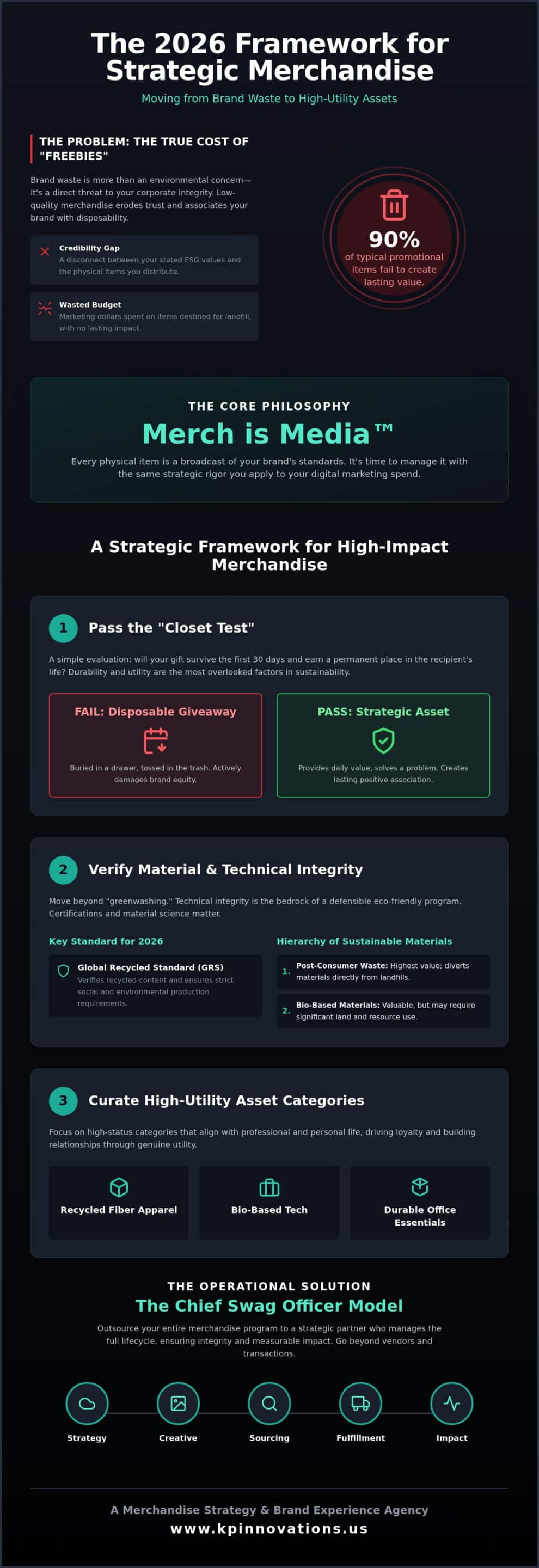
- Learn to eliminate brand waste by shifting from disposable giveaways to a “Merch is Media™” framework that prioritizes strategic, high-utility assets.
- Discover how to verify the technical integrity of eco-friendly corporate gifts using the 2026 GRS (Global Recycled Standard) and a hierarchy of sustainable materials.
- Understand why “The Closet Is Not a Fulfillment Strategy” and how global logistics management reduces the carbon footprint of your distribution.
- Identify high-status categories like recycled fiber apparel and bio-based tech that drive employee loyalty and client relationships.
- Explore the Chief Swag Officer model as a way to outsource the entire merchandise lifecycle, ensuring brand integrity and measurable marketing impact.
Beyond Greenwashing: Why Eco-Friendly Gifting is a Strategic Mandate
Brand waste isn’t just an environmental concern; it’s a direct threat to your corporate integrity. In 2026, the cost of “brand waste” is measured by the erosion of trust between a company and its stakeholders. When your brand claims to value sustainability while distributing low-quality items that break within a week, you create a credibility gap. We define this as the disconnect between your stated values and your physical reality. It’s a high-stakes touchpoint that either builds loyalty or creates friction. When your procurement team buys disposable items, they’re essentially buying a future reputational crisis.
Our core philosophy is that Merch is Media™. Every item you put in a client’s hand or an employee’s welcome kit is a broadcast. It tells a story about your standards and your vision for the future. Shifting from transactional giveaways to strategic assets means treating your merchandise with the same rigor you apply to your digital marketing spend. Choosing eco-friendly corporate gifts isn’t about ticking a box; it’s about ensuring your physical media reflects a brand worth following. You don’t need more stuff. You need better tools to build relationships.
The Psychology of Utility vs. Disposal
High-utility items are the only truly sustainable choice. If a product doesn’t solve a specific problem or provide daily value, it’s destined for the bin. This leads to the “Closet Test.” We ask a simple question: will your gift survive the first 30 days? If it’s buried in a drawer or tossed in the trash, it has failed as a strategic asset. Low-quality items don’t just waste your budget. They actively damage your brand equity by associating your name with planned obsolescence. Strategic assets—like those you find when you discover Fresh Off The Cap for sustainable mushroom cultivation kits—create a lasting positive association every time they’re used in a professional or personal setting.
Authentic Corporate Social Responsibility (CSR) requires total consistency across every department. Your merchandise program should be a visible proof point of your integrity. By integrating eco-friendly corporate gifts into your recognition and retention strategies, you move beyond the “green” checkbox to create measurable impact. This approach supports your ESG goals by reducing waste and ensuring ethical sourcing. It also plays a vital role in employee culture. When your team sees that your commitment to the planet extends to the very items they use every day, it builds a deeper sense of pride and alignment with the company’s mission.
The Lifecycle of Impact: Verifying Material and Technical Integrity
Technical integrity is the bedrock of a strategic merchandise program. In 2026, the Global Recycled Standard (GRS) serves as a critical benchmark for verifying that recycled content is handled according to strict social and environmental requirements. Without these certifications, your eco-friendly corporate gifts are little more than a marketing claim prone to scrutiny. Understanding the hierarchy of materials is essential; post-consumer waste, which diverts trash from landfills, often carries a higher strategic value than bio-based materials that may still require significant land use.
Our Strategy & Creative Development process prioritizes items that offer technical longevity. We focus on the life-of-product impressions rather than the initial cost. If a gift fails to function after three months, its environmental footprint is a total loss. This is especially true in the tech category, where high-capacity power banks and durable office essentials must be vetted for battery safety and component quality to avoid corporate liability.
The Closet Test: A Definition for Sustainable Merch
The Closet Test is a strategic evaluation of whether a physical asset provides enough ongoing utility to earn a permanent place in a recipient’s life rather than being discarded or hidden away. Durability is the most overlooked factor in sustainability. A shirt made from recycled plastic that pills after two washes is not a sustainable asset. We measure success through KPIs that track long-term utility and brand visibility. By following the framework in the University of Georgia’s Sustainable Purchasing Guide, we ensure that every item meets high standards of environmental and social impact.
Technical Standards for 2026 Corporate Liability
Navigating certifications like B-Corp, Fair Trade, and Oeko-Tex is no longer optional for high-growth brands. These labels provide a layer of protection against the risks of unverified sourcing in a complex global supply chain. For example, battery longevity in tech items isn’t just about utility; it’s a safety issue that reflects directly on your brand’s commitment to quality. When you treat your merch as media, you cannot afford the reputational risk of a product failure, particularly when distributing eco-friendly corporate gifts to a discerning audience. Our team acts as a guardian of your brand integrity by managing the technical details of strategic sourcing to ensure every item survives the scrutiny of your stakeholders.
Curating High-Utility Assets: Strategic Categories for 2026
Selecting the right categories for your merchandise program is a matter of brand alignment rather than catalog browsing. In 2026, we’re seeing a definitive shift toward private label apparel that utilizes recycled fibers to create high-status uniforms. These aren’t just garments; they’re wearable media that signal your company’s commitment to quality and the environment. By moving away from off-the-shelf options and toward a strategic apparel program, you ensure that every thread reflects your brand’s integrity. High-utility assets earn their place in the recipient’s daily life, which is the only way to guarantee a return on your investment.
Strategic tech and premium drinkware remain essential pillars of a modern gifting strategy. We prioritize high-capacity power banks and durable office essentials that solve real-world problems for a mobile workforce. Similarly, our drinkware strategy focuses on eliminating single-use plastics by providing premium tumblers that people actually want to carry. When you provide eco-friendly corporate gifts that possess genuine utility, such as a manual coffee grinder from Caffeine Lab, you move from being a source of clutter to a provider of value. This transition is vital for any brand looking to build long-term loyalty through physical touchpoints.
Choosing the right material requires balancing environmental impact with long-term performance. We evaluate three primary contenders for corporate apparel and accessories:
- Organic Cotton: Offers unparalleled comfort and breathability. It’s ideal for employee recognition but requires careful laundering to maintain its shape over time.
- Recycled Polyester: The leader in durability and color retention. It’s the best choice for high-use uniforms because it holds branding perfectly through hundreds of wash cycles.
- Hemp: An emerging powerhouse in sustainable textiles. It’s naturally antimicrobial and incredibly tough, getting softer with every use while maintaining its structural integrity.
The business case for premium materials is clear: higher initial quality leads to a longer product lifespan. This reduces the frequency of replacements and ensures your brand remains visible and untarnished for years.
Building Cohesive Eco-Kits for Events
Bundling items into a cohesive kit significantly increases the perceived value and utility of your merchandise. For trade shows and conferences, the goal is to provide a selection where portability meets sustainability. A well-curated kit tells a story of a brand that considers the recipient’s journey. Our event marketing solutions focus on items that are easy to pack and serve a purpose throughout the event. When eco-friendly corporate gifts are presented as a thoughtful system rather than a random collection, they transition from “stuff” to a strategic brand experience that participants value and keep.
The Operational Reality: Sourcing and Fulfillment of Global Eco-Programs
Buying eco-friendly corporate gifts is a significant step, but it’s only half of the equation. If your fulfillment process is inefficient, you negate the environmental benefits of the products themselves. Many organizations still rely on an office closet as their primary storage solution. This is not a strategy. It leads to damaged inventory, lost items, and a lack of accountability. When you don’t know what you have, you over-order. This creates a cycle of waste that contradicts your sustainability goals.
A strategic approach to fulfillment and logistics services considers the entire carbon footprint of your program. Shipping individual items across the globe from a centralized hub is often the most carbon-intensive way to manage merchandise. We focus on regional warehousing and optimized distribution to reduce transit emissions. Presentation also plays a critical role. We replace plastic-heavy packaging with retail-inspired, plastic-free alternatives. This ensures that the first physical touchpoint with your brand is both premium and responsible.
Strategic Sourcing: Beyond the Vendor List
Most distributors act as middle-men between you and a catalog. We function as your outsourced merchandise department. Our approach to strategic sourcing involves ground-up manufacturing to ensure total transparency in the supply chain. While we provide access to 1.2 million products, every item is vetted through a rigorous sustainability lens before it’s recommended. This level of control allows us to verify material claims and ethical labor practices. It moves your program from a series of transactions to a managed system that protects your brand integrity.
Optimizing the Last Mile: Eco-Conscious Delivery
Inventory waste is one of the most significant contributors to corporate environmental impact. By utilizing online company stores, we shift from a “push” model to a “pull” model. You only produce what employees and clients actually request. This on-demand approach eliminates the need for massive production runs that often end up in a landfill. Our warehousing strategies are designed to place products closer to the end recipient, significantly reducing the miles traveled for every delivery. This optimization ensures that your eco-friendly corporate gifts reach their destination with the lowest possible impact on the planet.
The KP Innovations Approach: Your Outsourced Merchandise Department
Stop viewing merchandise as a procurement task. It’s a brand experience. Most vendors in this industry operate on a transactional basis, waiting for you to provide a part number and a logo. We operate differently. Our agency model is built on the belief that physical assets are a vital part of your marketing mix. By moving from a vendor relationship to a strategic agency partnership, you gain a dedicated team that views your merchandise with the same rigor as your digital marketing spend. You wouldn’t invest in an ad campaign without a strategy; your physical media deserves the same level of intentionality.
The Chief Swag Officer Model acts as the guardian of your brand integrity. This role is specifically designed to protect your organization from the reputational risk of greenwashing. We don’t just take a supplier’s word for it. We verify every claim in the supply chain to ensure your eco-friendly corporate gifts actually meet the standards you promise your stakeholders. This proactive management turns a potential liability into a high-integrity asset that reinforces your corporate values at every touchpoint.
Full-Cycle Program Management
Your brand deserves a dedicated merchandise department that owns the entire lifecycle of your physical assets. We provide full-cycle management that begins with initial strategy and creative development, moving through global fulfillment and ending with detailed impact reporting. This comprehensive approach eliminates the operational burden on your internal marketing and HR teams. Instead of managing dozens of vendors and tracking shipments, your team can focus on high-level goals while we handle the logistical complexities of high-utility sourcing and distribution. Our system ensures that every item distributed is a strategic investment in your brand’s culture and relationships.
Start Your Strategic Eco-Program Today
The transition to a sustainable model begins with a clear-eyed audit of your current merchandise waste. Identify the items that consistently fail to provide value and prepare to replace them with high-utility alternatives. Moving to a high-integrity model isn’t just about changing materials; it’s about changing your philosophy on how physical items represent your company. By focusing on quality and lifecycle management, you reduce corporate waste while increasing the impact of every dollar spent. It’s time to treat your merchandise as the powerful media channel it truly is. Partner with a Chief Swag Officer for your sustainable sourcing and begin building a program that reflects the true ambition of your brand.
Securing Your Brand Integrity for 2026
The transition to a high-utility merchandise program is no longer optional for brands aiming to lead in 2026. True sustainability requires moving beyond the individual product to examine the entire lifecycle of your brand’s physical presence. By adopting the Merch is Media™ philosophy, you transform eco-friendly corporate gifts from potential waste into strategic assets that build culture and loyalty. This approach demands technical verification through standards like GRS and a logistical framework that eliminates the carbon footprint of inefficient distribution.
Your brand deserves a partner that treats every physical touchpoint with the same rigor as your digital marketing investment. We provide white-glove project management from initial design to global delivery. Our global fulfillment network is optimized for the operational realities of 2026, ensuring your program remains efficient and responsible. It’s time to stop managing vendors and start building a managed system that reflects your corporate integrity. Let’s eliminate brand waste and build lasting impact together.
Partner with a Chief Swag Officer for your sustainable sourcing and elevate your brand strategy today.
Frequently Asked Questions
What makes a corporate gift truly eco-friendly in 2026?
It’s a combination of material integrity, ethical manufacturing, and high-utility longevity. In 2026, an item is truly sustainable only if it survives the “Closet Test” and provides ongoing value to the recipient. We look for products that utilize GRS certified recycled content and are produced through transparent supply chains. If a gift doesn’t solve a problem or serve a daily purpose, it’s destined for a landfill, regardless of its recycled content.
How do I verify if a promotional item is actually sustainable?
You must look for third-party certifications like the Global Recycled Standard (GRS), Oeko-Tex, or B-Corp status. These labels provide a technical framework for verifying environmental and social claims. We don’t rely on a vendor’s marketing copy; we demand documentation that proves the material origin and manufacturing ethics. Verifying eco-friendly corporate gifts requires a strategic partner who manages the entire system from the ground up to ensure total transparency.
Why is high-utility more important than the “recycled” label?
A recycled product that breaks or isn’t used is still waste. High-utility items earn a permanent place in a recipient’s life, which maximizes the return on both the environmental and financial investment. When an item provides daily value, it generates more impressions and builds a stronger brand connection. We prioritize durability and function over trendy labels because the longest-lasting items are the ones that truly protect your brand integrity and the planet.
Can eco-friendly corporate gifts be sourced globally without high carbon footprints?
Yes, through regional warehousing and optimized distribution networks. Sourcing eco-friendly corporate gifts globally doesn’t have to mean high emissions if you use a strategic fulfillment model. We place inventory closer to the end recipient to reduce the “last mile” impact. By utilizing online company stores to produce only what’s needed, we eliminate over-production waste and the carbon footprint associated with shipping bulk items that might never be used.
What are the best sustainable materials for private label apparel?
Recycled polyester, organic cotton, and hemp are the primary choices for high-status uniforms. Recycled polyester is exceptional for durability and color retention through hundreds of washes. Organic cotton provides the premium feel employees expect, while hemp offers natural antimicrobial properties and incredible structural integrity. We help you choose the material that best matches your brand’s performance needs and ESG goals, ensuring your custom apparel serves as effective, long-term media.
How does the Chief Swag Officer model improve sustainability?
The Chief Swag Officer acts as a dedicated guardian of your brand’s physical integrity. Instead of just placing orders, this partner manages the entire system, from strategic sourcing to global fulfillment. This model eliminates the “greenwashing” risk by vetting every supplier and material claim with professional rigor. It shifts your program from a series of wasteful transactions to a managed system where every item is measured for its impact on your culture and relationships.
What is the “Closet Test” for corporate merchandise?
The Closet Test is our internal benchmark for measuring the strategic value of a physical asset. It asks whether a gift will be used regularly or hidden away in a closet before being discarded. If an item doesn’t earn a spot in a recipient’s daily routine within the first 30 days, it’s failed as a brand asset. We focus on curating high-utility items that pass this test, ensuring your investment builds loyalty rather than clutter.
Are there eco-friendly tech options for large-scale events?
Absolutely, but the focus must be on longevity and technical safety. We curate high-capacity power banks and durable office essentials that utilize post-consumer recycled plastics and bio-based materials. For large-scale events, portability meets sustainability when you bundle these items into cohesive kits. By avoiding cheap tech that fails quickly, you protect your brand from liability and ensure your event merchandise serves as a high-integrity broadcast of your corporate values.