
What makes a promotional item feel valuable to the person receiving it? Not its price tag or premium appearance alone. High perceived value promotional items earn a place in someone’s daily life because they’re useful, well chosen, and connected to a moment that matters. Yet merchandise is often chosen by habit, distributed without a clear purpose, and judged by how it looks instead of how it fits the experience.
It’s understandable to focus on the item, but the item is only one part of the experience. A thoughtfully chosen piece can recognize an employee, welcome a customer, or strengthen a client relationship. A generic giveaway can miss the moment entirely. Perceived value starts with relevance: who receives the merchandise, why they receive it, and what the experience communicates about your brand.
This article explains how to choose merchandise for real audiences and occasions, distinguish lasting value from a premium appearance, and connect selection, distribution, and follow-up into a purposeful program. With a Merch Is Media™ mindset, merchandise becomes more than a product decision. It becomes a brand experience, managed as a coherent program with clear intent.
Key Takeaways
- Judge an item by its relevance, usefulness, and meaning to the recipient, not just its price or premium appearance.
- Match high perceived value promotional items to the audience, occasion, brand, and experience you want to create.
- Compare options by audience relevance, usefulness, brand fit, timing, and operational fit instead of chasing luxury.
- Build each merchandise initiative around a clear moment and objective, then plan how items will be delivered and reviewed.
- Decide who owns the full merchandise program, from strategy and creative to sourcing, fulfillment, and reporting.
What Makes a Promotional Item Feel High in Perceived Value?
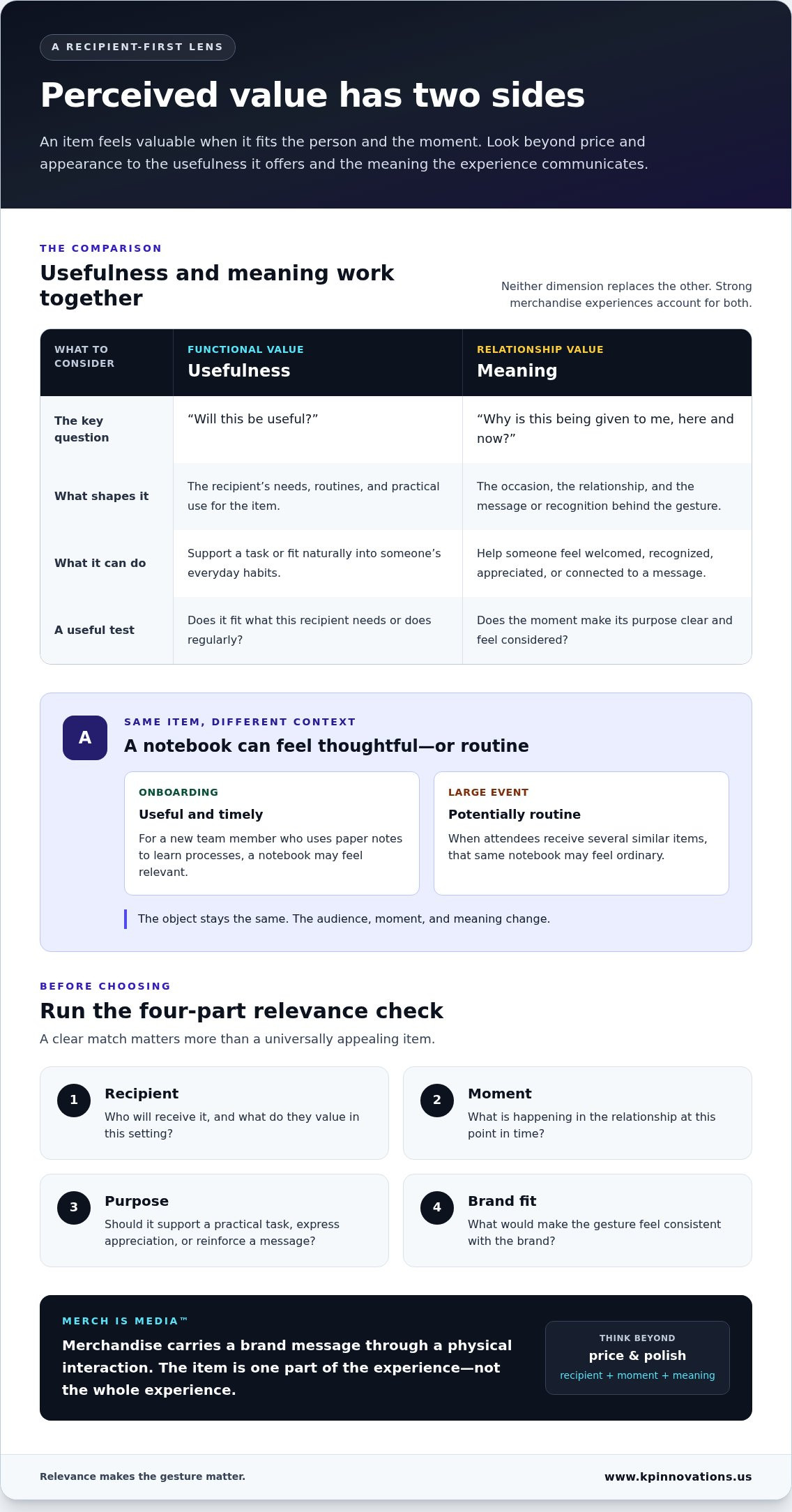
Perceived value is the recipient’s judgment of how relevant, useful, and meaningful an item is in a particular context. It isn’t a fixed quality built into the object. The same item can feel thoughtful to one person and unnecessary to someone else.
Price, materials, and appearance can shape first impressions, but none guarantees that an item will matter. A polished object may still be a poor fit for the recipient or occasion. In marketing, Value (marketing) considers the benefits people perceive in relation to what they give up or invest. For merchandise, that perspective shifts attention from the item’s cost or finish to the experience it creates for the person receiving it.
Perceived value is the recipient’s perspective
People bring different needs, habits, and associations to the same item. A practical object may be welcome to someone who will use it regularly, but irrelevant to someone with no need for it. Brand context matters, too. An item can signal care and recognition, or feel like an automatic distribution with little thought behind it.
Hypothetical example: A company gives employees a notebook during onboarding. For a new team member who uses paper notes to learn processes, it may feel timely and useful. At a large event where attendees receive several similar items, that same notebook may feel routine. The object hasn’t changed. The audience, moment, and meaning have.
Why usefulness alone does not tell the whole story
Practicality is a sound starting point: an item that fits a recipient’s routines has a reason to be kept and used. But usefulness alone doesn’t make merchandise distinctive. A functional item can still feel generic if it arrives without a clear connection to the person, occasion, or brand.
Consider the interaction around the item. Was it offered as part of a welcome, a recognition moment, or a meaningful client exchange? Did the presentation make its purpose clear? These details shape how the item is received. The product is one part of the experience, not the entire brand experience. That is the thinking behind Merch Is Media™: merchandise carries a brand message through a physical interaction.
To assess high perceived value promotional items, look beyond whether an option seems appealing in a catalog. Ask:
- Does this item fit the recipient’s needs or routines?
- Does the occasion give it a clear purpose?
- Does it express the brand in a way that feels appropriate?
- Will the delivery make the recipient feel considered?
The answers are more useful than a universal list of desirable products. Perceived value comes from the match between item, recipient, and moment. Start with that relationship, and product selection becomes a deliberate decision instead of a habit.
How Audience, Timing, and Brand Context Shape Perceived Value
An item is received within a relationship, not in isolation. The recipient’s needs shape whether it feels useful; timing shapes whether it feels relevant; and brand context helps explain what the gesture means. Perceived value grows when merchandise fits the recipient, the relationship, and the moment.
These elements work together. A practical item may meet a daily need, while a considered message or presentation adds emotional value by showing recognition, welcome, or appreciation. Neither dimension replaces the other. Functional value answers, “Will this be useful?” Relationship value asks, “Why is this being given to me, here and now?” Strong merchandise experiences account for both.
Match the item to the person and the moment
Start with the recipient’s situation, not a list of universally popular items. Consider what they’re doing, what they need, and what they’re expected to remember. An onboarding touchpoint can help a new employee feel prepared to join a team. Recognition can mark a contribution in a way that feels personal. Client gifting can acknowledge an ongoing relationship, while a campaign item can reinforce a specific message. Each context calls for a different role, even when the merchandise category overlaps.
A category’s broad appeal doesn’t prove it fits a particular audience. Before selecting an item, clarify:
- Who will receive it, and what do they value in this setting?
- What is happening in the relationship at this moment?
- Should the item support a practical task, express appreciation, or reinforce a message?
- What would make the gesture feel consistent with the brand?
These questions help teams consider functional and emotional value together. A useful item can support a task and still communicate care. The right balance depends on the purpose of the interaction.
Make the brand experience feel intentional
Design, message, and delivery influence how recipients interpret merchandise. A welcome item presented alongside a clear introduction to the team has a different context from the same item left on a table without explanation. The difference isn’t necessarily the product. It’s the connection between the item and the experience around it.
This fits the broader role of marketing described in the American Marketing Association’s Definition of Marketing, which includes creating, communicating, delivering, and exchanging offerings that have value. Merchandise can contribute when its design and presentation support a coherent brand impression. Distribution without a clear reason can feel incidental; a purposeful touchpoint makes the reason clear without promising a particular business result.
For high perceived value promotional items, sourcing helps make that intent tangible. The item needs to suit both the audience and the way it will be used in the experience. Thoughtful merchandise sourcing can support that alignment. The goal isn’t to make every interaction elaborate. It’s to make each choice feel considered from the recipient’s perspective.
How to Compare High-Perceived-Value Promotional Items Without Chasing Luxury
A universal “best item” list can’t account for different audiences, occasions, and delivery needs. A better comparison starts with the experience you want to support, then tests whether each option fits. Luxury may suit a particular relationship or moment, but a higher price or polished appearance doesn’t automatically make an item more meaningful to its recipient.
Use a decision framework, not a universal best-item list
Compare each option against the same criteria. This makes trade-offs visible and helps teams explain why an item fits its purpose. Use the framework as a guide, not a scoring system. A poor fit in one area may be reason enough to rule out an option, even if it looks strong elsewhere.
Audience relevance: Who will receive it, and does the item suit their role, needs, or routines? An item for a new employee may support their first days, while one for a client may fit an established relationship.
Usefulness: Does it serve a clear purpose for this audience? Consider how the recipient is likely to use it, not just whether the category is generally popular.
Brand fit: Does the item and its design feel consistent with how your organization wants to show up? Visibility alone isn’t a reason to choose an option.
Occasion: Why is the item being given now? Recognition, onboarding, a client touchpoint, and a campaign each create different expectations.
Operational fit: Can the item be prepared, presented, and delivered in a way that supports the intended experience? The format and distribution plan should work together.
Compare two broad possibilities for an employee recognition moment: a premium-looking keepsake and a practical item connected to the employee’s workday. The first may signal formality; the second may support regular use. Neither is inherently better. The right choice depends on what the recognition is meant to communicate and what would feel appropriate to the recipient.
Separate premium cues from meaningful value
Presentation can reinforce value. Thoughtful design, a clear message, and considered delivery can make an item feel intentional. But premium cues can’t compensate for a mismatch. A striking gift that doesn’t suit the recipient may carry less meaning than a modest, well-chosen item that fits the occasion.
Use the comparison to make a decision, not to promise a reaction. Perceived value belongs to the recipient, so no item can guarantee a particular response. Before choosing, ask which option best supports the interaction and whether the audience, brand, occasion, and delivery plan align. That’s a more useful test for high perceived value promotional items than appearance alone. It keeps product selection connected to the broader merchandise experience instead of treating the product as the whole program.
How to Build a Promotional Merchandise Program Around Valuable Moments
A merchandise program is easier to manage when it starts with a relationship moment, not a product request. That shift helps teams connect employee, customer, and client experiences to clear choices, then coordinate the work required to deliver them. For broader context on the role merchandise can play, see What Are Promotional Products? A Complete Guide to Branded Merch.
Start with the experience the business wants to create
Before comparing product categories, define who the experience is for and what’s happening in the relationship. Are you welcoming a new employee, recognizing a contribution, thanking a client, or supporting a campaign? The answer shapes what the merchandise should do. It might help someone feel prepared, mark an achievement, or make a brand message tangible. Merchandise can support the moment, but it can’t guarantee a particular response or business result.
A useful planning sequence keeps the purpose connected to execution:
- Define the moment. Identify the interaction the program should support.
- Name the audience. Consider who will receive the merchandise and what matters in that relationship.
- Set the objective. Clarify what the business wants the experience to communicate or help people do.
- Determine the item’s role. Decide whether it will recognize, welcome, equip, thank, or reinforce a message.
- Plan delivery. Choose how the item will reach the recipient and what context or communication should accompany it.
- Review the experience. Gather feedback and assess whether the item and process served their intended purpose.
For recognition, the item should support the appreciation itself, not stand in for it. The message, timing, and way the recognition is delivered all shape the experience. A thoughtful employee recognition program connects merchandise to the contribution being acknowledged, rather than treating distribution as the whole gesture.
Plan the system behind the item
Repeat programs need more than a recurring order. Creative Development gives the experience a coherent expression; Product Sourcing and Production Management connect the intended item to execution; Fulfillment supports delivery; and reporting helps teams review activity and make informed adjustments. Clear ownership across these steps reduces the risk of strategy, selection, and delivery becoming disconnected.
Company Stores can support self-serve ordering while helping teams organize merchandise access, budgeting, and reporting. With a defined process, employees or teams can use the store for relevant program needs without turning each request into a new, isolated product decision. The system still needs direction: clear guidelines help keep ordering aligned with the program’s purpose and brand context.
Building a program around high perceived value promotional items means managing the full experience, not simply selecting an appealing object. If sourcing is the next decision, explore merchandise sourcing as part of a coordinated program, with the audience, moment, and intended role guiding the choice.
From Promotional Item to Brand Media: The Strategic Partner Difference
A traditional promotional products vendor typically helps select and deliver items. That role can meet a specific order. A merchandise program with recurring employee, customer, and client moments also needs continuity: someone to connect planning, creative, production, fulfillment, and review.
A strategic partner looks beyond the individual order. The focus is on how merchandise supports the brand experience over time and whether each part of the program works together. That shift matters because even well-chosen items can become disconnected when no one owns the system around them.
What a Chief Swag Officer brings to the program
The Chief Swag Officer model provides outsourced merchandise department ownership and a single point of ownership across the merchandise ecosystem. Rather than treating every request as a separate transaction, the model connects a program’s purpose to the work needed to execute it. Learn more about the Chief Swag Officer model and how it brings structure to merchandise ownership.
That ownership spans specific disciplines: Merchandise Strategy establishes the program’s direction; Creative Development shapes how the brand is expressed; Product Sourcing aligns item selection with the intended audience and moment; and Production Management coordinates execution. Program Management maintains continuity across initiatives, while Fulfillment includes warehousing, kitting, shipping, and tracking.
Together, these functions make it possible to treat an item as part of a larger experience rather than a standalone purchase. The same program can support different needs, such as employee recognition, client gifting, or company apparel, while keeping decisions connected to the organization’s brand and operating process.
Measure and improve the role merchandise plays
Ownership should include a way to review the work. Program reporting can help teams see what was ordered, how initiatives were carried out, and whether execution aligned with the original intent. The right measures depend on the program’s objective. A recognition initiative and a client gifting program may call for different questions, so reporting should help teams assess what matters instead of relying on a single measure for every use.
Review creates an opportunity to adjust future decisions. Teams can consider recipient feedback, participation where relevant, operational patterns, and whether the experience communicated what it was meant to communicate. These observations can inform continuous optimization, but merchandise alone can’t guarantee loyalty, engagement, or business results.
Client testimonials include Chad Sierer of McLaren Philadelphia and Mike Noce of RDS Automotive Group. Their inclusion reflects the role of relationships in a merchandise partnership, not a promise that any program will produce a particular outcome.
Merch Is Media™ is a strategic perspective: merchandise is a channel through which people experience a brand. The item matters, but so do the intention, execution, and relationship around it. Treating high perceived value promotional items as part of that larger system helps teams make deliberate choices without mistaking merchandise for a guaranteed result.
Make Your Next Merchandise Moment More Intentional
Choose one upcoming moment in an employee, customer, or client relationship and use it to set a stronger standard for merchandise planning. Before discussing products, write a brief that names the recipient, the context, the message you want the experience to carry, and how you’ll review whether the execution felt appropriate. That discipline can turn a routine request into a more considered brand decision.
Use that brief to guide your search for high perceived value promotional items. The goal isn’t to find an item that impresses everyone. It’s to make a deliberate choice for a specific audience and occasion, then connect that choice to a dependable plan for creative, sourcing, and delivery.
Ready to move from ad hoc selection toward a more intentional program? Plan a strategic merchandise sourcing program with KP Innovations. Start with the audience, the moment, and the experience you want your brand to create.
Frequently Asked Questions
What does high perceived value mean for promotional items?
It describes the recipient’s assessment of an item after they encounter it, not just the impression made by a product description. To make that assessment useful, document what recipients are likely to notice, use, or question. A short post-distribution feedback prompt can reveal whether the item’s purpose was clear and whether anything about its format made it harder to use.
Do high-perceived-value promotional items have to be expensive?
No. A larger spend doesn’t remove the need to make a sound choice. Compare options by asking what the additional investment changes for the recipient: does it improve fit, usability, presentation, or the experience of receiving it? If the difference is mainly a more impressive appearance, it may not strengthen the program. This gives teams a practical way to discuss trade-offs without treating expense as a proxy for value.
How can a business tell whether a promotional item will feel valuable to its audience?
Ask people who understand the intended audience to review the proposed item and how it will be presented. What do they think it’s for? Who does it seem intended for? What might make it inconvenient or confusing? Their responses can surface assumptions the project team missed. Capture the feedback before finalizing the choice, then use it to refine the item or its presentation.
Are useful promotional items always high in perceived value?
No. An item can have a practical function but still create friction if it’s awkward to carry, difficult to use, or poorly suited to the recipient’s setting. Review the full use experience, not just the item’s intended function. Ask how someone would receive it, store it, and put it to use. Those practical details can reveal issues that a product description or a simple usefulness check may overlook.
How can a company measure the impact of promotional merchandise?
Build a simple record around the program’s stated purpose. Depending on the initiative, that record might include what was distributed, fulfillment issues, store activity, recipient feedback, and follow-up observations from the team responsible. Review the information across program cycles to spot patterns and decide what to adjust. Treat business results as influenced by many factors. Reporting can inform decisions without proving that merchandise alone caused an outcome.
What is the difference between a promotional product vendor and a strategic merchandise partner?
The practical difference is the scope of responsibility. For a one-time order, the key need may be product selection and delivery. For an ongoing program, define who maintains decision criteria, coordinates handoffs, tracks program activity, and carries lessons into future planning. Clarifying those responsibilities helps teams see whether their current approach covers the full workload or leaves internal staff to connect separate steps themselves.
Can promotional merchandise support employee and client experiences?
Yes. Build separate workflows for different use cases instead of routing every request through one generic process. For example, an onboarding initiative may need coordination with a new hire’s start, while uniform programs may require a way to handle sizing and reorders. Client Gifting can follow relationship stages. Distinct workflows make ownership clearer and help each experience reflect its intended purpose.