
Most corporate apparel programs are actually a hidden tax on your culture, filling closets with disposable shirts that your team wouldn’t even wear to the gym. You know the frustration of opening a box of branded hoodies only to find the logo is off-center and the fabric feels like sandpaper. It’s exhausting to manage the logistical nightmare of shipping to remote teams while trying to maintain brand consistency. This is why learning how to source custom apparel for business requires a shift from buying products to building a managed, strategic system.
In this article, you’ll learn how to move beyond the vendor-client relationship and adopt a sophisticated framework for 2026. We will explore how to navigate rising global tariffs, which reached 35.1% in late 2025, and how domestic sourcing can reduce lead time variability by 82%. You’ll discover a blueprint for a hands-off apparel program that treats your gear as a high-tier extension of your brand identity. We’ll preview how the Merch is Media™ philosophy transforms physical items into strategic assets that drive long-term loyalty and measurable impact.
Key Takeaways
- Stop treating your office as a warehouse and understand why “the closet” is where brand culture and ROI go to die.
- Learn how to source custom apparel for business through a strategic framework that prioritizes long-term brand impact over low-cost unit pricing.
- Differentiate between off-the-shelf basics and ground-up private label manufacturing to ensure your gear reflects a premium, sophisticated market position.
- Adopt a retail-first design philosophy to create apparel your team actually wants to wear, effectively turning your merchandise into a powerful media channel.
- Transition to a managed system using the Chief Swag Officer model and online stores to automate fulfillment and maintain brand consistency across remote teams.
The Business Problem: Why Most Custom Apparel Programs Fail
Most organizations treat apparel as a line-item expense rather than a strategic asset. They find a vendor, pick a shirt, and hope for the best. This transactional mindset is exactly why most programs fail. When you’re evaluating how to source custom apparel for business, you must look beyond the price per unit. The real costs aren’t found in the initial invoice. They are buried in your storage closets and your HR department’s wasted hours. Low-quality apparel is more than a waste of money; it’s a liability for your brand culture.
Choosing the wrong partner leads to a fragmented brand identity. Without a cohesive strategy, your team often ends up wearing three different shades of blue across five different styles of polo shirts. This inconsistency signals a lack of precision to your clients. Moving toward a private label approach ensures that every piece of clothing tells the same high-tier story. It’s about moving from a “one-off” order to a managed system that protects your brand equity.
The Closet Is Not a Fulfillment Strategy
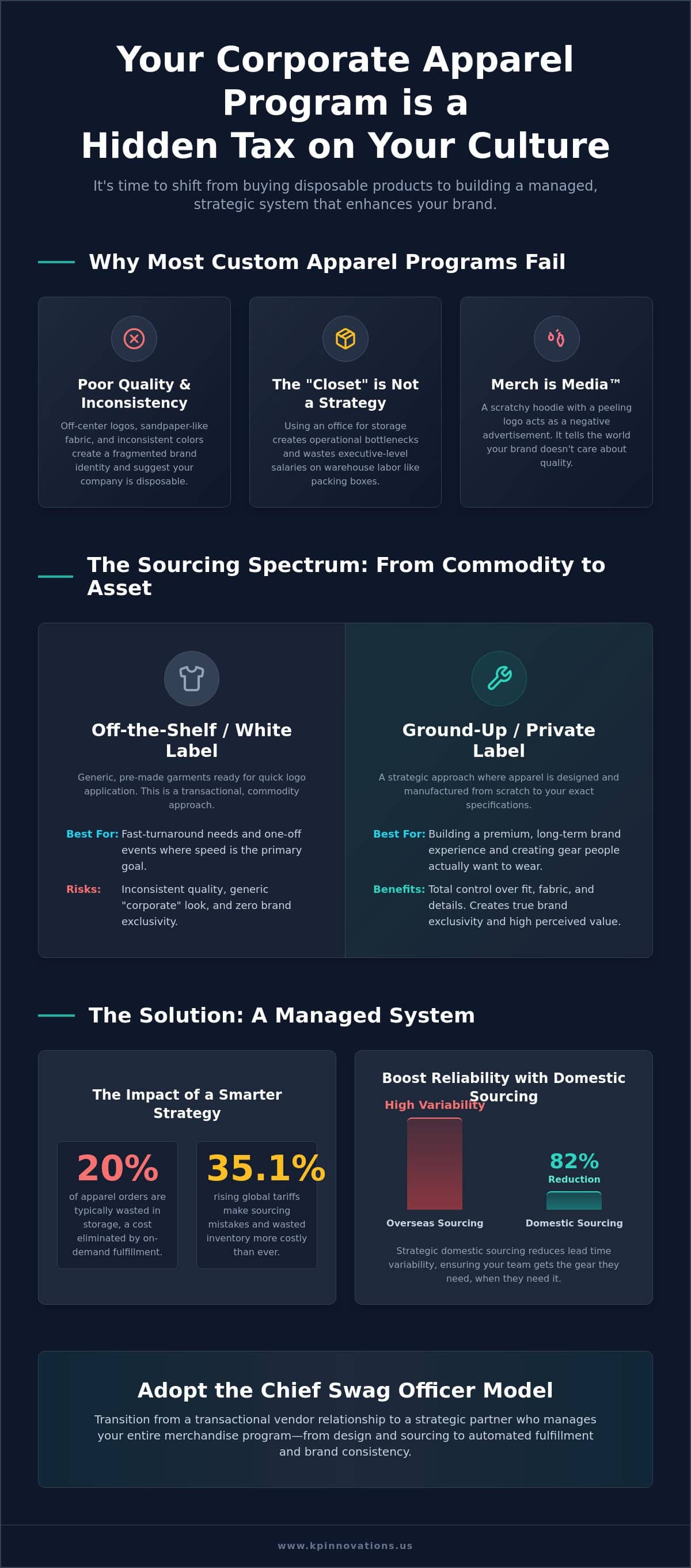
Storing inventory in a spare office isn’t just an eyesore. It’s an operational bottleneck. When your HR or marketing leaders spend their afternoons packing boxes and printing shipping labels, you’re paying executive salaries for warehouse labor. Industry data suggests that 20% of off-the-shelf apparel orders never actually reach an end-user. They get lost, damaged, or forgotten in “the closet.” Transitioning to on-demand fulfillment eliminates this waste. Strategic sourcing also addresses logistical speed. Domestic sourcing can reduce lead time variability by 82% compared to overseas partners, ensuring your team has the gear they need exactly when they need it.
Merch is Media™: The Cost of Poor Impressions
At KP Innovations, we believe that Merch is Media™. Every time an employee wears your branded hoodie, they act as a walking billboard for your company. However, if that hoodie is scratchy, poorly fitted, or features a peeling logo, it becomes a negative advertisement. It suggests your brand is disposable. By investing in high-tier items, you elevate the brand experience and ensure your message is one of quality. With apparel import tariffs hitting 35.1% in late 2025, the financial stakes for sourcing mistakes have never been higher. You can’t afford to buy gear that your employees won’t wear.
Understanding the Sourcing Spectrum: From Off-the-Shelf to Private Label
Choosing how to source custom apparel for business starts with a fundamental question: are you buying a product or building a brand? The answer determines where you fall on the sourcing spectrum. On one end, you have white-label basics. These are off-the-shelf garments ready for quick decoration, ideal for fast-turnaround event needs. On the other, you have full-scale manufacturing. Accessing a catalog of 1.2 million products is a powerful tool, but only if you have a merchandise strategy to filter the noise and find the right fit for your culture.
A sophisticated sourcing strategy treats apparel as an investment. This requires a deep understanding of Revolutionizing The Apparel Supply Chain through data and analytics. By analyzing lead times and tariff impacts, you can decide when to prioritize speed and when to invest in exclusivity. This isn’t just about picking a shirt; it’s about managing a complex global system to ensure your brand remains consistent across every touchpoint.
White Label vs. Private Label Apparel
For most high-growth brands, the transition to private label clothing is a milestone in brand maturity. Private label allows you to control the fit, fabric, and finishing details from the ground up. This exclusivity is vital when you want to avoid the “corporate uniform” look. However, global logistics in 2026 require agility. With US apparel import tariffs reaching 35.1% in late 2025, many leaders are diversifying their manufacturing. While overseas sourcing offers scale, domestic partners can reduce lead time variability by 82%, making them a strategic choice for high-demand programs.
Selecting the Right Fabric and Construction
The technical specs of your apparel dictate its longevity. Move beyond 100% cotton and consider performance blends or sustainable materials like recycled polyester. You should also pay attention to GSM (grams per square meter). A higher GSM often indicates a heavier, more durable fabric that survives the retail-laundry cycle. Decoration methods also play a role in perception. While many assume embroidery is the only premium choice, modern high-density prints or woven patches often provide a more contemporary, retail-ready finish. If you need help navigating these technical choices, a strategic sourcing partner can ensure your selections align with your long-term goals.
Evaluating Manufacturing Partners: Beyond the Price Per Unit
The lowest quote is often the most expensive. When you’re determining how to source custom apparel for business, the evaluation criteria must extend past the initial quote. A standard vendor provides a product; a strategic partner provides a system. This system includes everything from ethical compliance to the logistical agility required in a volatile 2026 market. With China’s share of US apparel imports dropping to 11.3% in late 2025, your partner needs the sourcing expertise to navigate a diversifying global supply chain without sacrificing quality or speed.
Scalability is a primary differentiator between a simple printer and a professional agency. Your partner should possess the infrastructure to manage a 50-person executive retreat with the same precision as a 5,000-person global rebrand. This requires a deep commitment to audit requirements. Ethical sourcing and labor compliance aren’t just buzzwords; they’re essential for protecting your brand equity. If a factory violation occurs, the damage to your reputation far outweighs any savings gained from a cheaper unit price.
The Strategic Agency Model vs. The Distributor
In 2026, high-growth companies are moving away from traditional distributors and toward an “Outsourced Merchandise Department” model. This approach integrates creative development directly into the sourcing process. Instead of just slapping a logo on a pre-made shirt, a strategic agency helps you design apparel that reinforces your brand’s unique identity. This high-touch service manages every detail, significantly reducing executive stress during large-scale rollouts. It’s about having a team that owns the entire lifecycle of the project, from initial concept to final delivery.
Logistics and Global Reach
International shipping and customs represent a major hurdle for modern corporate programs. Whether you’re sending client gifts to London or uniforms to Tokyo, you need a partner with global fulfillment capabilities. Effective warehousing strategies are also vital. Your brand should stay ready for immediate deployment, which means keeping inventory in strategic locations rather than in your office closet. When vetting a potential apparel factory, review their certifications for Corporate Social Responsibility (CSR). Ensuring your partners align with your ESG goals is a critical step in building a sustainable, long-term apparel program.
Designing for Longevity: Creating Apparel That Influences Culture
Designing for longevity means moving away from disposable items and toward pieces that command respect. When you’re determining how to source custom apparel for business, the goal isn’t just to put a logo on a shirt. It’s to create something your team actually wants to wear in their personal lives. A retail-first mindset ensures that your investment doesn’t end up forgotten in a drawer. If your apparel doesn’t meet the same quality standards as the brands your employees buy for themselves, it fails as a media channel.
Strategic branding requires a balance between the “Billboard” effect and subtle sophistication. Large, bold logos are effective for high-visibility events where brand recognition is the primary goal. However, for daily office wear or remote team culture, minimalist branding is the superior choice. Research shows that minimal branding increases the likelihood of apparel being worn more often, which significantly extends your brand’s exposure. This approach turns garments into high-value tools for employee recognition programs, as people take genuine pride in wearing gear that looks and feels premium.
Strategic Logo Placement
Premium apparel often utilizes alternative logo placements to create a more sophisticated look. Instead of the standard left-chest print, consider placements on the sleeve, the bottom hem, or the back neck. These subtle touches signal that the garment was designed with intention rather than just being a mass-produced commodity. It’s also vital to match your decoration method to the technical purpose of the fabric. For example, a heavy embroidery might ruin the drape of a lightweight performance shirt, whereas a soft-hand screen print or a woven patch would maintain its integrity. Retail Quality is the benchmark for corporate apparel in 2026.
Building a Collection, Not a T-Shirt
A successful apparel program feels like a curated collection rather than a random assortment of items. This involves selecting a mix of styles, such as quarter-zips, hoodies, and polos, that serve different roles and environments. Consistency is the foundation of brand trust. You must ensure that your brand colors remain exact across different manufacturing runs and fabric types. A cohesive collection also simplifies your client gifting strategy, allowing you to send high-tier items that align with your internal culture. To ensure your collection meets these rigorous standards, you need a partner who understands the nuances of technical design and manufacturing.
Ready to move beyond basic shirts and build a retail-ready apparel program? Explore our strategic sourcing services to start your project.
The Managed System: Transitioning to a Chief Swag Officer Model
The final stage in mastering how to source custom apparel for business is moving from a collection of vendors to a single, managed system. Most companies fail because they distribute the responsibility of apparel across multiple departments. HR handles new hire kits, marketing handles events, and sales handles client gifts. This fragmentation leads to inconsistent branding and wasted spend. By adopting the Chief Swag Officer model, you appoint a strategic lead who owns the entire lifecycle of your merchandise program, ensuring every piece of apparel reinforces your brand culture.
A managed system allows you to treat your merchandise with the same rigor as any other marketing investment. You shouldn’t just guess which items are popular; you should have data. Transitioning to online company stores provides visibility into inventory levels, popular sizes, and distribution patterns. This data-driven approach ensures your apparel remains a strategic asset rather than a logistical burden. When you measure the impact of your gear, you can justify higher-tier investments that drive real ROI.
Automating Distribution and Fulfillment
- Self-Service Outfitting: Empower employees to choose their own gear through dedicated company stores. This ensures they receive the styles and sizes they actually want to wear.
- HRIS Integration: Automate the onboarding process by connecting your store to your HR platform. New hires can receive a custom welcome kit the moment they sign their offer letter.
- Global Fulfillment: Eliminate the “closet problem” by utilizing professional warehousing. Whether your team is in New York or Singapore, they receive the same high-tier brand experience.
Partnering for Long-Term Brand Growth
In 2026, a sophisticated merchandise strategy is a significant competitive advantage. It’s no longer enough to reactively order shirts for a trade show. You need proactive program management that anticipates your needs and protects your brand equity. A strategic partner doesn’t just wait for your order; they identify trends, manage supply chain risks, and ensure your apparel collection evolves with your brand. This level of support allows your internal teams to focus on their core responsibilities while we handle the complexity of the physical brand experience.
Your brand deserves more than a vendor; it deserves a strategic department dedicated to your growth. Schedule a strategy session with KP Innovations today to build a managed apparel system that drives culture and long-term results.
Elevate Your Brand Through Strategic Apparel
Building your brand’s physical identity requires more than a vendor list; it requires a managed system that treats every garment as a strategic asset. As you look at how to source custom apparel for business in 2026, the distinction between a commodity and a culture-building tool is clear. Your gear is a media channel that influences culture and loyalty every time it’s worn.
At KP Innovations, we offer a design-to-distribution white-glove service that manages the complexity of global fulfillment for enterprise brands. With access to 1.2 million products and specialized expertise in private label apparel, we move your program from reactive ordering to proactive growth. Stop managing the logistical burden of the office closet and start scaling your brand’s impact with a partner who owns the entire process.
Partner with a Chief Swag Officer to build your apparel strategy and transform your merchandise into a powerful engine for brand growth. The future of your brand is physical; let’s make sure it’s built to last.
Frequently Asked Questions
How do I find a reliable custom apparel manufacturer for my business?
Reliable manufacturers are identified by their systems, not just their machines. Look for a strategic partner who offers a managed approach that includes design, ethical sourcing, and global logistics. A reliable partner acts as an outsourced department that manages the entire lifecycle of your merchandise. This ensures that your brand remains consistent and your internal teams are freed from the burden of managing vendors and shipping.
What is the difference between screen printing and embroidery for business apparel?
Screen printing is ideal for large, vibrant designs on lightweight fabrics, while embroidery provides a premium, durable texture for heavier items like outerwear. The decision should align with the garment’s technical purpose. For instance, a performance shirt might benefit from a soft-hand print, whereas a structured jacket requires the resilience of embroidery. Both methods serve as tools to enhance the brand experience and influence culture.
How much should I budget for custom corporate apparel in 2026?
Budgeting in 2026 requires a focus on total ROI rather than unit cost. You must account for external variables like the 35.1% average tariff rate on US apparel imports recorded in late 2025. A strategic budget prioritizes high-tier quality that employees will actually wear. This approach reduces waste and ensures your investment functions as a high-value media channel for your brand rather than a disposable expense.
What is the minimum order quantity (MOQ) for private label clothing?
Minimum order quantities for private label clothing depend on the complexity of the design and the specific manufacturing partner. Custom cut-and-sew projects often require higher volumes to justify the creation of unique patterns and fabric runs. Many domestic partners are adapting to offer lower MOQs for brands prioritizing speed and agility. We help you navigate these requirements to find the right scale for your specific program.
How can I manage custom apparel distribution for a remote team?
Managing distribution for remote teams is best handled through an automated online company store. This system allows employees to self-service their outfitting needs, which eliminates the logistical nightmare of manual shipping. By utilizing a global fulfillment partner, you ensure that every team member receives their gear on time, regardless of their location. This managed approach preserves your brand’s professional image across a distributed workforce.
What are the most popular custom apparel trends for businesses in 2026?
Current trends prioritize minimalist branding and sustainable materials like organic cotton or recycled polyester. Employees in 2026 prefer retail-quality designs that don’t look like standard corporate uniforms. High-return items like structured hats with puff embroidery remain popular. These trends focus on creating apparel that integrates into an employee’s personal wardrobe, effectively turning your merchandise into a vital part of your brand media.
Is it better to source apparel domestically or overseas?
The choice depends on your specific needs for speed versus scale. Domestic sourcing is superior for reliability, as it has been shown to reduce lead time variability by 82% compared to international partners. Overseas manufacturing offers scale for larger programs, despite the complexities of global logistics and fluctuating tariff rates. We help you balance these factors to mitigate risks associated with geopolitical shifts and supply chain disruptions.
Can custom apparel be integrated into an employee recognition program?
Custom apparel is a powerful tool for employee recognition when it’s integrated into a strategic system. High-quality items serve as physical markers of achievement that reinforce company culture. When you understand how to source custom apparel for business with a focus on longevity, you create rewards that employees value and wear with pride. This turns a simple recognition gesture into a lasting, measurable brand impression.