
A points store can make recognition feel fair, or expose inconsistencies in how it works. Managing a points-based employee reward store takes more than filling a catalog. Employees need clear earning rules, relevant choices, and a reliable path from redemption to delivery. When any part breaks down, recognition can feel arbitrary and administration can become a drain.
The challenge is making the program work for both employees and the teams responsible for running it. A well-managed store connects everyday recognition to company values while keeping the rules, budget, sourcing, and fulfillment clear.
This guide explains how to set understandable earning rules, build a catalog employees can connect with, and coordinate the work behind each reward. It also explores why merchandise is more than an item in a store. As “Merch is Media™,” a company’s choices can help shape the employee experience. With a clear strategy and the right operational support, a store can make recognition more consistent without making the program harder to manage.
Key Takeaways
- Start with the behaviors and outcomes you want recognition to reinforce, then make earning rules specific enough for employees and managers to apply consistently.
- Managing a points-based employee reward store means balancing meaningful employee choice with clear budgets, responsibilities, and fulfillment processes.
- Evaluate reward options for usefulness, inclusive appeal, brand fit, sourcing feasibility, and the work required to deliver them.
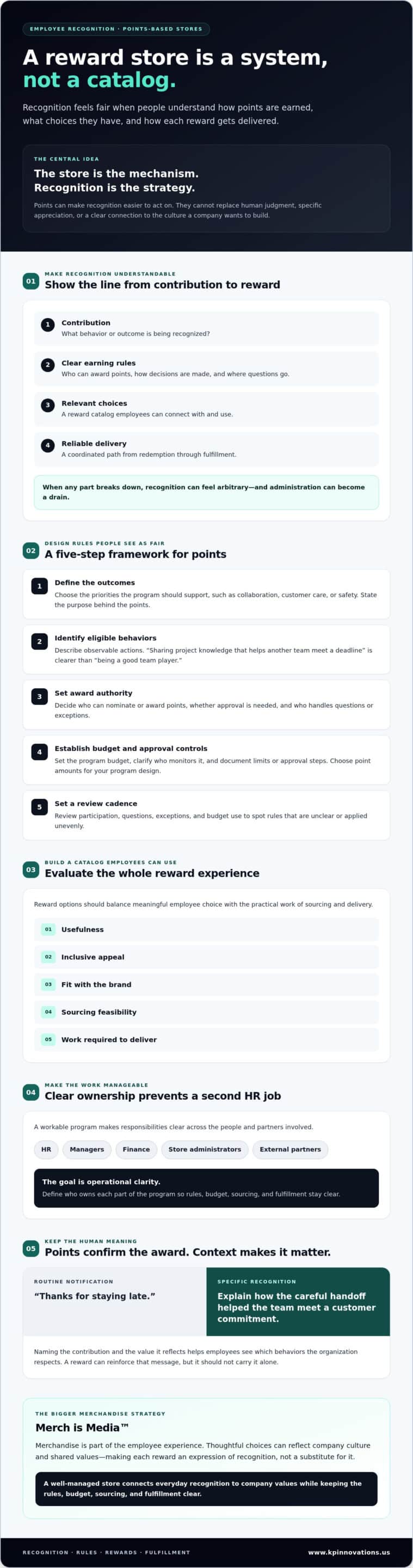
- Define what HR, managers, finance, store administrators, and external partners each own so the program doesn’t become a second HR job.
- Use merchandise with intention: as part of the employee experience, it can reflect company culture and bring the idea that “Merch is Media™” to life.
Managing a Points-Based Employee Reward Store Starts With Better Recognition
A points-based employee reward store is part of a recognition program where employees earn points for defined contributions and redeem them according to program rules. The store is the mechanism, not the strategy. Its value depends on whether recognition is timely, fair, and connected to the employee experience, rather than simply offering a catalog of logo-branded items.
Points administration tracks how recognition is awarded and redeemed; meaningful recognition explains why a contribution matters and connects it to the culture an organization wants to build. That distinction is central to managing a points-based employee reward store well. Points can make recognition easier to act on, but they can’t provide the human judgment and appreciation that give it meaning.
What employees should understand about earning and redeeming points
Employees should be able to follow a clear line from contribution to recognition: what behavior qualifies, how points are awarded, who can approve them, and what choices are available for redemption. Organizations set these criteria and terms. Explain them in plain language so employees don’t have to guess whether a contribution qualifies or how to use earned points.
For example, a program might recognize an employee who shares knowledge that helps a colleague complete a project. Explain why the contribution qualifies and how the award is determined under the program’s rules. That context helps employees understand the purpose of recognition, not just the transaction.
Why points alone don’t create meaningful recognition
An automatic points notification can confirm that an award was made. It can’t replace a thoughtful message from the person who saw the contribution. “Thanks for staying late” is less meaningful than explaining how an employee’s careful handoff helped the team meet a customer commitment. Specificity shows that recognition is connected to real work, not just a routine payout.
That connection matters for company culture. When recognition names the contribution and the value it reflects, employees can see which behaviors the organization respects. A reward can reinforce that message, but it shouldn’t carry it alone. For practical ideas on strengthening appreciation, explore this employee recognition programs overview.
This broader view aligns with Reward management, which considers how financial and non-financial rewards support organizational aims. Merchandise can also shape the experience: a thoughtfully chosen reward may reflect shared values and relationships. That’s the idea behind “Merch is Media™.” The item is a way to express recognition, not a substitute for it.
How to Design Points Rules Employees See as Fair
Fairness starts before the first points are awarded. Employees need to understand what the program is meant to reinforce, which contributions qualify, and how decisions are made. A clear framework helps managers apply the rules consistently and gives the organization a way to review whether the program reflects its priorities.
Use this sequence to shape the rules:
- 1. Define the outcomes. Choose the organizational priorities the program should support, such as collaboration, customer care, or safety. State the purpose so points don’t become a reward for activity without context.
- 2. Identify eligible behaviors. Describe observable actions that demonstrate those priorities. “Being a good team player” is open to interpretation; “sharing project knowledge that helps another team meet a deadline” is more specific. Include milestones or peer support only when they fit company policy.
- 3. Set award authority. Decide who can nominate or award points, whether approval is required, and who handles questions or exceptions. Make the process workable across teams, not just clear on paper.
- 4. Establish budget and approval controls. Set the program’s budget, clarify who monitors it, and document any limits or approval steps. Choose point amounts based on your program design rather than assuming one value fits every organization.
- 5. Set a review cadence. Decide when program owners will review participation, questions, exceptions, and budget use. Use each review to identify rules that are unclear or applied unevenly.
Which behaviors and milestones should earn points?
Start with stated priorities, then define examples employees and managers can recognize in day-to-day work. A service milestone might qualify if the organization’s policy includes it; peer support might qualify when it advances a defined collaboration goal. Not every meaningful contribution needs points. Some moments call for a direct thank-you, a thoughtful conversation, or another form of appreciation that fits better.
How can leaders keep point awards consistent?
Before launch, document who can award points, who reviews exceptions, how employees can ask questions, and how point adjustments are approved and recorded. Share the rules in plain language. Guidance on how to design an employee points reward system can provide another perspective, but the final criteria should reflect your organization’s goals and policies.
Then review participation patterns across teams and employee groups. Differences don’t prove unfairness, but they can prompt useful questions: Are some managers using the program less? Do the criteria fit different roles? Is recognition reaching only highly visible work? The answers can guide adjustments and make managing a points-based employee reward store more accountable.
Once the rules are settled, plan merchandise sourcing around approved choices and the experience you want the program to create. Explore strategic merchandise sourcing support as one part of that operational planning.
Build a Reward Store Catalog Employees Can Actually Use
A large catalog can still feel limited if its choices don’t fit employees’ lives. Catalog relevance depends on employee needs, not catalog size alone. Aim for useful, inclusive options that employees can access and that the organization can source and fulfill reliably.
Consider each reward category for both employee value and the work required to deliver it:
- Merchandise can make recognition tangible and reflect company culture, but one item won’t appeal equally to everyone. Consider usefulness, sizing or style preferences where relevant, brand fit, sourcing, and delivery requirements.
- Experiences can offer personal choice, but participation may depend on location, scheduling, accessibility, or other practical details. Confirm how employees can access and redeem each option.
- Gift cards offer flexibility, though they may feel less connected to the organization’s culture. Check the available choices and redemption terms for the specific program.
- Other options, such as charitable giving or learning opportunities, may suit particular employee interests or company priorities. Confirm eligibility, administration, and how each option will work before adding it.
These categories aren’t interchangeable. Compare them based on employee usefulness, inclusive appeal, brand fit, sourcing feasibility, and fulfillment needs. Confirm availability, shipping details, and redemption terms for each program rather than assuming they’ll be the same across suppliers or locations.
Choose categories around real employee needs
Use employee feedback and workforce context to guide the mix. A distributed team may need choices that are practical to access across locations, while employees in different roles may value different kinds of recognition. Ask what employees would use, not just what looks compelling in a catalog. Don’t treat one merchandise item as a universal favorite.
Keep the catalog current without adding noise
Set a regular review cadence to check relevance, availability, employee feedback, and fulfillment requirements. Assign an owner to approve new merchandise and decide what happens when an option becomes unavailable, including whether to replace or remove it. Clear ownership prevents outdated choices from lingering and keeps the store manageable.
An online company store can organize pre-approved branded merchandise and apparel, but it doesn’t replace the decisions about what belongs in a recognition catalog. See the company store services overview for information about store operations. When managing a points-based employee reward store, make the catalog express a considered employee experience, not just display products. That’s one way merchandise can function as media, carrying company values into a moment of recognition.
Manage the Store Without Creating a Second HR Job
A reward store needs more than someone to keep the catalog updated. It needs clear ownership of recognition decisions, budget oversight, employee communication, order handling, and issue resolution. Without that structure, HR can become the default contact for every question, even when another team owns the answer.
Assign responsibilities before launch. HR can own recognition policy and employee guidance; managers can submit or approve awards under the rules; finance can monitor budget controls; and communications can explain how the program works. Store administration can coordinate catalog updates and employee questions, while sourcing and fulfillment owners manage merchandise availability, order handling, delivery updates, and exceptions. One person may hold several roles, but every task needs a named owner.
Build a workflow employees can follow
Map the full journey from award to delivery: approval, point-account update, redemption, order handling, and issue resolution. Decide who confirms an award, who answers questions about points, who manages catalog changes, and who communicates about fulfillment. If an order is delayed or an item is unavailable, employees should know where to turn and what update to expect.
Don’t assume the reward platform handles every step. Confirm its actual features and any integrations before building them into the process. A merchandise partner can support sourcing and fulfillment, but shouldn’t be presented as the owner of HR policy or points software. For context on how employee merchandise programs fit into a broader operation, see the employee programs overview.
Review program health, not just activity
Set measures that make sense for your organization. Participation and redemption patterns can show whether employees are using the program and which choices they select. Pair those signals with employee feedback and operational issues. A low redemption rate, for example, is a prompt to investigate, not proof of a single cause. Rules may be unclear, the catalog may not feel relevant, or employees may be waiting on unresolved orders.
Use regular reviews to decide what needs attention: clearer communication, catalog changes, better-defined ownership, or a more reliable way to resolve fulfillment questions. Compare patterns across teams and roles, and ask what might explain differences before drawing conclusions. This keeps adjustments grounded in employee experience rather than assumptions.
Managing a points-based employee reward store becomes more sustainable when HR retains ownership of recognition policy and operational work has clear accountability. If merchandise sourcing is part of the workload, explore strategic merchandise sourcing support to clarify that part of the process.
Make the Reward Store Part of a Bigger Merchandise Strategy
A reward store works best when it connects recognition goals to the choices employees receive and the operations behind each redemption. Start with the outcomes you want to reinforce. Translate them into clear rules, build a catalog around employee needs, assign owners for sourcing and fulfillment, then use feedback and operational issues to guide adjustments.
That’s more than catalog management. Merchandise is part of the brand experience. A useful, thoughtfully selected reward can express what the organization values and help strengthen relationships at work. Merch is Media™: what a company chooses to put into an employee’s hands can carry meaning beyond the item itself.
When does an organization need a strategic merchandise partner?
Consider outside support if merchandise decisions are scattered across teams, sourcing work keeps recurring, or order handling and delivery questions are difficult to coordinate. A partner can help connect merchandise strategy, creative, sourcing, and fulfillment while the organization retains ownership of recognition policy and reward rules.
KP Innovations provides promotional products, private label apparel, company and team stores, and fulfillment and logistics services. Its white-glove project management can support merchandise projects from design through global fulfillment, while your organization keeps ownership of recognition policy and points rules.
What should a first conversation about sourcing cover?
Bring the program’s goals, the employee audiences it serves, the current process, and the friction points you’ve identified. Talk through the kinds of catalog choices employees need, how creative should reflect the organization, and who will own sourcing, order handling, fulfillment updates, and issue resolution. Clear boundaries matter too: reward rules and points software remain with the organization unless separately arranged.
The conversation should clarify responsibilities, not assume every challenge calls for a new platform or more products. It can establish where an external partner may support the merchandise side of the program and where internal teams should remain accountable. That division helps protect employee experience while keeping program ownership clear.
Managing a points-based employee reward store is a continuous practice: align recognition goals, rules, catalog, and operations, then use employee feedback and program experience to refine them. If your employee program needs a more deliberate approach to merchandise sourcing, discuss strategic sourcing for your employee program.
Make Recognition a More Thoughtful Employee Experience
A reward store is strongest when its rules feel fair, its choices reflect employee needs, and its operations have clear owners. Managing a points-based employee reward store isn’t just a matter of maintaining a catalog. It’s an opportunity to connect recognition to the behaviors and values an organization wants to reinforce.
Merchandise can help carry that message into the employee experience. “Merch is Media™” means treating each choice as a point of connection, not simply an item to redeem. A strategic partner can support the merchandise side, from creative and sourcing to fulfillment, while your organization retains ownership of reward policy and software.
KP Innovations offers access to over 1.2 million products and white-glove project management from design through global fulfillment. If your program needs a more coordinated approach to merchandise, discuss strategic sourcing for your employee reward program.
With clear ownership and thoughtful choices, recognition can become a more consistent and meaningful part of how your people experience the brand.
Frequently Asked Questions
What is a points-based employee reward store?
A points-based employee reward store is part of a recognition program where employees earn points for contributions defined by their organization and redeem them for available rewards. The organization sets eligible behaviors, approval rules, point values, and redemption terms. The store handles the choice and redemption side, but points alone don’t make recognition meaningful. A thoughtful message that explains why a contribution matters remains an essential part of the experience.
How do you manage a points-based employee reward store?
Managing a points-based employee reward store starts with clear rules and assigned owners. Define the program’s goals, eligible contributions, award approvals, budget oversight, catalog review, and fulfillment responsibilities. Explain the process in plain language so employees know how points are earned and used. Then review participation, redemptions, feedback, and operational issues to identify where communication, reward choices, or ownership may need adjustment.
How do you decide how many points employees should receive?
Set point values according to your program’s priorities, budget, and the relative significance of eligible contributions. There’s no universal point scale that fits every organization. Define a consistent approach for comparable actions, document who can approve awards or exceptions, and make the rationale understandable to employees. For example, if peer support qualifies, clarify what kind of support counts and apply the same criteria across teams.
What rewards should an employee points store offer?
Offer choices that employees can use and that your organization can source and deliver reliably. Depending on program goals and employee feedback, the catalog might include merchandise, experiences, gift cards, or other options. Assess each for usefulness, inclusive appeal, brand fit, accessibility, redemption terms, and fulfillment needs. Don’t assume one item works for everyone. A considered range of relevant options is more useful than a large catalog employees struggle to navigate.
How do you keep an employee reward catalog from becoming outdated?
Assign an owner and set a regular schedule to review the catalog for relevance, availability, employee feedback, and fulfillment concerns. Create a clear process for approving new choices and removing or replacing unavailable options. Review redemption patterns alongside employee comments; low interest can be a signal to investigate whether choices feel relevant or are practical to access. Confirm availability and redemption details before communicating catalog changes.
Can a points-based reward store replace employee recognition?
No. A reward store can support recognition by giving employees a tangible way to redeem points, but it can’t replace specific appreciation from a manager or colleague. A meaningful message names the contribution and explains how it reflects company priorities or values. Use points as one part of the experience, not as a substitute for human acknowledgment. Some contributions may be better recognized through a conversation or a direct thank-you.
How can a company manage reward-store fulfillment?
Map responsibility for order handling, employee updates, delivery questions, and issue resolution before the store launches. Confirm what the selected platform or provider actually supports instead of assuming it automates each step. A merchandise partner can support sourcing and fulfillment without owning recognition policy or points software. KP Innovations provides fulfillment and logistics services, including white-glove project management from design through global fulfillment.