
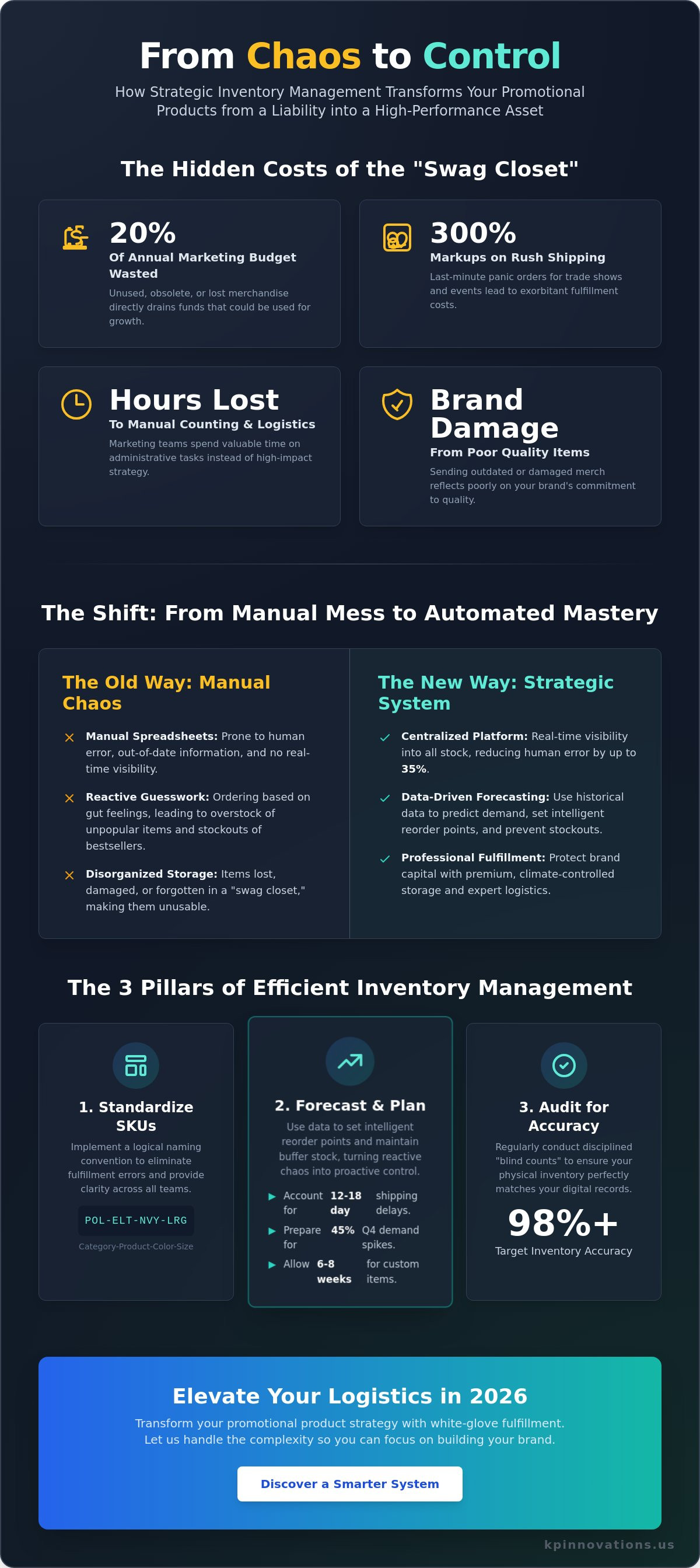
Your storage closet isn’t just full of boxes; it’s a graveyard for 20% of your annual marketing budget. When you’re digging through unorganized bins or paying 300% markups for 48-hour rush shipping, your merchandise becomes a liability rather than a strategic asset. Most brand managers agree that the panic of trade show prep usually stems from a total lack of visibility into their current stock. Effectively managing promotional product inventory shouldn’t feel like a second job, yet many teams lose hours every month to manual counting and logistics fires.
You deserve a system that works as hard as your brand does. We’ll show you how to transform your storage into a streamlined, high-performance engine that delivers clear ROI reporting and automated reordering. This guide outlines the exact strategies elite brands use to achieve hands-off logistics and premium fulfillment by 2026. You’ll discover how to eliminate aging stock and ensure your best items are always ready for the next big opportunity.
Key Takeaways
- Shift your perspective from disorganized storage to strategic asset management by adopting a data-driven approach to your branded merchandise.
- Establish a foundation for scale by implementing standardized SKU systems and centralized tracking platforms that replace inefficient manual spreadsheets.
- Optimize your marketing budget and prevent stockouts by managing promotional product inventory through precise seasonal forecasting and historical data analysis.
- Analyze the hidden labor and opportunity costs of internal fulfillment to determine if your brand is ready for a professional, third-party distribution model.
- Discover how a white-glove logistics partnership can transform your warehousing and kitting into a premium experience that reflects your brand’s elite standards.
Why Promotional Product Inventory Management is a Strategic Business Necessity
Managing promotional product inventory is the strategic control of your branded assets throughout their entire lifecycle. It’s the difference between a box of wrinkled shirts in a hallway and a sophisticated fulfillment system that delivers your message exactly when it matters most. For years, companies relied on “swag closets” where items were forgotten or lost. That era ended when global supply chains became volatile. In 2026, your merch is no longer just a giveaway; it’s a critical component of your marketing infrastructure.
Moving to data-backed inventory systems allows your brand to stay agile. When you don’t track your assets, you invite hidden costs. Obsolescence claims a significant portion of unmanaged stock, while last-minute rush shipping for a trade show can triple your per-unit cost. Effective oversight integrates the Core Pillars of Efficient Inventory Tracking to maintain a lean, responsive supply chain. This professional approach ensures your brand remains consistent across every department and location.
Inventory as Brand Capital
Every SKU in your warehouse represents a touchpoint for your brand identity. If a client receives a damaged or outdated item, the “premium” image you’ve built vanishes instantly. At KP Innovations, we maintain a “Premium Baseline” where high-quality storage and climate-controlled environments preserve the integrity of every garment and gadget. We don’t just store products; we protect your reputation. Inventory Velocity is the speed at which merch reaches recipients.
The ROI of Real-Time Visibility
Knowing your exact stock levels prevents “promotional chaos” and the panic buying that often happens 48 hours before a major product launch. When you have total visibility, you can optimize your marketing budget by only ordering what moves. This data-driven approach is the first step toward choosing the right apparel factory for your next collection. If you know your burn rate for specific items, you can negotiate better production slots and avoid the 15% to 20% price premiums associated with emergency restocking. Real-time visibility turns your inventory from a liability into a powerful tool for brand elevation.
Core Pillars of Efficient Inventory Tracking and Organization
Managing promotional product inventory requires more than a simple headcount. Successful brands treat their merch like high-value assets. Moving away from manual spreadsheets is the first step toward a professionalized supply chain. A centralized tracking platform provides real-time visibility, reducing the risk of human error by 35% compared to legacy tracking methods. This digital transition allows marketing teams to focus on strategy rather than counting boxes.
Standardizing Your Branded SKUs
Consistency starts with a logical naming convention. Use a “Category-Product-Color-Size” format for every item. For example, a navy polo in size large becomes POL-ELT-NVY-LRG. This precision is vital for understanding what are promotional products in a strategic context. Clear SKUs prevent fulfillment errors during high-pressure events. Label apparel with scannable barcodes on individual polybags; hard goods like premium drinkware should feature labels on the outer carton to streamline bulk scanning.
Setting Intelligent Reorder Points
Smart inventory management relies on data, not guesswork. By 2026, global shipping fluctuations are expected to increase lead times by an average of 12 to 18 days. You must calculate “Buffer Stock” to survive these gaps. Use a standard safety stock formula: multiply your maximum daily usage by your maximum lead time, then subtract the product of your average daily usage and average lead time. For custom private-label items, account for a 6-week production window plus a 2-week quality control buffer. This proactive approach prevents stockouts during peak Q4 event seasons when demand typically spikes by 45%.
Maintaining accuracy requires a disciplined audit schedule. Adopting a methodology for Efficient Inventory Tracking and Organization ensures physical stock counts match digital records with at least 98% accuracy. Conduct “blind counts” monthly where staff record quantities without seeing the expected system totals. This level of detail is what separates average vendors from elite brand partners. If your current system feels chaotic, you can partner with a dedicated account manager to professionalize your logistics and fulfillment process from the thread up.
Mitigating Demand Challenges: Forecasting and Seasonal Planning
Strategic inventory control transforms promotional products from mere giveaways into powerful marketing assets. To succeed in 2026, brands must transition from reactive ordering to proactive forecasting. This process begins with a deep dive into 2025 order history to pinpoint recurring annual peaks. Data from the 2025 fiscal year indicates that Q4 gifting cycles often require 40% more storage capacity than Q2. By managing promotional product inventory through a data-first lens, you eliminate the stress of last-minute rushes and ensure your brand remains front and center when it matters most.
Data-Driven Demand Forecasting
Your 2025 performance data serves as the blueprint for 2026 success. We analyze ‘Burn Rates,’ which represent the speed at which specific SKUs are depleted each month, to adjust quarterly procurement strategies. If a premium tech kit has a burn rate of 50 units per month, maintaining a 90 day buffer ensures you never miss a client touchpoint. Demand smoothing is the strategic practice of leveling out inventory fluctuations by scheduling production during off-peak periods. This approach prevents ‘Promotional Chaos,’ a state where sudden demand spikes lead to high expedited shipping costs and stockouts. Professional managing promotional product inventory requires this level of precision to maintain an elite brand image.
Managing Seasonal Swings
Seasonal planning requires a long-term horizon. For major industry trade shows occurring in June 2026, procurement should begin 6 to 9 months in advance. This lead time allows for fully custom, private-label apparel creation that standard vendors cannot match. To manage the influx of holiday corporate gifting without overwhelming your storage facility, we implement staggered shipping schedules. Coordination between your sales and HR departments is vital; a sudden hiring wave of 50 new employees in March 2026 can disrupt stock levels if not forecasted in January.
- Trade Show Readiness: Lock in designs by January 15, 2026, for summer events to secure better manufacturing rates.
- Holiday Logistics: Utilize kitting services in October to avoid the December shipping bottleneck.
- Tech-Sensitive Items: Use ‘just-in-time’ delivery for items with lithium batteries or fast-evolving specs to ensure product freshness.
Addressing ‘Dead Stock’ is equally vital for a lean operation. We identify low-velocity items that haven’t moved in 180 days and implement liquidation strategies. This might include using them as ‘surprise and delight’ additions to standard orders or as internal employee rewards. Clearing these items by the end of Q3 2026 frees up capital and shelf space for high-impact, elite merchandise that drives genuine ROI. We don’t just store products; we manage a strategic pipeline that supports your growth.
DIY vs. Managed Fulfillment: Choosing the Right Model for Your Brand
Many brands start by tucking boxes into a spare room or a corner of the marketing department. This “office closet” model feels cost-effective initially, but it’s often the most expensive way of managing promotional product inventory. When your high-value marketing team spends four hours kitting gift boxes instead of developing strategy, your brand loses momentum and revenue.
The True Cost of Internal Management
Internal fulfillment hides significant drains on your bottom line. Commercial real estate in major business hubs now averages $35 per square foot. Dedicating 200 square feet to disorganized boxes represents a $7,000 annual hidden tax on your operations. Beyond the floor space, the labor cost is staggering. The average marketing manager earns roughly $40 to $60 per hour; using that talent for packing tape and shipping labels is a poor allocation of resources.
- Shipping Errors: Non-logistics staff have error rates 15% higher than professional fulfillment centers. A single mislabeled package to a VIP client can cost hundreds in shipping fees and thousands in lost goodwill.
- Last-Resort Ordering: Without real-time visibility, teams often realize they’re out of stock 48 hours before an event. This leads to rush production fees that can increase unit costs by 50% or more.
- Brand Inconsistency: DIY kitting often lacks the “white-glove” touch. Inconsistent folding or messy packing materials can make a premium product look cheap.
Scaling with Online Company Stores
Professional fulfillment bridges the technology gap between manual spreadsheets and automated growth. While manual tracking fails once a brand exceeds 50 unique SKUs, an integrated ERP system provides 100% accuracy on stock levels. This is where managing promotional product inventory moves from a chore to a competitive advantage. Managed online stores allow your global team to order what they need, when they need it, without bothering an administrator.
A digital storefront automates the entire pull-and-ship process. Data from 2024 shows that 75% of B2B buyers now prefer digital self-service over manual order forms. By integrating your inventory directly with corporate procurement platforms, you eliminate the friction of internal approvals. This transition is the logical conclusion for high-growth brands that want to protect their image. Professional kitting ensures every box arrives as a curated brand experience, not just a shipment of goods.
Ready to move beyond the office closet and elevate your brand’s logistics? Partner with KP Innovations for elite fulfillment services that turn your merch into a strategic asset.
Elevating Your Logistics with KP Innovations’ White-Glove Fulfillment
Managing promotional product inventory effectively requires more than just a shelf in a warehouse. It demands a sophisticated logistics partner that understands the nuances of brand equity. At KP Innovations, we’ve established a “Premium Baseline” for every stage of the fulfillment process. This means our quality control standards exceed industry norms, ensuring that every item leaving our facility is a perfect representation of your company. We provide the infrastructure for global distribution while maintaining the personal touch of a boutique agency.
Our facility integrates custom apparel production directly with immediate fulfillment. This eliminates the lag time found with traditional vendors who source from third parties. When you partner with us, you’re not just hiring a shipping company; you’re gaining a strategic ally that treats your inventory like a high-value asset. We manage the complexities of SKU tracking and stock replenishment so you can focus on high-level marketing goals. Our 6-step process ensures that every project, whether it involves 50 units or 50,000, receives the same white-glove attention.
End-to-End Brand Support
We provide a seamless transition from “Thread Up” apparel design to doorstep delivery. Unlike competitors who source generic blanks, we build fully custom, private-label apparel that sets your brand apart. Our kitting services are designed for maximum impact. Whether you’re welcoming 100 new employees or sending a curated gift to an elite client, our team handles the assembly with precision. We specialize in global fulfillment, maintaining total brand consistency across international borders. Your team in London receives the same high-quality experience as your headquarters in New York, with zero deviation in quality.
Your Strategic Partner in Growth
KP Innovations is where merch becomes marketing. We move beyond simple logo application to manage your entire brand experience. Every client works with a dedicated account manager who acts as a single point of contact for project-based logistics. This eliminates communication gaps and ensures that 100% of your specific requirements are met. We use data-driven reporting to show you exactly how your inventory is performing. These insights are vital for your next marketing strategy session, helping you decide which items to retire and which to scale based on real-world demand. If you’re ready to stop worrying about managing promotional product inventory and start focusing on growth, Book a Discovery Call for a custom logistics audit.
Master Your Brand Logistics for 2026
Success in the coming year hinges on moving beyond basic storage toward a sophisticated, data-driven strategy. Effective brands prioritize core pillars like precise tracking and seasonal forecasting to navigate demand shifts without missing a beat. By choosing a managed fulfillment model, you eliminate the friction of DIY logistics and ensure your premium merchandise is always ready for delivery. Successfully managing promotional product inventory means your merch isn’t just sitting in a warehouse; it’s actively working to build your brand equity.
KP Innovations offers the elite infrastructure and white-glove project management required to execute these complex operations from our Horsham, PA facility. We provide access to over 1.2 million strategic products, giving you the variety and quality needed to stand out. It’s the reason Fortune 500 companies and luxury brands rely on us to handle their most critical campaigns. We’re ready to help you transition from a simple vendor relationship to a true strategic partnership.
Ready to elevate your brand logistics? Start a project with KP Innovations today.
Your brand deserves a logistics partner that cares about the details as much as you do. Let’s build something exceptional together.
Frequently Asked Questions
What is the best way to track promotional product inventory for a remote team?
The most effective method is utilizing a centralized, cloud-based inventory management platform that provides real-time visibility across all locations. A 2024 industry report indicates that 68% of distributed teams now use digital portals to reduce shipping errors and ensure brand consistency. These systems allow your team to order branded assets from any location while you maintain total control over stock levels and budget allocations.
How do I calculate reorder points for custom apparel with long lead times?
You should use the standard formula: (Average Daily Usage x Lead Time in Days) + Safety Stock. Because premium custom apparel often requires a 30 to 45 day production window, your safety stock should cover at least 14 days of unexpected demand. If your team uses 15 shirts per week and the lead time is 30 days, you must trigger a reorder when your stock hits 85 units.
What should I do with outdated or ‘dead’ promotional stock?
You can liquidate obsolete inventory through employee incentive programs, donation to 501(c)(3) nonprofits, or textile recycling initiatives. Statistics show that roughly 15% of annual promotional stock becomes outdated due to rebranding or event cancellations. Donating these items provides a tax benefit and supports your corporate social responsibility goals while clearing valuable warehouse space for high-performing SKUs.
Is it cheaper to manage swag inventory in-house or outsource to a fulfillment partner?
Outsourcing is typically more cost-effective for organizations shipping more than 50 individual orders per month. Third-party logistics providers reduce overhead by up to 20% through negotiated bulk shipping rates and shared warehouse labor costs. Managing promotional product inventory through a partner also eliminates the need for you to lease expensive square footage or manage seasonal staffing fluctuations.
How can I integrate my promotional inventory with my existing ERP system?
You can achieve seamless integration by using API-driven connections or specialized middleware that syncs your inventory data with platforms like SAP, Oracle, or Microsoft Dynamics. This automation reduces manual data entry errors by 40% according to recent logistics benchmarks. It ensures that your marketing spend is reflected accurately in your financial reporting and provides a single source of truth for your procurement team.
What are the common mistakes in promotional product inventory management?
The most frequent errors include over-ordering without historical data and failing to perform quarterly physical audits. Research shows that 30% of businesses lose ROI by holding excess stock for longer than 12 months, which leads to product degradation. Another mistake is ignoring the hidden costs of storage and handling, which can quietly inflate your marketing budget if not monitored closely.
How does inventory management impact the ROI of my marketing campaigns?
Strategic inventory management boosts ROI by eliminating rush shipping fees and ensuring your best-performing assets are available for critical sales opportunities. Companies with optimized stock levels see a 12% increase in overall campaign efficiency. You avoid the 25% budget drain often caused by last-minute production premiums, allowing you to reallocate those funds into higher-quality, premium items that leave a lasting impression.
Can I use an online store to manage employee uniform distribution?
Yes, a dedicated company store is the elite solution for managing uniform distribution across multiple departments or locations. This method reduces size-related return rates by 18% compared to manual spreadsheet tracking. You can set specific credit limits or annual refresh cycles for each employee, ensuring everyone stays on-brand without the administrative headache of manual order collection and distribution.