
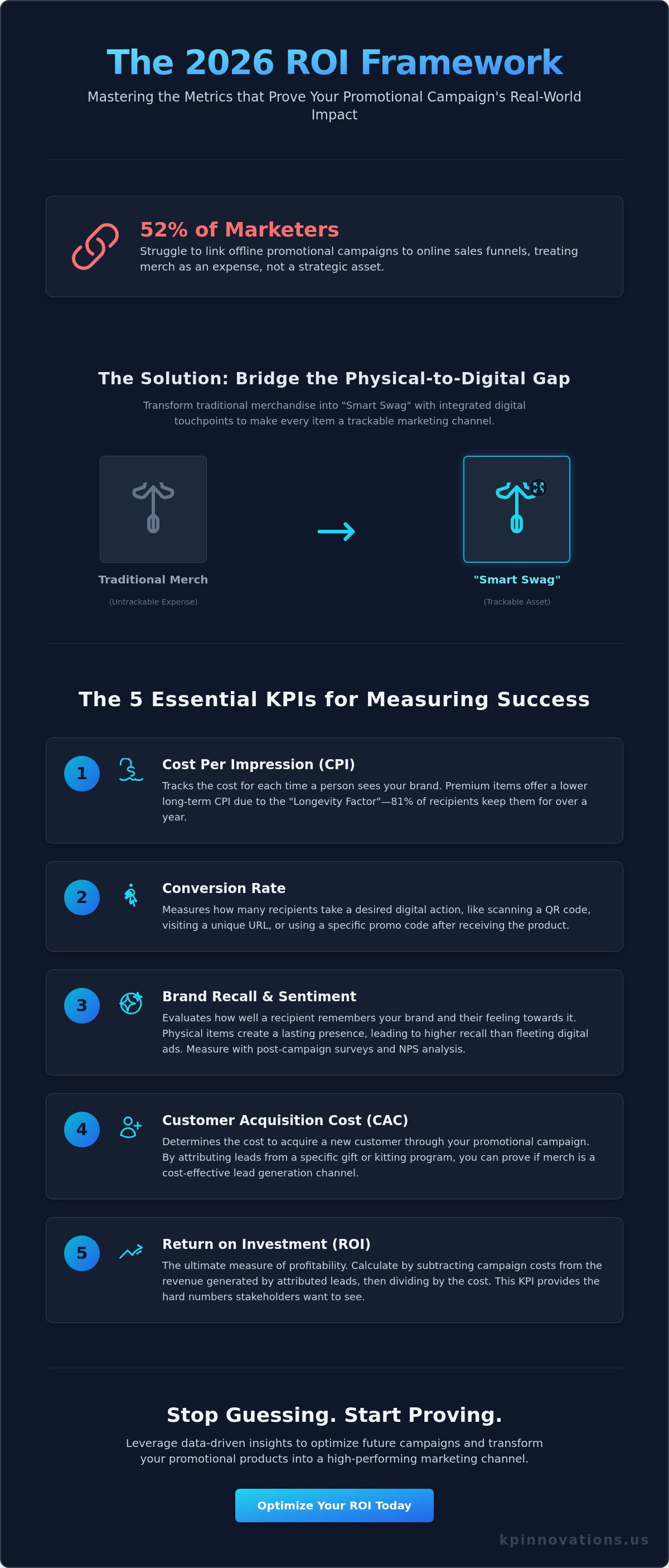
A promotional product that cannot be tracked is simply a line item expense; it isn’t a strategic asset. You likely already know that premium apparel and elite goods can elevate a brand. However, you still face the hurdle of measuring promotional campaign success when communicating with a board of directors that primarily speaks in digital conversion rates. It’s a common pain point. In fact, a 2023 industry report found that 52% of marketers struggle to link offline activations to online sales funnels. You want your merch to work harder, and you’re right to demand more than just a logo on a shirt.
This guide introduces the 2026 ROI Framework. It’s a sophisticated system designed to help you master the metrics that prove your brand’s real-world impact. We’ll show you how to move beyond the perception of “cheap giveaways” and start treating every item as a strategic touchpoint that delivers hard numbers. You’ll gain a clear list of KPIs, practical methods for tracking offline engagement through integrated tech, and a professional framework to present these results to your stakeholders. It’s time to stop guessing and start proving how your brand’s physical presence drives your bottom line.
Key Takeaways
- Learn how to align your promotional objectives with the marketing funnel to ensure every premium item serves a strategic business purpose.
- Master the five essential KPIs for measuring promotional campaign success, from calculating Cost Per Impression to tracking digital conversion rates.
- Discover how to bridge the physical-to-digital gap by transforming traditional merchandise into “Smart Swag” with integrated digital touchpoints.
- Understand how to quantify brand sentiment and longevity by using post-campaign surveys and Net Promoter Score (NPS) analysis.
- Gain the expertise to optimize future ROI by leveraging data-driven insights and selecting a premium apparel factory that prioritizes quality.
Defining Success: Setting Strategic Objectives for 2026
Success isn’t an accident. It’s the result of rigorous planning that begins long before a single SKU is selected. Before choosing a product, you must define the “Why.” High-level marketing effectiveness relies on aligning every physical touchpoint with a broader business goal. In 2026, measuring promotional campaign success requires looking beyond simple distribution. It requires a deep dive into how a physical asset moves a prospect through the funnel.
Tactical distribution is about volume. Strategic brand elevation is about impact. We define success as a measurable increase in brand equity or conversion rates. If a premium jacket sits in a closet, it’s a gift. If it generates three referrals from a high-value account, it’s a strategic asset. Your promotional strategy must mirror the three stages of the marketing funnel to ensure your budget isn’t just spent, but invested.
The Awareness vs. Conversion Debate
Top-of-funnel goals focus on reach. We track impressions and brand recall through wide-scale distribution at events or trade shows. For high-value prospects at the bottom of the funnel, we pivot to transactional goals like closed-won deals. Strategic promotional intent is the alignment of product choice with specific buyer journey stages. We don’t send a basic plastic pen to a C-suite executive expecting a million-dollar contract. Instead, we use elite, private-label apparel to solidify a relationship that’s already in the consideration phase.
SMART Goals for Branded Merchandise
Specific goals move the needle. Don’t just aim to “get your name out.” Set a target like “generating 500 demo requests” through a targeted kitting campaign. Measurable success requires identifying your data sources before the first box ships. This might include:
- Custom QR codes tied to specific landing pages
- Unique promo codes for attribution in your CRM
- Direct mail tracking for high-value “white glove” deliveries
Time-bound objectives are also critical. Measuring promotional campaign success is impossible without a defined window. Set a 180-day period to track the long-tail impact of high-quality items. Premium goods often stay on a client’s desk for years, providing a persistent brand presence that digital ads can’t match. By 2026, the brands that win will be those that treat their merch as a sophisticated marketing channel rather than an afterthought.
The 5 Essential KPIs for Measuring Promotional Campaign Success
Measuring promotional campaign success requires moving beyond vanity metrics like the number of items distributed. You need concrete data to justify marketing spend and prove the value of physical brand assets. According to Harvard Business School Online, identifying Essential Marketing KPIs allows teams to align their physical tactics with overarching business goals. By focusing on specific, measurable indicators, you transform simple merch into a high-performing marketing channel.
- Cost Per Impression (CPI): This metric tracks the cost of each time a person sees your brand. High-quality items offer a lower CPI over time because they stay in use longer.
- Conversion Rate: This measures how many recipients took a digital action, such as scanning a QR code or visiting a specific URL after receiving a product.
- Brand Recall: This psychological metric evaluates how well a recipient remembers your brand. Physical items often result in higher recall than digital banner ads.
- Customer Acquisition Cost (CAC): By tracking leads generated from a specific gift or kit, you can determine if your promo strategy is a cost-effective lead generation channel.
- Return on Investment (ROI): The final formula for profitability. You calculate this by subtracting the campaign cost from the total revenue generated by those leads, then dividing by the campaign cost.
Calculating Cost Per Impression (CPI)
Calculating the long-term value of high-quality items requires looking past the initial invoice. Premium custom apparel and elite hard goods have a significantly lower CPI than digital ads because of the “Longevity Factor.” A 2024 PPAI Consumer Study found that 81% of people keep promotional products for more than a year. If you distribute a $0.50 plastic pen that breaks in two days, your CPI is high because the impressions stop immediately. A $20 vacuum-insulated tumbler that stays on a client’s desk for 12 months generates thousands of impressions, driving the cost per view down to fractions of a cent. High-quality items build a lasting presence that digital algorithms can’t replicate.
Tracking Conversion and Lead Attribution
Direct response metrics bring digital precision to physical products. Using unique promo codes or dedicated landing pages allows you to see exactly which recipients engaged with your brand. Physical touchpoints often play a vital role in multi-touch attribution. A premium gift can warm up a cold lead, making them 30% more likely to respond to a follow-up email. This creates a “Halo Effect” where your other marketing channels see improved performance during a campaign. These five indicators provide the clarity needed for measuring promotional campaign success in a competitive 2026 market. To ensure your next project is built for results, consider working with a strategic brand partner who prioritizes data over decoration.
Tracking the Untrackable: Bridging the Physical-to-Digital Gap
Measuring promotional campaign success used to rely on anecdotal evidence and gut feelings. In the 2026 ROI framework, that’s no longer the standard. We’ve moved beyond simple giveaways to a strategy where every item serves as a data-generating asset. By integrating digital touchpoints into physical items, we create “Smart Swag.” This approach turns a static logo into a dynamic entry point for your sales funnel, allowing you to track engagement with the same precision as a PPC ad.
Our white-glove fulfillment process doesn’t just deliver packages; it delivers insights. We leverage fulfillment data to identify exactly when a high-value prospect receives their gift. This allows sales teams to time their follow-ups perfectly. When merch becomes marketing, every SKU becomes a measurable touchpoint in the customer journey.
QR Codes and Custom Landing Pages
QR codes are the most efficient way to bridge the gap between a physical product and your digital ecosystem. However, placement is everything. We recommend placing trackable codes on high-utility promotional products where they feel like a feature, not an afterthought. For example, a QR code on a premium tech organizer can lead directly to a setup guide or an exclusive video.
- Redemption Portals: Design these to capture lead data in exchange for premium items. A 2024 industry report showed that 72% of B2B recipients are willing to provide professional details for a high-quality, “private label” gift.
- Post-Scan Analytics: Don’t stop at the scan. Analyze heat maps and bounce rates on your merch-driven landing pages to see if the physical item’s quality matches the digital experience.
- Dynamic Content: Use serialized QR codes to deliver personalized messages to different segments of your mailing list.
NFC and Smart Packaging Solutions
Near-Field Communication (NFC) takes the digital handshake to an elite level. Unlike QR codes, NFC tags can be embedded inside the fabric of a garment or the lining of a bag. A simple tap of a smartphone creates an instant connection. Digital-physical synergy is the seamless transition from a branded item to a measurable online action. This technology allows for a sophisticated, frictionless user experience that aligns with a premium brand position.
Smart packaging adds another layer of intelligence to your strategy. By using kitting solutions with integrated sensors, you can track when a high-value prospect opens their gift box. This data allows for “just-in-time” marketing. If a prospect opens their elite gift at 10:00 AM, your account manager can follow up by 2:00 PM while the brand impact is still fresh. This level of strategic coordination ensures your promotional efforts aren’t just seen, but are fully utilized to drive revenue.
Analyzing Qualitative Success: Brand Sentiment and Longevity
Digital impressions are fleeting, but a premium physical product occupies a permanent space in a client’s life. While quantitative data provides the “what,” qualitative analysis explains the “why” behind your results. Measuring promotional campaign success requires a deep dive into how your audience feels about your brand long after the initial interaction. High-quality merchandise creates a visceral, emotional connection that a digital banner simply cannot replicate. It’s the difference between a transient scroll and a tangible relationship.
To quantify these feelings, look at these specific qualitative indicators:
- Net Promoter Score (NPS) Shifts: Deploy post-campaign surveys 30 days after distribution. A successful campaign often results in a 10% to 15% lift in “likelihood to recommend” scores among recipients.
- The Unboxing Effect: Track organic social media mentions. When a recipient feels compelled to share your gift on LinkedIn or Instagram, you’ve moved from “vendor” to “valued partner.”
- The Utility Test: This measures how often a recipient actually uses the item. A 2024 study by PPAI indicated that 72% of consumers keep a promotional product if it’s functional and high-quality.
Measuring Brand Affinity and Sentiment
Perception is reality in brand building. Using a Premium Baseline for products ensures your company is associated with elite standards. When you choose private label apparel built from the thread up, you aren’t just giving a shirt. You’re providing a status symbol. This strategy builds immense internal employee pride and external trust. Recipients view a brand that invests in quality as a brand that will invest in its clients. Measuring promotional campaign success through these perceptions reveals the true strength of your brand equity.
The Secondary Market and Pass-Along Value
A high-quality item rarely ends up in the trash. It often finds a second life. When a premium backpack is gifted or seen in a public setting, it generates social proof. This “in the wild” visibility acts as a silent endorsement from the user. Measuring the lifespan of an item serves as a direct proxy for brand loyalty. If a recipient keeps your branded jacket for three years, your cost-per-impression drops to nearly zero while your brand authority continues to climb. Don’t settle for average promotional vendors who provide disposable items. Focus on longevity to ensure your message sticks.
Optimizing Future Campaigns with KP Innovations
Measuring promotional campaign success provides the blueprint for your next marketing cycle. Data from your initial rollout identifies which items stayed in customers’ hands and which were discarded. If 82% of your recipients kept a premium weight hoodie but only 12% retained a plastic desk accessory, your next product selection becomes a data-driven decision rather than a guess. We help you use these insights to pivot away from low-impact items toward high-retention assets.
Strategic alignment starts with quality. Selecting the right apparel factory is essential for ensuring your ROI isn’t undercut by poor craftsmanship. When a garment lasts for 50 or 100 washes, your cost-per-impression drops significantly over time. We utilize a proven 6-step process that aligns every SKU with your specific brand KPIs, ensuring that every dollar spent contributes to long-term brand equity.
White-Glove Management and Strategic Sourcing
We don’t just put your logo on a product. Our dedicated account managers act as strategic partners, analyzing your past performance to curate selections from a massive catalog of 1.2 million products. This level of variety allows us to find the exact material, fit, and function that matches your audience’s lifestyle. Whether you’re launching a domestic initiative or a global campaign, our fulfillment infrastructure handles the logistics. We measure success across international borders, ensuring consistent brand quality whether a package arrives in New York or London.
- Expert Curation: We filter through 1.2 million options to find the top 1% that fits your brand.
- Global Reach: International fulfillment eliminates the headache of customs and varied shipping standards.
- Quality Assurance: Every item is vetted to meet premium standards before it reaches your team or clients.
Scaling Success with Company Stores
Moving from one-off “swag” orders to a managed company store model is the most effective way to scale your impact. Online team stores allow you to track real-time demand and product popularity through actual user behavior. Instead of over-ordering and letting inventory sit in a closet, you can implement a “just-in-time” fulfillment strategy. This shift reduces waste by 30% on average and significantly improves your campaign’s Return on Effort.
A managed store provides a centralized hub where your team can access pre-approved, high-quality merchandise. It streamlines the ordering process and ensures that every piece of gear out in the world meets your brand’s elite standards. You’ll gain access to analytics that show exactly what your employees and customers value most, allowing for constant optimization.
Book a Discovery Call with KP Innovations
Turn Your Merch Into a Strategic Growth Engine
The 2026 ROI framework shifts your focus from simple distribution to intentional brand elevation. Success now requires bridging the gap between physical touchpoints and digital tracking while monitoring the five essential KPIs that drive real growth. Mastering measuring promotional campaign success isn’t just about the initial handoff; it’s about analyzing brand sentiment and the long-term impact of every item you share. When you treat merch as a strategic marketing asset, you create a lasting impression that transcends the product itself.
KP Innovations provides the end-to-end support needed to execute these complex strategies. We’re trusted by Fortune 500 companies to handle everything from sourcing to fulfillment with a proven 6-step white-glove process. With access to over 1.2M products, we ensure your brand delivers a premium experience every single time. We don’t just print logos. We build your vision from the thread up to ensure your marketing dollars work harder.
Start your next strategic campaign with KP Innovations
Your brand has a story to tell, and we’re ready to help you tell it with confidence and precision.
Frequently Asked Questions
How do you calculate ROI for a promotional product campaign?
ROI is calculated by subtracting the total campaign investment from the revenue generated and dividing that result by the initial cost. According to 2024 PPAI data, 80% of recipients remember the brand on a promotional item, which directly impacts long term revenue. Tracking unique redemption codes or specific landing pages allows you to attribute sales to individual products. This level of detail is vital for measuring promotional campaign success accurately across your entire marketing department.
What are the most important KPIs for trade show giveaways?
Lead conversion rate and cost per lead are the two most vital metrics for trade show success. Research from the Center for Exhibition Industry Research in 2023 shows that premium giveaways increase booth traffic by 50% compared to standard setups. You should track how many visitors convert into qualified leads within 30 days of the show. High quality items ensure your brand stays top of mind long after the convention center doors close.
Can you track who actually uses the promotional items we send out?
You can track item usage by integrating digital markers like unique QR codes or NFC chips into your premium apparel and hard goods. These tools provide real time data on engagement frequency and geographic reach. Industry trends from 2025 indicate that NFC adoption in high end corporate gifts has risen by 40% as companies demand better analytics. This technology transforms a simple gift into a strategic asset that delivers measurable engagement data.
Is brand awareness a ‘vanity metric’ or a real indicator of success?
Brand awareness is a legitimate indicator of success when it’s linked to recall and purchase intent. The 2024 ASI Global Ad Impressions Study notes that a single promotional pen generates 3,000 impressions during its lifecycle. These aren’t just empty numbers; they represent 3,000 moments of brand reinforcement. When a prospect recognizes your logo during a critical buying moment, your investment in elite merchandise pays off by significantly shortening the sales cycle.
How does the quality of a product affect its measurable success?
Product quality directly impacts the “keep rate” and the frequency of brand exposure. A 2023 PPAI study found that 72% of consumers associate the quality of a promotional product with the reputation of the company. Premium items typically stay in use for over 12 months, whereas lower quality alternatives are often discarded within 48 hours. Choosing elite products ensures your message survives long enough to influence a customer’s final purchasing decision.
What is the best way to use QR codes on promotional merchandise?
The most effective way to use QR codes is by linking them to dynamic, personalized landing pages rather than a generic website. Use specific URLs for different product types to identify which items generate the highest engagement. This strategy is a cornerstone of measuring promotional campaign success because it creates a direct link between physical merchandise and digital analytics. It allows your marketing team to see exactly how recipients interact with your brand.
How long should I wait before measuring the success of a campaign?
You should perform an initial assessment at 30 days and a comprehensive ROI audit at 6 months. Many B2B sales cycles take at least 180 days to convert from the first physical touchpoint. Tracking the long term durability of the item is also essential; a high quality custom jacket often generates brand impressions for two years or more. Regular reviews at the 90 and 180 day marks provide the most reliable performance data.