
A T-shirt order can meet an event deadline and still miss the brand moment. Philadelphia custom t-shirt printing works harder when it starts with a purpose: welcoming new employees, bringing a customer event to life, or creating a shared experience across teams. The shirt is the medium. What people feel when they receive and wear it is the message.
It’s understandable to focus first on the garment, artwork, and print method. But when those choices happen in separate conversations, a one-time order can be hard to repeat and disconnected from the larger brand experience. “Merch Is Media™” offers a more useful lens: merchandise can shape how people experience your brand, not just display its logo.
This article explains how to plan a thoughtful T-shirt program for a Philadelphia-area business, from defining the moment and selecting apparel to coordinating creative, sourcing, production, and fulfillment. A strategic partner can bring those decisions into one connected process, helping your team build consistency across people, locations, and future orders.
Key Takeaways
- Align audience, use, creative, and apparel choices before production so each decision supports the intended experience.
- Philadelphia custom t-shirt printing can serve a single event or an ongoing apparel program, but the ownership and coordination needs differ.
- A shared workflow keeps project decisions connected from the initial brief through distribution.
- Design continuity, fulfillment, and reporting can support consistency across teams and future orders.
- A Chief Swag Officer model brings strategy, creative, sourcing, production, and fulfillment into a managed merchandise program.
Philadelphia Custom T-Shirt Printing Starts With the Brand Moment
A team needs apparel that helps people feel part of a shared effort. An event needs a visible thread connecting staff, participants, or guests. A customer touchpoint may call for something useful that extends the interaction. In each case, Philadelphia custom t-shirt printing is most effective when the shirt serves a clear business purpose, not simply as a place to put a logo.
Business custom T-shirt printing means selecting and decorating apparel to support a specific brand purpose. That might mean helping employees feel included at an internal event or creating a shared identity for a team across locations. The audience, setting, and intended experience shape the decisions that follow. A logo alone can’t tell you whether a shirt feels relevant, useful to wear, or suited to the moment.
Which business moments can a custom T-shirt support?
Start by naming who will wear or receive the shirt and what the moment should communicate. For a Philadelphia-area business, that could mean preparing staff for an event, recognizing an internal milestone, or building a shared identity across locations. The intended experience changes with the audience:
- Employee apparel: Help employees feel included and recognizable, whether the shirt is for onboarding, a team gathering, or an ongoing apparel program.
- Event shirts: Give staff, participants, or volunteers a visual point of connection that fits the event’s purpose and atmosphere.
- Customer touchpoints: Make a shirt part of a welcome or appreciation experience, with a design and garment suited to the people receiving it.
- Team identity: Create a shared visual cue for groups working together while keeping the design aligned with the wider brand.
These uses overlap, but they aren’t interchangeable. A shirt for an employee team may need to feel different from one given to event guests. Defining the moment first helps teams make deliberate choices instead of treating every order as the same transaction.
Why the shirt matters beyond its printed logo
People form impressions of a brand through many kinds of interaction. The broader idea of a brand includes the associations people connect with it, as explored in What is a Brand? Garment choice, design, and context all influence how branded apparel is received. A shirt selected for its intended use can feel considered. A mismatch between the garment and occasion can make the design feel like an afterthought, even when the logo is correct.
This is one way to think about Merch Is Media™: apparel is a brand channel, and its design and context shape how people encounter it. It isn’t a guaranteed sales driver. A thoughtful selection can support a more coherent experience for employees, customers, or event participants.
Philadelphia Custom T-Shirt Printing: Design to Production
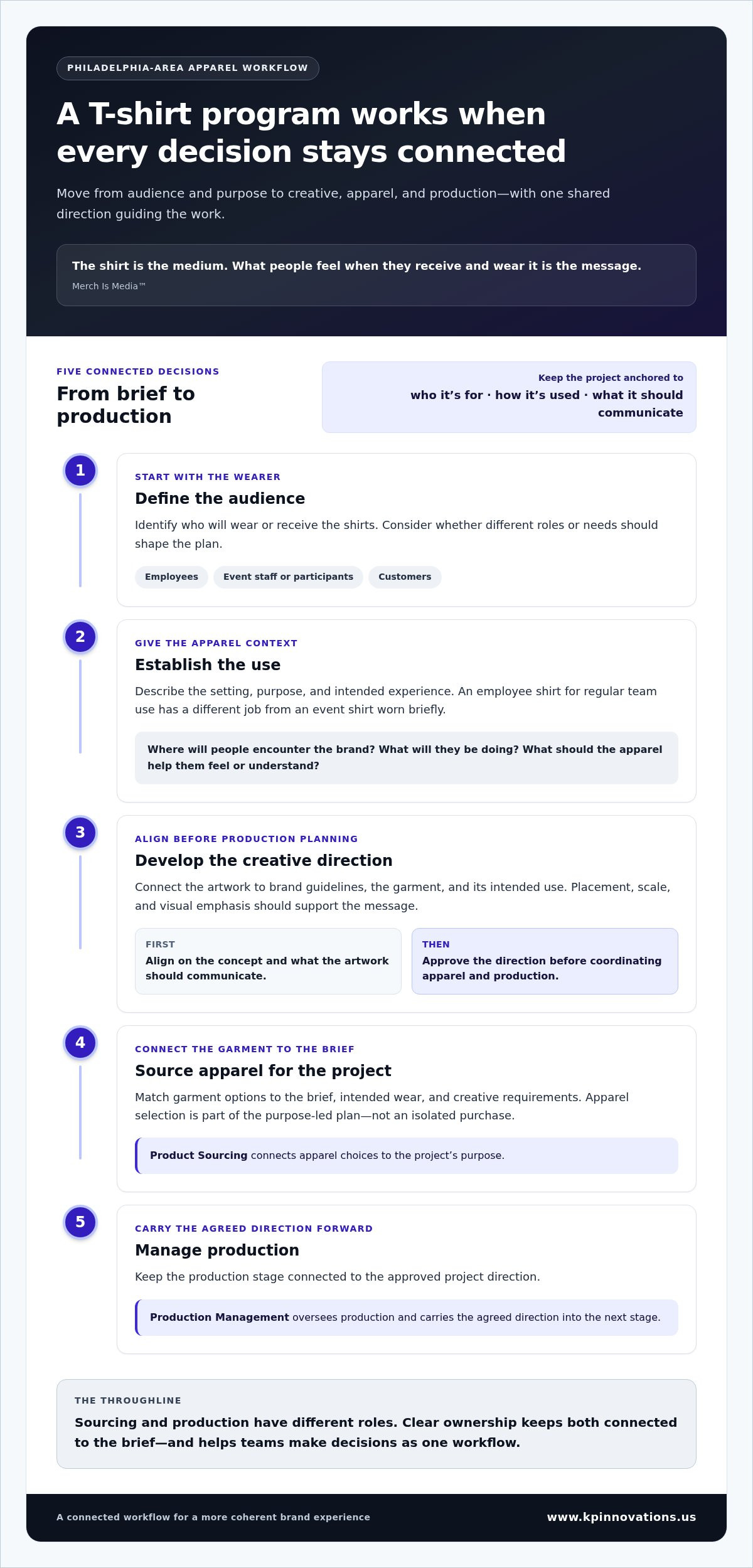
A strong apparel project moves through connected decisions. Those decisions shouldn’t be collapsed into a vague request for “shirts with the logo.” For Philadelphia custom t-shirt printing, a useful brief gives creative and production teams a shared reference: who the shirts are for, how they’ll be used, and what the brand should communicate. That sequence helps teams make decisions with purpose and surface open questions before production begins.
Start with audience, purpose, and design direction
Begin with the wearer and setting. An employee shirt for regular team use has a different job from an event shirt worn briefly by staff and participants. Note where people will encounter the brand, what they’ll be doing, and what the apparel should help them feel or understand. Then connect that context to brand guidelines and project objectives.
Creative Development turns those inputs into a focused visual direction. Consider how the artwork will relate to the garment and its intended use. Placement, scale, and visual emphasis should support the message rather than compete with it. A design that works on a presentation slide may need adjustment to feel balanced on apparel. Keep creative decisions distinct from production decisions: first align on the concept and what the artwork should communicate, then coordinate apparel selection and production around the approved direction.
Coordinate sourcing and production decisions
With the audience, use, and creative direction established, move through sourcing and production in a deliberate order:
- Define the audience: Identify who will wear or receive the shirts and whether different roles or needs should shape the plan.
- Establish the use: Describe the setting, purpose, and intended experience so the apparel has a clear context.
- Develop creative: Align the artwork with brand guidelines and the garment, then approve the direction before production planning.
- Source apparel: Match garment options to the brief, intended wear, and creative requirements. Product Sourcing connects apparel selection to the project’s purpose rather than treating it as an isolated purchase.
- Manage production: Production Management oversees the production stage and keeps it connected to the agreed project direction.
Product Sourcing and Production Management have different roles, but they work best as parts of the same lifecycle. Sourcing connects apparel choices to the brief. Production Management carries the agreed direction into the next stage. Clear ownership helps marketing, HR, and operations teams coordinate decisions without losing sight of the project context.
A clear brief gives creative and production teams a shared standard for making decisions. It doesn’t need to predict every detail. It should make the audience, use, brand direction, and project priorities clear to everyone involved. That foundation turns separate choices into apparel that feels intentionally connected to the business moment.
One-Off Order or Ongoing Program? Compare the Real Work Behind Custom T-Shirts
A single shirt order can be straightforward: a defined event, a clear audience, an approved design, and a distribution plan. But when apparel appears across employee programs, events, or customer experiences, each new order can bring fresh decisions. The distinction isn’t about order size. It’s whether the need ends with one project or keeps returning as part of how the business operates.
For a Philadelphia-area company planning Philadelphia custom t-shirt printing, a product transaction may be enough for a clearly bounded need. Recurring apparel brings different questions about continuity and ownership. Compare the work involved:
| Business consideration | One-time order | Recurring apparel needs |
|---|---|---|
| Ownership | A project lead coordinates a defined request and its decisions. | Ongoing ownership connects requests to shared priorities and established direction. |
| Design continuity | Creative is developed for a specific event or project. | Design direction carries across future orders and different teams. |
| Ordering coordination | Teams align around one brief and approval process. | Requests may come from different departments, locations, or occasions and need coordination. |
| Fulfillment | Distribution is planned for a defined group or moment. | Fulfillment fits an ongoing program and its varied distribution needs. |
| Reporting | The project can be reviewed against its specific purpose. | Consistent tracking can help teams understand activity across the program. |
Matching apparel to the project brief matters in either case. Coordinated Product Sourcing connects that brief to apparel decisions, whether the need is a single event or part of a wider program.
When a single custom T-shirt order may be enough
A one-time order can make sense when the project has a clear endpoint, such as shirts for a specific event with a defined audience and purpose. A transaction-focused process may suit that contained need. It still benefits from a concise brief and coherent creative direction. Clarifying who the shirts are for and what the event calls for keeps decisions aligned without expecting the apparel alone to deliver a business result.
When repeat needs call for program ownership
Recurring uniform, employee, event, or client apparel needs can involve changing requests, multiple stakeholders, and repeated decisions about design and distribution. That’s where Program Management becomes relevant. It coordinates merchandise activity over time, keeping ownership and direction connected as needs recur. Instead of asking each team to restart the process independently, the business can manage apparel as part of a consistent program without assuming every project will be identical.
The useful question isn’t simply, “Do we need another order?” It’s, “Is this apparel supporting a continuing experience?” A single project can stay focused and bounded. Repeated needs may benefit from an owner who sees how decisions connect across the program.
A Philadelphia-Area Custom T-Shirt Workflow That Keeps Teams Aligned
A T-shirt project can involve marketing, HR, operations, event staff, and the people who’ll receive the apparel. Without a shared workflow, each group may make decisions from a different starting point. A clear sequence keeps the work connected, whether shirts are for a Philadelphia-area company event, a community gathering, or teams working across locations.
Build a brief that keeps decisions connected
Start with a project brief that captures the audience, purpose, brand direction, intended use, and distribution context. For example, note whether apparel is for employees at an internal gathering, staff supporting a public event, or customers receiving a branded touchpoint. These details give creative and production decisions a common reference without dictating a particular garment or design.
Define internal ownership early, too. Identify who consolidates creative feedback and who approves production decisions. If several departments are involved, route feedback through designated owners rather than asking each group to make separate changes. Keep open questions, such as garment selection or design direction, visible as decisions to resolve. This helps teams distinguish settled requirements from preferences that still need alignment.
Move through the project in connected stages
Once the brief is aligned, use it to guide each handoff. This sequence helps teams see what needs attention and who owns the next decision:
- Confirm the brief: Align on audience, purpose, brand direction, and where the shirts will be used.
- Develop creative: Gather feedback through the agreed owner and bring the design direction to approval.
- Plan apparel and sizes: Coordinate size information and garment choices as project inputs, guided by intended wear and approved creative.
- Manage production: Carry approved decisions into Production Management so the work remains connected to the brief.
- Coordinate distribution: Map destinations and recipients, then plan how apparel will reach the people or teams it’s intended for.
Keep approvals connected to the decisions they cover. Creative approval establishes the agreed design direction; production approval addresses the production plan. Separate checkpoints help prevent late feedback from reopening decisions that have already been settled.
Plan distribution for people, places, and future needs
Distribution planning starts with the destination. Shirts for one event may be organized differently from apparel being sent to several teams or held for future needs. Gathering size information and mapping recipients to destinations as part of the project plan helps teams coordinate what is needed, where it needs to go, and how it will be distributed.
Fulfillment includes warehousing, kitting, shipping, and tracking. Coordinating these steps with apparel decisions connects production to distribution. A well-managed apparel workflow is a set of connected stages, each with clear ownership.
For a Philadelphia-area apparel project, bring the brief, sourcing, production, and distribution plan together before teams make disconnected choices. Coordinate apparel sourcing around your project brief to keep selection tied to the intended use and broader workflow.
How KP Innovations Turns Philadelphia Custom T-Shirt Printing Into a Managed Brand Program
Ordering shirts is one task. Owning how apparel supports a business over time is a different kind of work. KP Innovations approaches Philadelphia custom t-shirt printing as part of a broader merchandise program, connecting the decisions behind each project instead of stopping at product selection and delivery. That distinction matters when apparel supports employee, customer, or event experiences beyond a single order.
What the Chief Swag Officer model owns
The Chief Swag Officer model gives businesses a dedicated partner to coordinate merchandise across its lifecycle. Strategy informs creative, creative guides sourcing, and production and fulfillment stay connected to the program’s purpose. The result is one point of ownership for a merchandise ecosystem, rather than a series of disconnected product requests.
The work begins with Merchandise Strategy, defining the role merchandise should play and how it supports the brand experience. Creative Development translates that direction into a clear creative approach. Product Sourcing connects the project brief to apparel choices, and Production Management oversees the production stage. Fulfillment supports distribution through warehousing, kitting, shipping, and tracking. Reporting can help teams review program activity and inform future planning.
This connected model also helps businesses consider T-shirts alongside other merchandise needs, rather than treating every item as an unrelated purchase. A broader view of promotional products and merchandise programs puts apparel in context with the experiences and relationships the company wants to support.
Why a strategic partner changes the work
A traditional vendor transaction centers on fulfilling a product request. A strategic partner looks beyond that order to its purpose, decision ownership, and future needs. That doesn’t mean every T-shirt request needs an ongoing program. It means recurring needs can be considered together, with opportunities to review what’s working and keep decisions aligned as the business evolves.
Client feedback offers a glimpse of apparel-related work. Chad Sierer of McLaren Philadelphia praised work involving duffle bags, polos, hats, and private-label apparel. Mike Noce of RDS Automotive Group referenced custom polos, hats, and charity event apparel. These examples show the kinds of merchandise and apparel projects clients have discussed, without suggesting that a product alone delivers a business outcome.
For teams building a merchandise program, the goal isn’t simply to place the next order. It’s to give strategy, creative, sourcing, production, fulfillment, and review a clear relationship to one another. That’s how merchandise can work as a brand channel rather than a series of disconnected transactions.
To connect apparel choices to your project’s purpose, explore Product Sourcing with KP Innovations.
Give Your Next Apparel Project a Clear Purpose
The next step isn’t choosing a shirt. It’s deciding what role apparel should play in the experience you want employees, customers, or event participants to have. For Philadelphia custom t-shirt printing, set that intention before the project begins, then define what a useful result would look like for your organization. That might mean a consistent team identity, a more considered event experience, or a clearer process for future apparel needs.
Use that purpose to guide the decisions that follow, and make room to learn from the project. What resonated with the people receiving the shirts? Which choices were easy for teams to coordinate, and where did decisions become fragmented? These reflections can help shape future merchandise planning. The goal isn’t to make every order larger. It’s to make each apparel decision more connected to your brand and the people who experience it.
Ready to connect apparel choices to a business purpose? Start a Product Sourcing conversation with KP Innovations and give your next apparel project a clear direction.
Frequently Asked Questions
How much does Philadelphia custom T-shirt printing cost?
Cost depends on the apparel and decoration choices, creative requirements, and how the shirts will be distributed. For a useful budget discussion, define the audience and purpose first, then capture apparel needs, design direction, and fulfillment plans in one brief. That gives the project a clearer scope and helps teams compare options against what the shirts need to accomplish, rather than focusing on price in isolation.
How long does custom T-shirt printing take?
Timing depends on the project’s requirements and stages, including creative approvals, apparel sourcing, production, and distribution. A project with several decision-makers needs time for feedback and sign-off before production can proceed. For an event, work backward from the date and account for internal reviews and delivery planning. A coordinated schedule helps teams understand how decisions affect the overall plan.
Is there a minimum order for custom T-shirt printing?
Order requirements depend on the project and its apparel and production choices. Start by defining the intended use, audience, and design needs. A contained event order and a recurring apparel program may call for different planning. For business teams, a clear scope connects the requested quantity to the people and purpose the shirts are meant to serve.
What artwork do I need for custom T-shirt printing?
Start with the current logo, relevant brand guidelines, and any creative direction tied to the project. Include the intended audience and where the shirts will be worn, since that context can influence how the design should appear on apparel. If the artwork is still being developed, describe the message and visual priorities rather than treating a finished file as the only useful starting point. Keep feedback organized through a designated approver.
Can a business order different T-shirt sizes for one team?
Yes. A business can organize a team order around the different sizes employees request. Collect responses in a roster with each person’s name and selected size, then have an internal owner review the entries for duplicates or missing responses. Keeping that roster separate from creative files also makes it easier to share only the information needed for apparel planning.
How can a company keep custom T-shirt designs consistent across repeat orders?
Use a simple version-control rule for artwork: identify the approved file clearly, archive earlier drafts, and record who can authorize a change. This helps prevent an outdated design from being reused by mistake or informal edits from becoming the new standard. If a later order needs an exception, document it as a deliberate change rather than overwriting the original reference. Clear approval authority makes the design history easier to manage.
Can custom T-shirts support a Philadelphia business event?
Yes. Custom T-shirts can help identify staff, create a shared visual presence for participants, or give attendees a tangible reminder of an event. The right role depends on the audience and the experience the business wants to create. For a Philadelphia-area gathering, consider who will wear the shirts, how they’ll be used during the event, and how distribution will work. Treat apparel as one part of the event experience, not a guaranteed source of sales.