
Your corporate clothing shouldn’t be a generic giveaway that employees only wear on laundry day. In a market projected to reach $321 billion by the end of 2026, the standard “logo-on-a-blank” approach is no longer enough to compete for attention or talent. When you invest in private label apparel for corporate branding, you’re not just buying shirts; you’re developing a proprietary media channel. At KP Innovations, we believe Merch is Media™, and your apparel should reflect the same retail-quality standards as the brands your team buys on their own time.
You’ve likely felt the frustration of watching a significant portion of your marketing budget sit in a cardboard box because the garment quality didn’t meet your brand’s standards. It’s a logistical nightmare to manage sizing and global distribution, especially with new 2026 compliance hurdles like California’s SB 707 or strict FTC labeling requirements that can carry penalties of over $51,000 per violation. This guide will show you how to transform your clothing line into a strategic asset that employees actually want to wear. We’ll explore how to streamline your fulfillment, ensure retail-grade quality, and turn every garment into a powerful driver of internal culture and brand visibility.
Key Takeaways
- Stop treating apparel as a one-off purchase and start viewing it as a proprietary media channel that builds long-term brand equity.
- Learn why private label apparel for corporate branding outperforms off-the-shelf options by offering total control over garment construction, fit, and color precision.
- Follow a structured framework to move from creative strategy and technical design to selecting a reliable factory partner for your custom line.
- Discover how the Chief Swag Officer model replaces fragmented vendor relationships with a managed system that handles everything from design to global fulfillment.
Why Your Corporate Apparel Strategy is Failing (and the Closet Problem)
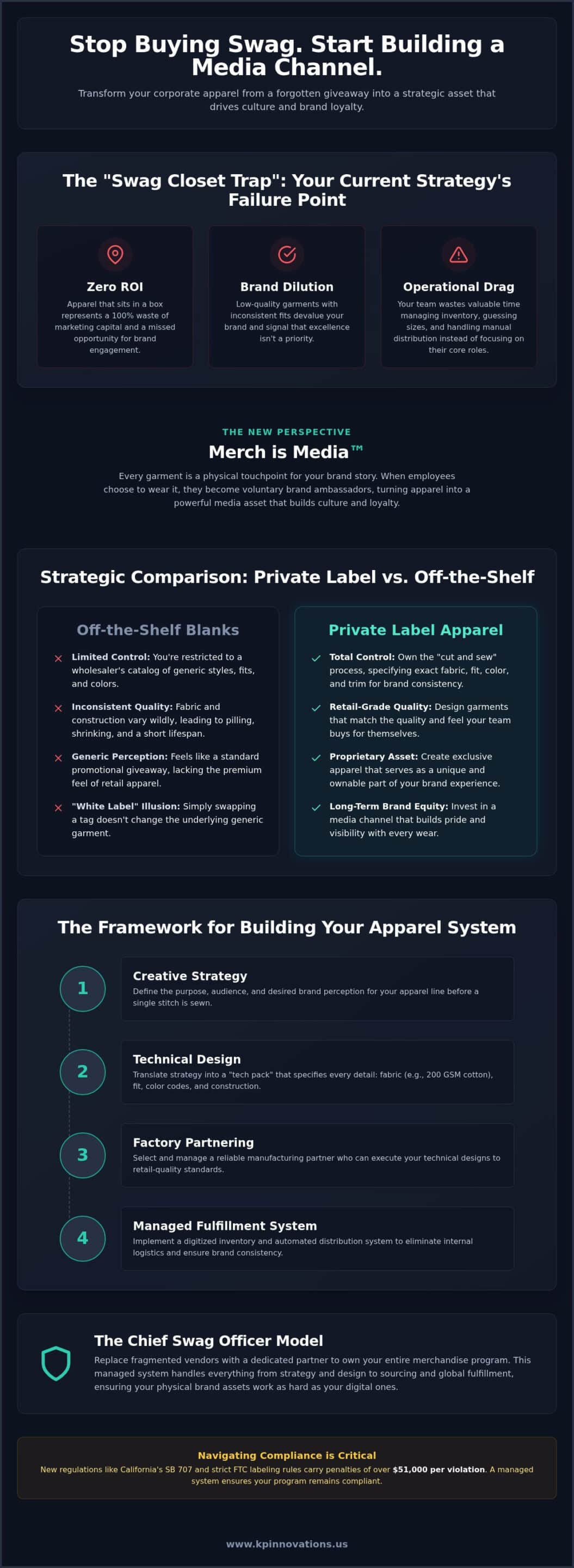
Most corporate apparel programs aren’t strategies; they’re reactions. A department head realizes an event is three weeks away, panics, and orders five hundred shirts from a generic online vendor. This transactional approach creates what we call the “Swag Closet Trap.” It’s a graveyard of mismatched sizes, outdated logos, and low-quality fabrics that your employees simply won’t wear. When your merchandise sits in a dusty box in the office supply room, your marketing ROI is zero. Worse, it represents a significant waste of capital that could have been invested in building a proprietary brand experience.
The failure often stems from a vendor-first mentality. Standard distributors focus on moving units of someone else’s product. They don’t care if the fit is inconsistent or if the fabric pilling after three washes devalues your brand equity. To understand a better way, we must first look at What is Private Label? and how it applies to your organization. By utilizing private label apparel for corporate branding, you move away from buying “stuff with a logo” and begin designing garments from the ground up. This shift ensures that every piece of clothing reflects your company’s high standards and strategic intent.
The Closet Is Not a Fulfillment Strategy
Managing apparel logistics internally is an operational nightmare. Your marketing or HR teams shouldn’t spend their valuable time sorting through boxes, guessing sizes, or driving to the post office. Manual distribution leads to inconsistent brand representation. One department might be wearing retail-quality vests while another is stuck with scratchy, ill-fitting t-shirts. This fragmentation kills brand cohesion. Transitioning to a managed fulfillment system eliminates these headaches. By digitizing your inventory and automating distribution, you ensure that every employee receives the right size and style exactly when they need it. This isn’t just about storage; it’s about professionalizing your supply chain to protect your brand’s physical presence.
Merch is Media™: Changing Your Perspective
We view every garment as a physical touchpoint for your brand story. In 2026, the lines between work and life have blurred, and your team expects apparel that fits their lifestyle. High-quality private label apparel for corporate branding acts as a catalyst for culture and employee pride. When a team member chooses to wear your brand on the weekend, they’ve become a voluntary brand ambassador. This is the essence of Merch is Media™. You aren’t just giving away a shirt; you’re launching a media asset that influences loyalty and relationships. If the quality is retail-grade, the “media” is effective. If the quality is poor, the message is that your brand doesn’t value excellence. Strategic merchandise management ensures your physical assets work as hard as your digital ones.
Beyond the Logo: Defining Private Label as a Strategic Asset
Most organizations confuse branding with decoration. They believe that heat-pressing a logo onto a mass-produced polyester shirt constitutes a brand experience. It doesn’t. True private label apparel for corporate branding involves designing proprietary garments from the ground up. This means you own the “cut and sew” process. You aren’t limited by what a wholesaler has in a warehouse. In 2026, the power of exclusivity is a major differentiator. When you control the manufacturing, you ensure your apparel fits your team’s specific needs while maintaining a retail-first perception that off-the-shelf blanks can’t replicate.
Owning the technical specifications allows for total control over fabric, fit, color, and trim. This level of precision is vital for brands that prioritize consistency. If your brand identity relies on a specific silhouette or a unique fabric feel, private label is the only way to guarantee that every shipment meets those requirements. It moves your merchandise from a line item in the marketing budget to a strategic asset that builds long-term equity.
Private Label vs. White Label Clothing
Many vendors offer white label services, which simply involve removing a manufacturer’s tag and replacing it with your own. For premium brands, this is often insufficient. White labeling doesn’t solve the problem of poor fit or generic fabric. Private label goes deeper by utilizing custom fabrication. You can specify a 200 GSM cotton for a substantial, high-end feel rather than settling for the standard 150 GSM industry average. To understand the nuances of this approach, you can explore our Private Label vs. White Label Comparison to see which path aligns with your brand goals.
The Anatomy of a Private Label Garment
The difference between a “swag” shirt and a retail garment lies in the details. Private label allows for custom neck labels, hem tags, and even branded buttons or zippers. These are the subtle signs of a premium brand that employees notice. Technical specs also play a role; the weave of the fabric determines how the garment holds its shape after fifty washes. We integrate functional design based on your industry. A tech firm might need internal pockets for headphones, while a hospitality brand requires moisture-wicking fabrics that withstand high-heat environments. If you are ready to move beyond generic options, our team can assist with strategic sourcing to find the right manufacturing partners for your vision.
Strategic Comparison: Why Private Label Outperforms Off-the-Shelf Brands
When you rely on off-the-shelf blanks, you’re at the mercy of someone else’s dye lot and inventory levels. It’s impossible to maintain true brand consistency when your primary blue varies between a polo, a hoodie, and a quarter-zip because they were sourced from three different manufacturers. Choosing private label apparel for corporate branding eliminates this fragmentation. By owning the manufacturing process, you specify exact corporate Pantones across every product line. This level of precision ensures that your brand looks the same in a boardroom as it does on a job site, protecting the visual integrity you’ve worked hard to build.
Quality control is the other major differentiator. Third-party manufacturer stock is notorious for variability; a “Medium” from one batch might fit like a “Large” from the next. Private label removes this guesswork. You set the technical specifications for fit and finish, ensuring that the tenth garment is identical to the first. While the upfront investment in custom engineering is higher, the per-unit cost at scale is often lower because you are removing the retail markup of a middleman brand. You’re paying for the quality of the garment, not the prestige of a third-party logo.
Off-the-Shelf vs. Private Label: The ROI Breakdown
The lifespan of a generic promotional tee is remarkably short. Most end up as rags or in landfills after just a few washes because the collar stretches or the fabric pils. A custom-engineered garment, however, is built to retail standards, meaning it stays in an employee’s wardrobe for years. This longevity drastically increases your “wear-rate,” which is the only metric that truly matters for physical brand assets. ROI in this context is the total number of organic brand impressions generated over the full lifecycle of a garment compared to its total production and distribution cost. When people choose to wear your brand on their day off, your cost-per-impression drops to nearly zero.
Case Study: Elevating the Uniform Program
A custom-designed uniform does more than just identify a worker; it changes how customers perceive your entire operation. In industries like hospitality or home services, a high-performance, private label uniform signals a level of professionalism that off-the-shelf options can’t match. There is also a profound psychological effect on employee morale. When a team member puts on a garment that fits well, feels premium, and looks modern, they feel valued by the organization. This “Retail Pride” factor transforms a daily requirement into a symbol of belonging, directly influencing culture and retention rates across the company.
Building the System: A Framework for Private Label Implementation
Developing a successful private label apparel for corporate branding program requires moving from a project-based mindset to a systems-based approach. It isn’t just about picking a fabric; it’s about building a repeatable framework that ensures every garment reinforces your brand’s premium position. We manage this through a four-step methodology designed to eliminate the operational friction typically associated with custom manufacturing. By professionalizing the process, we turn apparel into a scalable marketing asset.
- Step 1: Strategy & Creative Development. We start by defining the “why” behind the garment. Your apparel should solve a specific business problem, whether that’s increasing brand visibility or improving employee retention.
- Step 2: Sourcing & Technical Design. This involves selecting the right manufacturing partners who can execute your specific vision while meeting modern compliance standards.
- Step 3: Production Management. We oversee the entire manufacturing cycle. This ensures that quality is maintained through every stitch and that the final product matches the approved samples.
- Step 4: Logistics & Global Distribution. The system isn’t complete until the right size reaches the right person. We handle the complexities of global fulfillment, navigating customs and local regulations for your distributed team.
The Importance of Technical Tech Packs
A tech pack is the blueprint for your garment. It includes precise measurements, material specifications, and construction details that leave zero room for interpretation. In the world of private label apparel for corporate branding, precision prevents costly production errors. Without a detailed tech pack, you risk receiving a shipment of five hundred shirts with inconsistent collar heights or wrong sleeve lengths. This technical rigor is a core part of our creative development process, ensuring that your vision is translated accurately on the factory floor.
Managing the Global Supply Chain in 2026
The regulatory landscape for textiles changed significantly in 2026. With the CPSC’s mandatory e-filing for product safety information as of July 8, 2026, and California’s SB 707 requiring detailed fiber documentation, ethical sourcing is no longer optional. You need a partner who understands these complexities and can navigate seasonal production cycles to avoid delays. By working with a strategist who owns the sourcing process, you protect your brand from the legal and reputational risks of non-compliance.
If you’re ready to professionalize your merchandise program, our team can help you build a custom sourcing strategy that aligns with your brand’s long-term objectives.
The Chief Swag Officer Model: Why Your Brand Needs a Managed System
Leadership teams often delegate merchandise to an overworked marketing coordinator or HR assistant. This fragmented approach is why programs fail. A CEO wouldn’t manage the company’s cloud infrastructure or legal strategy in their spare time; your physical brand assets deserve the same level of professional oversight. The Chief Swag Officer model provides a dedicated strategist who owns your entire merchandise program. By outsourcing this department, you ensure that every piece of private label apparel for corporate branding is treated as a strategic marketing investment rather than an administrative burden.
A managed system replaces the chaos of manual spreadsheets with proprietary Company Stores. These platforms allow for frictionless employee ordering while maintaining strict control over brand standards and budget. You can empower department heads to order what they need without worrying about logo misuse or inconsistent garment quality. This decentralized ordering with centralized control is the only way to scale a premium brand experience across a global or remote workforce.
From Vendor to Strategic Partner
The primary difference between a distributor and a strategic agency is the shift from transactional to relational. We don’t just take orders; we manage a program. This involves white-glove project management that covers everything from technical design to global fulfillment. By consolidating your merchandise strategy under one roof, you gain access to over 1.2 million products and a team that understands how to measure impact. We track success through brand impressions and employee engagement, ensuring your physical assets deliver a measurable return on your marketing spend.
Outcome: A Brand That Lives Beyond the Office
The ultimate objective of private label apparel for corporate branding is to create a brand experience that resonates in the real world. When your team wears your apparel at a coffee shop or a weekend event, they’ve transitioned from employees to brand ambassadors. This organic visibility is the most powerful form of media you can own. Our Merch is Media™ philosophy ensures that your garments are built with the quality and style required to live beyond the office walls. This strategy builds deep-level loyalty and turns every garment into a lasting asset for your organization.
If you are ready to stop ordering shirts and start managing a proprietary brand experience, it’s time to professionalize your approach. Schedule a strategy session with your Chief Swag Officer today to begin building a merchandise system that drives culture and growth.
Turn Your Brand into a Proprietary Media Asset
Your merchandise program is more than a line item; it’s a physical representation of your brand’s standards and culture. Moving beyond generic blanks ensures your team wears garments they actually value, rather than adding to the “swag closet” graveyard. By adopting private label apparel for corporate branding, you gain total control over fabric, fit, and color precision. This strategic shift transforms clothing from a simple giveaway into a high-impact media channel that generates organic impressions every time it’s worn in the real world.
At KP Innovations, we act as your Chief Swag Officer to manage the operational complexities of your program. With access to over 1.2 million products and deep expertise in global fulfillment and logistics, we provide the white-glove project management necessary for a scalable, high-end apparel line. It’s time to stop reacting to event deadlines and start building a managed system that drives long-term loyalty and brand equity. We look forward to helping you professionalize your physical brand presence.
Elevate your brand with a custom private label strategy and let’s build a physical brand experience that lasts.
Frequently Asked Questions
What is the difference between private label and custom screen printing?
Custom screen printing is a decoration method applied to a pre-existing blank garment. In contrast, private label apparel for corporate branding involves designing and manufacturing the garment from the yarn up. This approach allows you to specify the exact fabric weight, silhouette, and internal labeling, ensuring the final product is a proprietary asset rather than a decorated commodity.
What are the minimum order quantities (MOQs) for private label corporate apparel?
Minimum order quantities for private label projects are typically higher than those for off-the-shelf blanks because the factory must set up a custom production run. While these vary based on garment complexity and fabric requirements, most professional programs begin at several hundred units per style. This scale is necessary to justify the custom “cut and sew” process and ensures you receive the best per-unit value.
How long does the private label design and production process take in 2026?
The lifecycle for a custom apparel project in 2026 generally spans twelve to twenty weeks from initial strategy to final distribution. This timeline accounts for creative development, technical sampling, and production. It also includes the necessary time to navigate 2026 regulatory requirements, such as the CPSC’s mandatory e-filing for product safety. Starting early ensures your brand isn’t compromised by rushed production or shipping delays.
Can we integrate private label apparel into our existing employee recognition program?
You can absolutely integrate proprietary apparel into your recognition strategy through a managed company store platform. Instead of generic trophies, employees receive high-end, private label items as rewards for milestones or performance. This creates a more meaningful brand experience because the reward is a retail-quality garment they’ll actually wear in their daily lives, reinforcing their connection to the company culture.
Is private label apparel more sustainable than off-the-shelf options?
Private label offers superior sustainability because you have direct control over the raw materials and ethical standards of the factory. You can specify organic cotton, recycled polyester, or PFAS-free textiles to meet 2026 environmental regulations like California’s SB 707. Off-the-shelf options often lack this level of supply chain transparency, making it difficult to verify the true environmental impact of the garment.
How do we manage sizing and distribution for a global team?
Managing a global team requires a centralized fulfillment system that handles localized sizing and international logistics. We recommend using a platform that allows employees to input their own sizes and shipping details directly. This eliminates the operational burden on your internal teams and ensures that your private label apparel for corporate branding reaches every team member, regardless of their geographic location or local customs regulations.
What industries benefit most from proprietary private label clothing lines?
Industries with high public visibility or distributed workforces, such as tech, hospitality, and professional services, see the highest return on proprietary apparel. Any organization where employees act as brand ambassadors benefits from garments that reflect a retail-first perception. When your team looks like they belong in a high-tier retail environment, it immediately elevates your brand authority in the eyes of your clients and customers.
Why is a tech pack necessary for custom corporate apparel?
A tech pack is the essential blueprint that translates your creative vision into a technical reality for the factory. It includes every measurement, stitch type, and material specification required for production. Without this document, you risk receiving inconsistent products that don’t match your brand standards. Precision in the design phase prevents costly manufacturing errors and ensures your custom clothing line is executed perfectly every time.