
The “cheap” generic label you’re avoiding might actually be the smartest vehicle for your brand’s expansion in 2026. You want to build a legacy, not just slap a logo on a blank tee. It’s frustrating to feel stuck between the 250-piece minimums of custom manufacturing and the fear of looking like every other “me-too” brand on the market. You recognize that your choice in the private label vs white label clothing debate will define your profit margins and your supply chain resilience for years to come.
We’re here to help you master these manufacturing paths so you can scale your brand equity without the typical industry headaches. You’ll learn how to manage the new 2026 regulatory landscape, including the mandatory EU Digital Product Passport and rising import tariffs that now reach up to 40 percent. This guide provides a strategic breakdown of MOQs, customization depth, and the specific steps required to turn physical garments into high-value strategic assets for your business.
Key Takeaways
- Master the strategic distinctions between private label vs white label clothing to align your manufacturing with your long-term brand vision.
- Evaluate the impact of customization depth on your intellectual property, from basic logo placement to proprietary tech pack ownership.
- Assess the financial and logistical trade-offs of domestic versus international sourcing in the 2026 tariff and regulatory landscape.
- Understand how to transition from testing markets with accessible white label minimums to scaling with fully custom private label collections.
- Discover how professional fulfillment and logistics services turn physical apparel into high-impact tools for brand elevation.
Defining Private Label and White Label Clothing
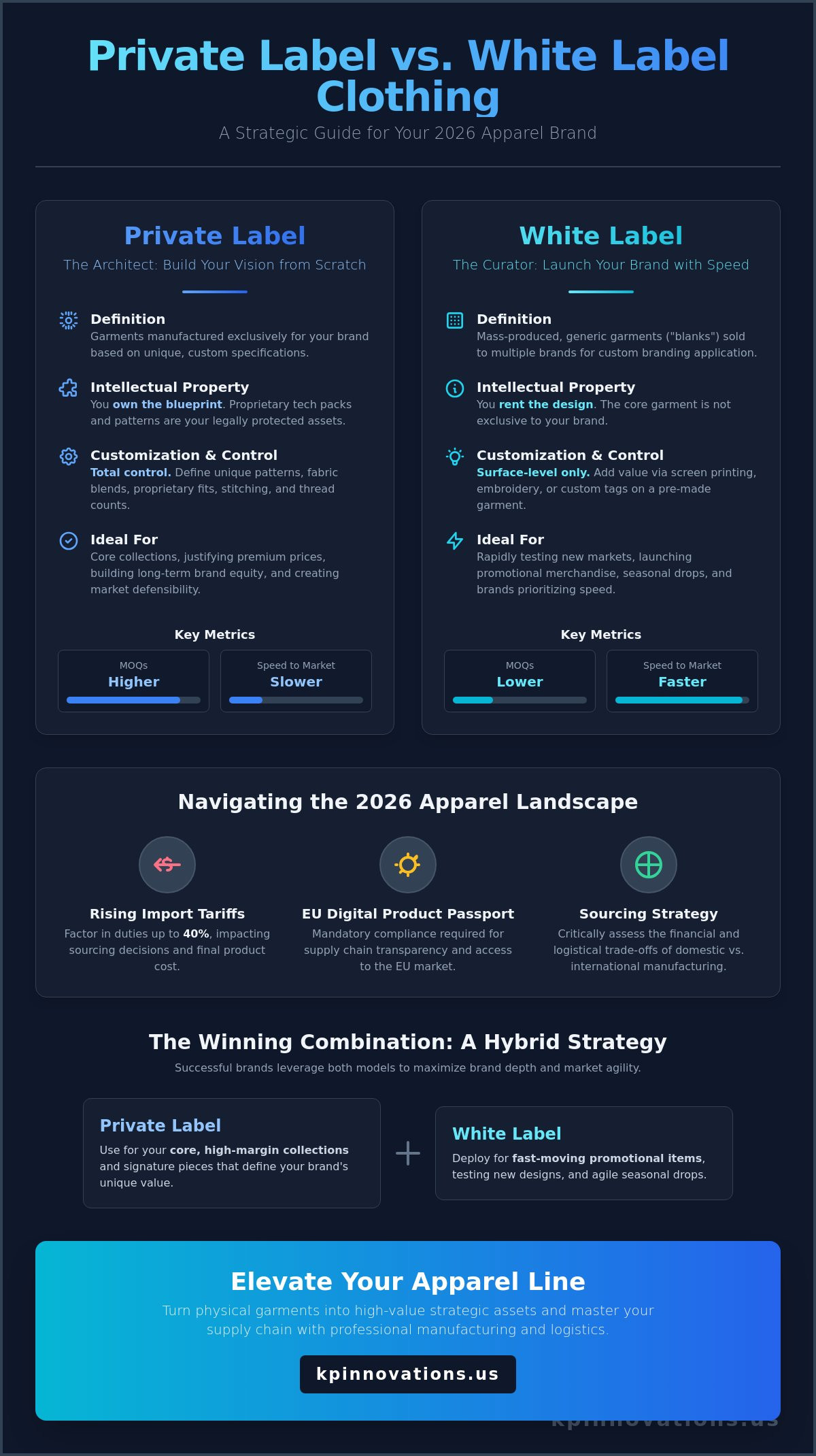
In the 2026 garment industry, the distinction between manufacturing models has never been more critical for brand equity. While sectors like tech or food use these terms to describe software or ingredients, the apparel world uses them to define the very soul of a product. At its core, the private label vs white label clothing decision is a strategic trade-off between total creative exclusivity and rapid speed to market. Both models leverage specialized third-party manufacturing expertise, allowing you to focus on high-level brand strategy while professionals handle the complex machinery of production and logistics.
The clothing industry treats these terms with a level of precision that goes beyond simple rebranding. In fashion, the physical construction of the item is just as important as the logo on the tag. Whether you’re building a luxury line or a high-performance athletic brand, you’re essentially choosing how much of the supply chain you want to own and how much you want to outsource to proven experts.
What Is Private Label Apparel?
Private label is the definitive choice for brands seeking to own their intellectual property from the ground up. This model involves garments manufactured exclusively for your brand based on custom specifications. You control every detail. This includes unique patterns, specific fabric blends, and proprietary fits that distinguish a premium garment from a basic promotional item. By investing in private label, you ensure your product isn’t just another item on a shelf; it’s a unique physical asset. This “gold standard” approach is essential for brands that want to justify a higher price point and build long-term market defensibility.
What Is White Label Apparel?
A White-label product in the clothing industry refers to mass-produced, generic garments sold to multiple retailers. These “blanks” are already manufactured and stored in warehouses, waiting for your branding to be applied. Common examples include high-quality T-shirts, fleece hoodies, and corporate headwear. This model facilitates rapid scaling because the heavy lifting of design and production is already complete. It’s the fastest way to launch a branded merchandise line without the long lead times of custom manufacturing. You simply choose the styles that align with your brand and add your custom labels or embroidery.
The choice between these paths defines your operational rhythm. White label offers agility; you can test a new market or launch a seasonal collection in a matter of weeks. Private label offers longevity and brand depth. Many successful brands in 2026 utilize a hybrid strategy, using white label for fast-moving promotional items and private label for their core, high-margin collections. Understanding the nuances of private label vs white label clothing ensures you select the manufacturing path that best supports your current scale and future ambitions.
Key Differences: Customization, Control, and Intellectual Property
The decision in the private label vs white label clothing debate ultimately hinges on how much of your brand’s DNA you want to own. While white label allows you to curate a collection quickly, it offers limited control over the physical architecture of the garment. You’re essentially renting another manufacturer’s design expertise. In contrast, private label manufacturing allows you to secure your intellectual property through proprietary tech packs and patterns. These documents are the blueprints of your brand. They ensure that your specific vision is repeatable, scalable, and legally protected from imitation.
Quality control also shifts dramatically between these two models. With white label “blanks,” you’re reliant on the manufacturer’s existing standards. If their stitch density or fabric weight changes, your product changes too. Private label manufacturing places the control back in your hands. You can specify the exact thread count, the reinforced stitching techniques, and the sustainable fabric certifications required to meet your brand’s promise. This level of oversight turns a simple piece of clothing into a strategic asset that justifies premium pricing.
Cut and Sew Manufacturing vs. Blank Customization
Most entry-level brands begin with blank customization. This involves taking pre-made garments and adding value through screen printing, embroidery, or custom hem tags. While efficient, you’re limited by the existing silhouette and fabric of the blank. Cut and Sew is the process of creating a garment from raw fabric rolls based on custom patterns. This private label approach allows for total structural freedom. You can design unique pocket placements, contrasting panels, or specialized ventilation that simply doesn’t exist in the white label market. If your goal is to disrupt a category with a new silhouette, cut and sew is your only viable path.
Ownership of Design and Fit
Proprietary sizing is a massive competitive advantage in the premium apparel market. When you choose white label, you run the risk of your competitors selling the exact same garment with a different logo. This leads to “race to the bottom” pricing because the products are functionally identical. Private label allows you to develop a “signature fit” that keeps customers loyal. You can also source specialized hardware, such as custom-branded zippers or unique buttons, that further distinguish your line. For brands ready to move beyond generic offerings, exploring custom apparel solutions provides the foundation for true market exclusivity.
By owning your designs, you build long-term brand equity. You aren’t just selling a shirt; you’re selling a proprietary product that cannot be found anywhere else. This intellectual property becomes a tangible value on your balance sheet, making your brand more attractive to investors and more resilient against market shifts.
Business Strategy: Choosing the Right Path for Your Brand
Your manufacturing strategy should be a direct reflection of your market positioning. A luxury brand requiring proprietary fits cannot rely on the same infrastructure as a corporation launching a seasonal promotional campaign. The private label vs white label clothing decision isn’t merely a choice of “beginner versus expert.” It’s a calculated move based on your current capital, your desired margins, and the speed at which you need to capture market attention. High-tier brands often use both models simultaneously to balance innovation with operational efficiency.
Risk management in 2026 is largely defined by Minimum Order Quantities (MOQs). For many organizations, the barrier to entry for custom work is the initial volume commitment. A typical private label production run starts at a minimum of 250 pieces, requiring a more significant upfront investment in inventory. Conversely, white label collections are much more accessible, with MOQs often starting around 70 pieces. This lower threshold allows you to test new designs or colorways without overextending your capital or risking excess stock in an era where the destruction of unsold goods is increasingly regulated.
Cost Analysis and ROI Expectations
While white label garments have lower upfront costs, they often command lower long-term margins due to market saturation. If anyone can buy the same blank, your primary lever for competition is price. Private label manufacturing requires higher initial spending on tech packs and sampling, but it builds a defensible asset. You’re creating a product that competitors cannot replicate. This uniqueness increases your brand valuation and allows for premium pricing that absorbs the higher manufacturing costs over time.
Speed to Market vs. Long-Term Brand Equity
Speed is a competitive advantage for seasonal trends and corporate swag. White label allows you to go from concept to delivery in a fraction of the time required for custom manufacturing. However, building a legacy requires the depth that only private label provides. Many sophisticated brands employ a hybrid model. They use white label for fast-moving basics and event merchandise while reserving private label for their “hero” pieces. This approach ensures you remain agile enough to follow trends while maintaining the proprietary quality that defines your brand’s core identity.
Ultimately, your manufacturing path must scale with your ambitions. Whether you’re prioritizing the rapid deployment of branded merchandise or the meticulous construction of a custom apparel line, the goal is to turn every garment into a strategic tool for growth. By aligning your production model with your specific business phase, you ensure that your supply chain remains an asset rather than a liability.
Sourcing and Logistics in 2026: USA vs. International Manufacturing
The logistics of 2026 require a more sophisticated approach than simply finding the lowest unit cost. Your choice in the private label vs white label clothing landscape directly dictates your exposure to shifting international trade policies. With US tariffs on apparel imports from China and Vietnam reaching 20-40% in early 2026, the financial math of sourcing has changed. Brands must now weigh the lower labor costs in regions like Bangladesh against the rising costs of cross-border compliance and transportation. Strategic sourcing now includes preparing for the EU Digital Product Passport (DPP), which becomes mandatory for textiles sold in the European Union starting between 2026 and 2027. This requires a level of transparency and data management that standard vendors often can’t provide.
Whether you choose custom production or branded blanks, your manufacturing partner must act as a strategic advisor to navigate these regulatory hurdles while maintaining your brand’s ethical standards. In an era where the sustainable fashion market is valued at $12.46 billion, transparency isn’t just a legal requirement; it’s a core consumer expectation. Your supply chain is no longer a back-office function. It’s a visible part of your brand identity that influences 50% of global apparel sales driven by Gen Z and Millennial buyers.
The Benefits of Domestic Manufacturing
American manufacturing has seen a significant resurgence as brands prioritize agility over raw volume. Working with domestic facilities allows for drastically faster lead times and lower shipping costs. It also facilitates easier communication and on-site quality inspections in hubs like Horsham, PA. Beyond the operational perks, the “Made in USA” label carries immense marketing power. It signals a commitment to local labor and high ethical standards, which resonates with modern demographics seeking brand authenticity.
Fulfillment and Global Distribution Strategies
A successful apparel line requires more than just a finished product; it needs an efficient path to the end user. Sophisticated brands are moving beyond simple production and into integrated fulfillment and logistics services. This approach reduces overhead by centralizing warehousing and distribution. For corporate entities managing global workforces or retail brands scaling across multiple channels, streamlining the journey from the factory floor to the doorstep is essential. High-touch logistics management ensures your custom apparel arrives on time, protecting your brand equity at every touchpoint.
By consolidating your manufacturing and distribution through a single strategic partner, you eliminate the friction points that typically stall growth. This managed process allows you to maintain control over your inventory while focusing on high-level market expansion. You turn physical items into strategic assets by ensuring they’re available exactly when and where your market demands them.
Elevating Your Apparel Line with KP Innovations
KP Innovations provides the essential infrastructure to bridge the gap between basic promotional products and premium, retail-ready apparel. We don’t just supply garments. We manage the entire lifecycle of your product line. Whether you’re weighing the pros and cons of private label vs white label clothing, our team provides white-glove project management that handles every detail from initial design concepts to global fulfillment. We help you move beyond the traditional vendor relationship. We become a strategic partner that prioritizes your brand’s long-term growth and market defensibility.
For brands prioritizing speed and accessibility, we offer access to a massive database of 1.2 million products. This allows us to source the perfect white label base that aligns with your specific quality standards and budget. We then apply sophisticated customization techniques to ensure your branded merchandise feels premium and intentional. If your vision requires a proprietary fit or unique fabric specifications, our custom private label solutions are designed to build your brand from the ground up. We manage the complexities of cut-and-sew manufacturing, ensuring your intellectual property is protected and your product remains unique in the marketplace.
Strategic Partnership: Beyond Simple Sourcing
We position ourselves as an extension of your team. Our consultative approach is essential for choosing the right apparel factory in a 2026 market defined by strict compliance and rising costs. We don’t just find a manufacturer; we find the right manufacturer for your specific scale. Our goal is to transform physical items into strategic assets that represent your brand’s commitment to quality and precision. We take the stress out of supply chain management so you can focus on high-level strategy.
Integrated Company Stores and Logistics
Managing a large-scale apparel program requires more than just production. It requires a seamless distribution model. We simplify team outfitting and retail distribution through custom online company store platforms. These platforms provide a professional, user-friendly interface for your employees or customers to access branded gear. Key benefits of our integrated model include:
- Centralized Fulfillment: Our Pennsylvania-based center manages inventory with precision.
- Global Reach: We offer robust global distribution capabilities to reach your team anywhere.
- Reduced Overhead: Our managed logistics eliminate the need for internal warehousing.
- Scalable Solutions: Our systems grow with your brand, from small batches to massive corporate rollouts.
Your journey from design to delivery is fully managed. This allows you to scale with absolute confidence. Partner with KP Innovations for your custom apparel project today to elevate your brand’s physical presence and secure your place in the 2026 market.
Build Your Apparel Legacy in 2026
The landscape of apparel manufacturing is shifting toward transparency, speed, and proprietary value. Your choice in the private label vs white label clothing debate ensures your brand remains competitive against rising international tariffs and new global sustainability regulations. You now understand that while white label offers rapid market entry with accessible minimums, private label provides the custom silhouettes and intellectual property ownership necessary for premium positioning. Success in this sector requires more than just a vendor. It requires a partner who understands the complexities of global logistics and domestic quality standards.
With access to over 1.2 million products and specialized expertise in ground-up private label manufacturing, we provide the white-glove project management needed to reduce your operational stress. We turn physical garments into strategic tools for growth. Elevate your brand with custom apparel solutions from KP Innovations. Your vision deserves a supply chain that is as ambitious as your brand goals. We’re ready to help you lead the market.
Frequently Asked Questions
Is private label the same as white label in the clothing industry?
No, these are distinct manufacturing models. White label apparel consists of generic garments mass-produced for many retailers who simply add their own branding. In the private label vs white label clothing comparison, private label is exclusive. It involves garments manufactured specifically for your brand using your proprietary designs, patterns, and technical specifications.
Which is better for a startup: private label or white label apparel?
White label is typically the superior choice for startups. It allows you to launch a collection with significantly less capital and lower risk by using pre-existing garment styles. You can test your brand’s market fit quickly and then reinvest your profits into fully custom private label production as your audience grows.
What are the typical Minimum Order Quantities (MOQs) for private label clothing?
A custom private label production run typically starts at a minimum of 250 pieces as of June 2026. This higher threshold is necessary to cover the costs of creating custom patterns and setting up specialized assembly lines. White label options are more accessible for smaller brands, with MOQs often starting around 70 pieces for a branded collection.
Can I turn a white label garment into a private label product later?
Yes, transitioning from white label to private label is a common strategic move. You can start by adding custom labels and prints to high-quality blanks to establish your brand’s aesthetic. Once you’ve validated your designs and built a customer base, you can move into custom manufacturing to own the patterns and fits that your customers already love.
How does Cut and Sew manufacturing differ from standard private labeling?
Cut and Sew is the most advanced form of private labeling. While some private label services might just offer custom tags on a factory’s existing silhouette, Cut and Sew involves creating the garment from raw fabric rolls based on your unique blueprints. This gives you total control over every seam, pocket, and specialized hardware choice.
What are the biggest risks when sourcing private label clothing overseas?
Financial volatility and regulatory compliance are the primary concerns in 2026. US tariffs on certain apparel categories from China and Vietnam have reached 20-40%, which can quickly erode your margins. You also face the complexity of complying with the EU Digital Product Passport requirements and the new legal prohibitions on destroying unsold textile goods.
How much control do I have over the fabric choice in white label clothing?
Your control is limited to the manufacturer’s existing catalog. You can choose from various weights, colors, and blends that the factory already stocks, but you cannot request a proprietary fabric weave or a custom-engineered textile. If your brand’s value proposition relies on a unique, proprietary fabric, you must utilize a private label manufacturing model.
Why is the ‘Made in USA’ label important for private label brands in 2026?
Domestic manufacturing provides a strategic hedge against international trade tensions and rising import costs. It allows for much faster lead times and simplifies the quality inspection process. In 2026, the “Made in USA” label also serves as a powerful marketing tool that signals ethical labor practices and high-tier quality to socially conscious consumers.