
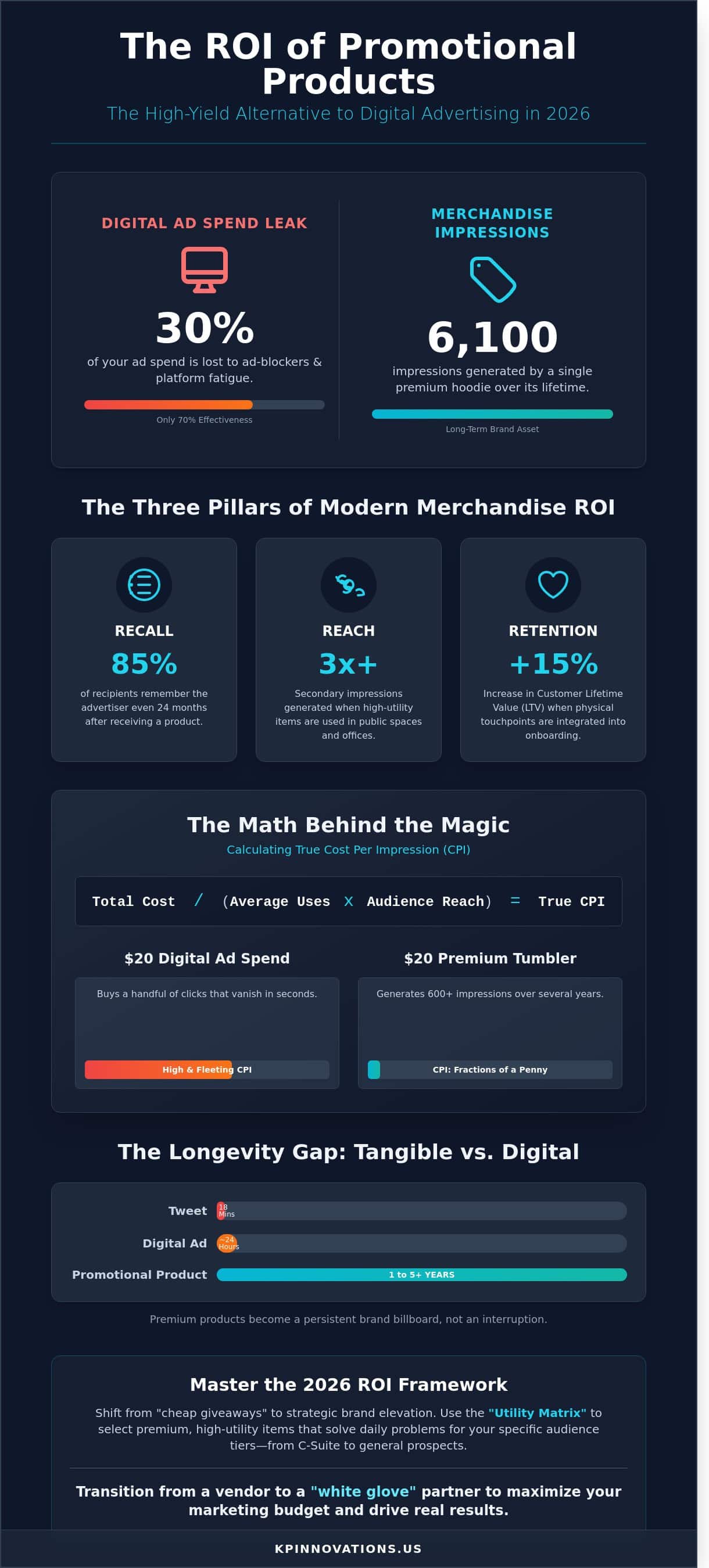
Your digital ad spend is likely losing 30% of its effectiveness to ad-blockers and platform fatigue. Meanwhile, a single premium hoodie can generate 6,100 impressions over its lifetime. Most brand managers treat merchandise as a line-item expense, but in 2026, the highest-performing brands treat it as a high-yield alternative to traditional advertising. Mastering the ROI of promotional products is no longer about counting units given away at a trade show. It’s about strategic brand elevation, moving beyond vendor status to a place where merch becomes marketing.
You’ve likely felt the sting of a wasted budget on “trash” swag that fails to move the needle on customer loyalty. It’s a common struggle to track offline conversions while facing pressure to reduce costs without sacrificing quality. This guide promises to change that. You’ll learn how to calculate and maximize your return by focusing on high-utility, private-label assets that outperform digital channels. We’ll provide a clear framework for measuring success and the data you need to support elite product choices that drive higher brand loyalty scores.
Key Takeaways
- Discover why the 2026 marketing landscape favors physical assets and how to accurately measure the ROI of promotional products through brand impressions and conversion actions.
- Learn the specific formula to calculate Cost Per Impression (CPI) and see how premium merchandise outpaces traditional digital ad spend in long-term value.
- Understand the “Cost of Cheap” and why investing in premium, high-utility items is essential for protecting your brand’s reputation and ensuring product longevity.
- Master the 2026 ROI Framework by using the “Utility Matrix” to select products that solve daily problems for specific audience tiers, from the C-Suite to general prospects.
- Elevate your brand strategy by transitioning from a vendor model to a “white glove” partnership that handles logistics and project management to maximize your marketing budget.
Redefining the ROI of Promotional Products in 2026
The traditional view of merchandise as a line-item expense is officially obsolete. In 2026, leading brand managers define the ROI of promotional products as the aggregate value of high-frequency brand impressions combined with specific conversion actions. We’ve moved past the era of “cheap giveaways” into a strategic phase where every item serves as a tangible brand asset. While the fundamental principles of calculating Return on Investment remain rooted in financial gain, brand managers in 2026 are expanding their scope to include the compounding value of physical brand assets.
Elite brands now distinguish between expense-based thinking and asset-based marketing. An expense is a one-time cost for a fleeting digital ad. An asset is a premium, private-label garment that stays in a client’s wardrobe for over 5 years. This shift is driven by the three pillars of modern ROI:
- Recall: The ability for 85% of recipients to remember the advertiser even 24 months after receiving a product.
- Reach: The secondary impressions generated when high-quality items are used in public spaces or office environments.
- Retention: The 15% increase in customer lifetime value (LTV) observed when physical touchpoints are integrated into the onboarding process.
Why Physicality Wins in a Digital-First World
By 2026, the average consumer is bombarded by over 10,000 digital marketing messages daily, leading to unprecedented ad fatigue. Physical products bypass this noise through the Endowment Effect, a psychological phenomenon where individuals value an object more highly simply because they own it. When a customer holds a premium weight hoodie or a precision-engineered tech accessory, the brand moves from a screen to a lived experience. In the context of brand equity, ROI represents the measurable appreciation of long-term recall and positive sentiment generated per physical touchpoint.
The 2026 ROI Formula: Beyond the Spreadsheet
Measuring the ROI of promotional products now requires a blend of quantitative data and qualitative sentiment analysis. We no longer look at unit cost in a vacuum. Instead, we track “Brand Sentiment” as a leading indicator of future revenue growth. Data from 2025 shows that 40% of recipients are likely to share a “unboxing” experience of high-end custom kits on social media. This organic reach provides a secondary layer of “free” impressions that traditional digital spend cannot replicate. Integrating these social signals with direct sales metrics creates a holistic view of campaign success that satisfies both the creative director and the CFO.
The Math Behind the Magic: Calculating Cost Per Impression (CPI)
To master the ROI of promotional products, you have to look past the unit cost and focus on the lifecycle of the item. Calculating the true value requires a simple but powerful formula: Total Cost / (Average Uses x Audience Reach). When you apply this to a $20 premium branded tumbler, the numbers are staggering. If a client uses that tumbler twice a week for two years, they generate over 200 personal impressions. If they use it in an office or gym, the secondary reach triples that figure. A $20 spend on a LinkedIn ad might buy you a handful of clicks that vanish in seconds; a high-quality physical asset delivers a CPI measured in fractions of a penny over its multi-year lifespan.
The “half-life” of digital content is notoriously short. A tweet lasts eighteen minutes. A promotional product often stays in a consumer’s home for an average of one to five years. According to the PPAI industry sales report, which tracked a $26.78 billion market in 2024, consumers prioritize utility and quality. When an item provides value, it isn’t just a gift; it’s a persistent brand billboard.
Promotional Products vs. Traditional Advertising
Traditional advertising is interruptive. It forces a pause in a consumer’s entertainment or research. Promotional products are additive; they solve a problem, like needing a charge or a warm layer. This shift in psychology is why 89% of consumers remember the advertiser of a promotional product they received within the last two years. There is also a significant “pass-along” value. Data shows that 55% of consumers give a promo item to a peer if they don’t keep it themselves, effectively doubling your initial ROI through a secondary organic endorsement.
Tracking the Untrackable: QR Codes and Custom URLs
Modern brand managers don’t have to guess about impact. By 2026, smart-packaging and laser-etched QR codes have become the standard for elite brands. These codes link directly to unique landing pages, allowing you to attribute specific lead captures or sales to a particular kitting campaign. You can explore our strategic kitting solutions to see how physical touchpoints drive digital conversions. Beyond external sales, implementing internal stores allows you to track employee engagement. When staff members actively select and “purchase” branded apparel using company credits, you gain a concrete metric for internal brand adoption and cultural health.
Quality Over Quantity: Why ‘Premium’ is the Ultimate ROI Driver
Cheap promotional items carry a hidden tax: the cost of immediate disposal. When a brand chooses a $1.50 plastic pen that leaks or a scratchy polyester shirt, they aren’t saving money. They’re paying to be associated with frustration. This “trinket tax” destroys the ROI of promotional products by ensuring the item never leaves the trash bin. Brand association is a powerful force; gifting inferior products sends a clear message that your company cuts corners. If the product feels cheap, the recipient assumes your service is, too.
Premium items shift the narrative from disposable “swag” to strategic brand assets. An academic study on promotional product effectiveness published in the International Journal of Advertising shows that even incidental use of branded items positively affects consumer reactions. However, that positive friction only exists if the item stays in use. High-quality, private label apparel outperforms standard “logo slapping” because it mimics the retail experience consumers actually enjoy. Durable goods also solve the sustainability challenge. By 2026, 75% of corporate buyers will prioritize eco-conscious sourcing. Providing one rugged, high-end vacuum-insulated tumbler instead of five flimsy plastic bottles reduces waste and significantly boosts brand perception.
The Lifecycle of a Premium Product
The marketing cycle of a product is tied directly to its utility. A $50 premium tech organizer kept for 60 months creates thousands of impressions, whereas a $5 “swag bag” filler kept for 5 days yields almost zero long-term value. This longevity is why we focus on private label apparel and custom-built goods. When a product serves a genuine purpose, it remains in the recipient’s daily routine for years, driving down the cost-per-impression to fractions of a cent.
Avoiding the ‘Trinket Trap’
Identifying products that provide value to the 2026 consumer requires a shift toward retail-quality merchandise. Consumers no longer want “promotional” items; they want gear that fits their lifestyle. High-quality merch becomes a status symbol for employees, signaling that they belong to an elite organization that values excellence over shortcuts. Moving away from the “Trinket Trap” ensures your brand is seen in the boardroom rather than the landfill. Strategic gifting focuses on items that solve problems, which is the only way to protect the ROI of promotional products in a crowded market.
The 2026 ROI Framework: Strategic Product Selection
The ROI of promotional products depends on your ability to move beyond generic giveaways. You aren’t just buying merch; you’re investing in a brand touchpoint. The Utility Matrix dictates that an item’s value is directly tied to its daily use. A 2024 PPAI study found that 85% of people remember the brand on a product they use every day. If your item sits in a desk drawer, your ROI is zero.
Seasonal timing acts as a secondary ROI multiplier. Distributing high-quality apparel in October for the winter season ensures your brand is visible during peak holiday travel. Data from 2025 consumer surveys indicates that 72% of recipients feel more positive toward a brand that gives them a seasonally relevant gift. This isn’t just luck; it’s a calculated distribution strategy designed to maximize impressions during high-traffic months.
Audience-Specific Selection Strategies
Strategic selection means matching the product to the recipient’s influence level. For the C-Suite, focus on elite, thoughtful items like top-grain leather portfolios that command respect in boardrooms. Startup and tech audiences prioritize high-utility items like MagSafe chargers that solve the battery anxiety of mobile professionals. Explore these 15 Swag Ideas Your Customers Actually Want for specific examples tailored to your vertical.
The 6-Step Process for Guaranteed Campaign Success
Maximizing the ROI of promotional products requires a managed, end-to-end approach. We don’t just put your logo on a product. Our proven 6-step process handles everything from initial design and global sourcing to kitting and fulfillment. This “white glove” management eliminates the 15 to 20 hours of internal coordination typically required for a mid-sized campaign. It’s about reducing internal resource costs while maintaining total brand control.
Our infrastructure manages brand consistency across 1.2 million potential SKUs. Whether you need private-label apparel built from the thread up or custom tech kits, the process remains seamless. End-to-end logistics is the hidden multiplier here. It ensures your campaign hits desks in London and Los Angeles simultaneously without a single shipping error. This level of precision is what separates a strategic partner from an average promotional vendor.
Maximizing Your Marketing Budget with KP Innovations
Most brand managers treat merchandise as a line item; we treat it as a strategic asset. KP Innovations isn’t just a vendor. We’re a strategic partner that transforms how your company views the ROI of promotional products. When you move away from transactional buying, you stop wasting budget on items that don’t convert.
Our “White Glove” project management is designed to save your team time and money. On average, our dedicated account managers save clients 40 hours of administrative work per campaign. We handle everything from initial sourcing to final quality control. This managed approach eliminates the 15% waste typically seen in unmanaged programs where low-quality goods are often rejected or discarded. By ensuring every piece meets elite standards, your budget goes further.
Logistics shouldn’t eat your margins. We leverage global fulfillment to eliminate the “hidden” costs of shipping and storage. By utilizing localized distribution centers, we’ve helped brands reduce international shipping overhead by up to 22%. You don’t have to worry about managing multiple warehouses or navigating complex customs; we handle the kitting and delivery so your products arrive exactly when and where they’re needed.
Elevating Your Brand Beyond the Logo
We don’t just put your logo on a product. Our “Thread Up” philosophy for custom apparel is built on the idea that quality drives retention. We build garments from the fabric choice to the final stitch, ensuring the fit and feel match your brand’s premium position. This increases the ROI of promotional products because high-quality apparel is worn 50% more often than standard blanks. Fortune 500 companies and luxury brands rely on KP Innovations because they know their reputation is tied to the physical items they distribute. Where Merch Becomes Marketing!
Ready to Elevate Your ROI?
Maximizing your 2026 marketing budget requires three things: quality, utility, and strategy. Cheap giveaways are a cost; strategic assets are an investment. Our team is ready to help you audit your current merch spend and identify areas where you can improve engagement while lowering logistics friction. Don’t settle for average results from a standard vendor. Let’s build a roadmap that puts your brand in the hands of the right people with the right products.
Book a discovery call today to audit your current strategy and see how our 6-step process delivers measurable results.
Turn Your 2026 Merch Into a High-Performance Marketing Asset
The marketing landscape for 2026 demands a shift from generic giveaways to strategic, high-impact brand assets. You’ve seen how the ROI of promotional products hinges on the balance between premium quality and a low cost per impression. When you choose items that consumers actually keep, you aren’t just buying merchandise; you’re securing years of brand visibility. It’s time to move past the average vendor and embrace a strategy that treats your gear as a serious investment in brand equity.
KP Innovations specializes in this level of excellence. We offer white-glove project management and access to a massive catalog of 1.2 million products to ensure your brand stands out. Fortune 500 leaders and luxury brands rely on us because we have the sourcing power to handle every detail from the thread up. We don’t just print logos; we build comprehensive marketing solutions that deliver measurable results and leave a lasting impression on your target audience.
Book a Discovery Call to Maximize Your Merch ROI
Your brand’s next big win starts with a single strategic choice. We’re ready to help you elevate your marketing and achieve the results your team expects.
Frequently Asked Questions
How do you calculate the ROI of promotional products?
You calculate the ROI of promotional products by subtracting the total campaign investment from the total value of generated leads or sales, then dividing that figure by the original investment. For a 2026 strategy, track specific conversion metrics like unique QR code scans or dedicated landing page visits. If a $5,000 custom apparel campaign generates $25,000 in lifetime customer value, your return is 400%. This data-driven approach ensures your merch works as a strategic marketing asset.
What is a good cost per impression (CPI) for branded merchandise?
A competitive cost per impression for premium branded merchandise is $0.005 or less. According to 2024 industry research, a high-quality outerwear piece costing $50 generates 6,100 impressions over its lifetime, resulting in a CPI of less than one-tenth of a cent. This outperforms digital display ads, which often average $0.70 per thousand impressions. Choosing durable, retail-grade items ensures your brand stays visible for 12 months or longer, maximizing every dollar spent.
Do expensive promotional products actually have a higher ROI?
Premium products often deliver a 35% higher ROI because recipients keep high-value items for an average of 14 months. Cheap, disposable items usually end up in landfills within 24 hours, which wastes your initial investment and damages brand perception. When you invest in elite, private-label apparel or tech, you’re buying long-term brand equity. A $30 vacuum-insulated tumbler provides more daily impressions over two years than 100 plastic pens that break in a week.
How can I track the success of a promotional product campaign?
You track campaign success by embedding unique identifiers like custom QR codes, personalized URLs, or specific promo codes into the product design. In 2026, 82% of brand managers use these digital bridges to link physical merch to CRM data. You can also measure success through social media mentions or employee retention rates following internal kitting programs. These metrics provide clear evidence of how your products drive specific business outcomes and customer engagement.
What are the most effective promotional products for 2026?
The most effective products for 2026 include retail-aligned heavy fleece hoodies, smart tech accessories, and circular-economy lifestyle goods. Data shows that 70% of B2B buyers prefer receiving lifestyle gifts they can use outside the office. We focus on creating apparel from the thread up, ensuring the fit and fabric meet retail standards. This strategy transforms a simple shirt into a premium wardrobe staple that recipients wear for years rather than days.
Why is quality more important than quantity for brand ROI?
Quality is vital because 72% of consumers equate the quality of a promotional gift with the reputation of the company. Distributing 100 premium, custom-branded bags creates more brand advocates than handing out 1,000 flimsy plastic totes. High-quality items increase the ROI of promotional products by reducing cost-per-use and preventing your logo from being associated with disposable junk. We believe premium is the baseline; it’s the difference between being a vendor and a strategic partner.
Can promotional products replace digital advertising?
Promotional products shouldn’t replace digital ads, but they offer an 85% brand recall rate that digital channels can’t match. While a social media ad disappears in seconds, a physical product provides a tactile brand experience in the recipient’s home or office. Integrating merch with your digital strategy creates a multi-sensory campaign. Using physical goods to drive traffic to digital landing pages often increases click-through rates by up to 40% compared to standalone emails.
How does fulfillment and logistics impact the total ROI of a project?
Fulfillment and logistics account for up to 20% of a project’s total cost, making efficient kitting and shipping essential for ROI. Delayed or damaged deliveries reflect poorly on your brand and negate the value of the product inside. Our white-glove project management handles every detail from sourcing to final delivery. By streamlining the supply chain and using strategic distribution centers, we reduce shipping waste and ensure your premium merch arrives in perfect condition.