
Your brand’s physical presence is a strategic asset, but did you know that an embroidered logo can survive 100 wash cycles while typical screen printing begins to degrade after just 30? Selecting the right path between screen printing vs embroidery for logos is about more than aesthetics; it is about protecting your investment and ensuring your brand remains elite. You’ve likely worried about logos peeling off after a few washes or felt confused by digitizing fees that range from $20 to $60 per design. We know you want your apparel to reflect the same quality as your services without the headache of hidden logistics or poor durability.
This guide empowers you to master the nuances of ink and thread so your brand identity is executed with premium precision and maximum ROI. You’ll gain a clear framework for selecting the right method based on garment type, fabric weight, and intended use. We’ll also explore how to navigate the July 1, 2026, California Textile EPR Law to keep your sourcing strategy compliant and sustainable. By the end of this article, you’ll have the confidence to choose high-end finishes that leave a lasting impression while maximizing the lifecycle of every SKU in your collection.
Key Takeaways
- Understand how the tactile difference between ink and thread influences consumer perception and reinforces your brand’s premium market position.
- Master the strategic choice of screen printing vs embroidery for logos by evaluating how volume, setup fees, and digitizing costs impact your overall ROI.
- Identify durability benchmarks to ensure your custom apparel maintains its elite appearance through 50 to 100+ wash cycles.
- Use our decision matrix to match complex design elements, like gradients or fine lines, with the fabric type that best supports them.
- Learn how to move beyond basic logo placement by integrating decoration into a holistic, private-label brand strategy.
Screen Printing vs. Embroidery: Defining Your Brand’s Visual Impact
Your brand’s visual identity serves as a silent ambassador. Choosing the right decoration method is a high-stakes decision that dictates how clients perceive your professionalism. In 2026, the debate over screen printing vs embroidery for logos has shifted from simple cost analysis to a sophisticated brand alignment strategy. We treat every garment as a marketing tool. This ensures the medium matches the message you send to the market. Precision matters. Details define your brand.
The “feel” of a logo determines its perceived value. When a recipient touches a logo, their brain instantly categorizes the brand. Is it disposable or is it elite? This tactile feedback is why we focus on “Merch as Marketing.” We don’t just put a logo on a product; we build a strategic asset designed for longevity and a lasting impression. Embroidery and screen printing offer different psychological cues that can either elevate or diminish your brand’s prestige.
The Psychology of Thread: Why Embroidery Signals Prestige
Thread creates a physical presence that ink can’t match. The tactile nature of embroidery appeals to the senses. It immediately associates your brand with luxury and attention to detail. A standard corporate logo, typically requiring 5,000 to 8,000 stitches, adds weight and dimension to the fabric. This method is the gold standard for executive quarter-zips, polos, and headwear because premium is our baseline. When a client feels the raised texture of a 3D puff design, they recognize an investment in quality. Embroidery often outlasts the garment itself. It can survive over 100 wash cycles without losing its structural integrity. It’s built to last.
The Vibrancy of Ink: When Screen Printing Wins the Room
While thread offers texture, ink offers unmatched visual scale and color precision. Screen printing remains the powerhouse for bold, high-impact branding where Pantone-perfect accuracy is essential. Modern techniques have evolved to provide a “soft hand” feel. This removes the heavy, plastic-like texture of the past. It’s ideal for large-scale designs on t-shirts or hoodies that need to feel like retail fashion. If your strategy involves high-volume distribution, screen printing provides the best ROI. For orders exceeding 250 pieces, costs are often 30% to 50% lower than embroidery. High-quality screen printing ensures your logo is visible from across the room. It makes a statement.
Choosing between these methods requires a deep understanding of your target audience. If you position your brand for a luxury market, embroidery provides the elite finish expected by high-level stakeholders. For mass-market reach or high-energy events, the vibrancy of screen printing wins. We help you navigate these choices to ensure your apparel is built from the thread up.
Screen Printing: The Powerhouse for Bold, High-Volume Branding
Modern screen printing isn’t just about squeegees and ink anymore. By 2026, automation has completely transformed the production floor. Automated screen handling and exposure units ensure every unit in a 1,000-piece run is identical. This level of precision is essential as OSHA penalties for manual labor violations increased in mid-January 2026, pushing the industry toward safer, automated workflows. When you’re deciding between screen printing vs embroidery for logos, the economics of scale often dictate your strategy. For orders exceeding 250 pieces, screen printing typically reduces costs by 30% to 50% compared to embroidery. It is the tactical choice for trade show tees, large event giveaways, and oversized back graphics that demand attention from across a room.
Longevity depends entirely on ink quality. Cheap inks lead to cracking and fading after just a dozen washes. We use premium formulations designed to withstand 30 to 50 wash cycles while maintaining their original color vibrancy. This ensures your brand doesn’t look weathered or unprofessional after a few months of wear. If you are planning a large-scale rollout, our custom apparel experts can help you select the most durable ink for your specific garment types.
Advanced Ink Techniques: Beyond the Standard Print
We offer more than just flat ink. High-density printing provides a raised, architectural look that mimics the dimension of embroidery but keeps the boldness of print. For brands seeking a retail feel, water-based inks sink into the fibers for a “soft hand” finish. We also integrate specialty finishes like metallics and reflectives to ensure high-impact visibility. These techniques turn simple promotional products into strategic brand assets.
Fabric Compatibility for Printed Logos
Cotton remains the gold standard for ink adhesion because it absorbs pigments naturally. However, high-performance synthetics like polyester present challenges. Without proper management, “dye migration” can cause the fabric color to bleed through your logo. We solve this by using specialized blockers and low-cure inks. As the California Textile EPR Law (SB 707) requires producers to register by July 1, 2026, we also prioritize sustainable, eco-friendly inks that meet new regulatory standards without sacrificing quality.
Custom Embroidery: Elevating Apparel with Texture and Durability
Thread is the architecture of elite branding. While ink sits on the surface, embroidery is built into the fabric itself. This creates a physical dimension that demands respect. When evaluating screen printing vs embroidery for logos, consider that a standard corporate design requires between 5,000 and 8,000 stitches. This density creates a crisp, professional edge that remains sharp for years. We don’t just “place” a logo. We engineer a strategic stitch map that aligns with the garment’s weave. This method is the definitive choice for polos, high-end outerwear, and headwear. It is also the cornerstone of premium private label apparel where the goal is a retail-ready finish.
Durability is where embroidery truly excels. An embroidered logo can easily withstand 100 or more wash cycles. In many cases, the decoration outlasts the garment itself. This longevity makes it a superior investment for uniforms and frequently worn executive apparel. It ensures your brand identity remains intact long after a printed alternative might show signs of wear. We focus on this long-term ROI to help you build a wardrobe that reflects your brand’s stability and commitment to quality.
Digitization: The Foundation of Elite Embroidery
Success starts with professional digitizing. This is the process of converting your digital artwork into a specific path for the needle to follow. It’s a technical art form. Proper digitizing balances stitch count with fabric weight to prevent puckering or “pulling” on lighter materials. We ensure the tension is calibrated for every specific SKU in your order. Cheap, automated digitizing ruins premium apparel ROI by creating distorted logos that look unprofessional and amateurish.
Specialty Embroidery Styles for 2026
We push beyond the flat stitch to offer modern, high-impact styles. 3D puff embroidery is a major trend for 2026 headwear. This technique uses a foam insert to raise the design, adding a bold architectural element to hats and heavy jackets. It typically adds between $2.00 and $5.00 per item but significantly increases the perceived value. For a more sophisticated approach, we recommend tonal embroidery. By matching the thread color to the fabric, you achieve a “quiet luxury” look that is both subtle and elite. If your logo is highly detailed with complex gradients, custom patches provide a versatile alternative. These can be manufactured separately and then applied to the garment, preserving the fine lines of your brand identity without sacrificing the premium feel of thread.
The Decision Matrix: Comparing Cost, Fabric, and Design Complexity
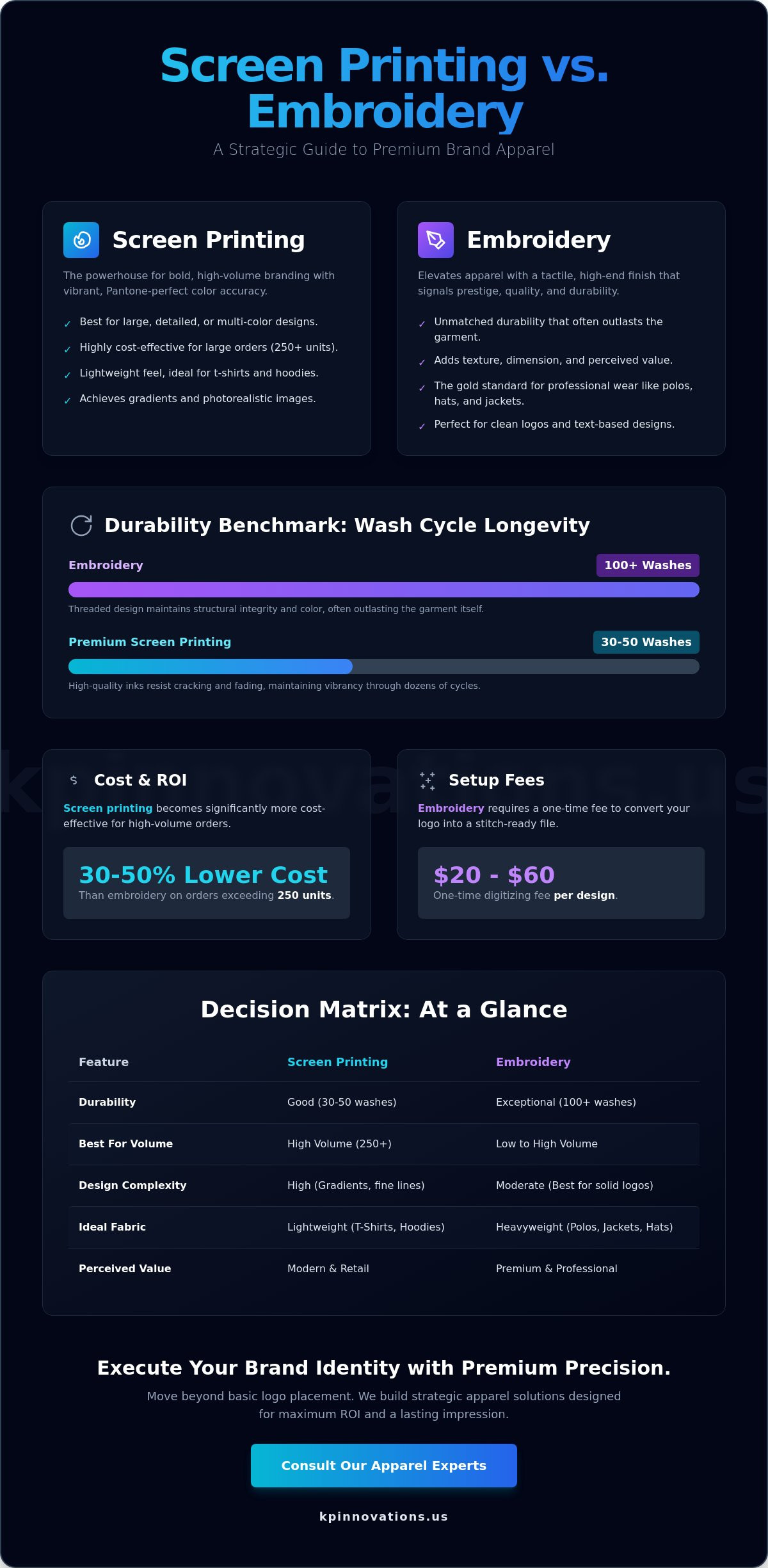
Choosing between screen printing vs embroidery for logos requires a calculated look at your project’s specific variables. It isn’t just about which looks better on a screen. You must account for the garment’s lifecycle and your intended ROI. A design that looks elite on day one but fails the “50-Wash Test” is a liability to your brand. While screen printed designs typically show wear after 30 to 50 wash cycles, embroidery remains crisp through 100 or more. This long-term durability often answers the common objection regarding the higher initial cost of thread. If your team wears these garments daily, the lower cost-per-wear of embroidery makes it the more strategic investment.
Cost Analysis: Bulk vs. Small Batch
The economics of decoration are driven by setup requirements. Screen printing involves creating physical stencils for every color in your logo. This makes small runs expensive. Conversely, embroidery requires a one-time digitizing fee ranging from $20 to $60 to convert your art into a stitch map. For small orders under 24 pieces, embroidery is often the more affordable choice because you avoid screen setup costs. However, the scale shifts dramatically at high volumes. For orders of 250 pieces or more, screen printing becomes 30% to 50% cheaper than embroidery. We help you identify the “break-even” point where your volume justifies the transition from thread to ink to maximize your budget.
Matching the Method to the Material
Fabric weight dictates your decoration strategy. Heavy fleeces and thick jackets demand the structural integrity of embroidery. Stitches anchor into the heavy pile without getting lost. Thin performance fabrics or lightweight t-shirts require a different approach. We follow the “Weight Rule” to ensure your logo doesn’t cause the garment to sag or pull. A heavy 8,000-stitch logo on a 4-ounce performance tee will drape poorly and feel uncomfortable. In these cases, high-quality screen printing or a lightweight heat transfer is the superior choice. Selecting the right base is critical, so we recommend reviewing our guide on Choosing the Right Apparel Factory to understand how fabric sourcing impacts your final product.
Design complexity also plays a role. If your logo features fine gradients or photographic detail, screen printing is the only way to maintain those nuances. Embroidery struggles with tiny text under 0.25 inches and complex color blends. Before you commit to a production method, request a strategic consultation with our team to ensure your design complexity matches your chosen medium for a flawless finish.
Strategic Apparel Solutions: The KP Innovations Difference
Executing a high-end brand strategy requires more than just picking a decoration method. While the technical choice of screen printing vs embroidery for logos is vital, the execution determines your final ROI. We move beyond simple logo placement to provide true brand elevation. Our “Thread Up” approach ensures that every garment is built as a strategic asset from the foundation. We don’t just put your logo on a product; we integrate it into the very DNA of the apparel. This level of thoughtfulness is what separates us from average promotional vendors who prioritize speed over precision.
Our proven 6-step process removes the stress from your team. We handle every detail from initial sourcing to final kitting and logistics. This white-glove project management is why Fortune 500 companies and luxury brands trust us with their global corporate fulfillment. We ensure that whether your logo is stitched on an executive quarter-zip or printed on a high-volume event tee, the brand identity remains consistent and premium across all SKUs. Every project we deliver is designed to leave a lasting impression on your clients and employees alike.
Private Label Integration and Custom Sourcing
We provide access to over 1.2 million products, ensuring you never have to settle for a fabric that doesn’t match your decoration needs. This massive sourcing network allows us to create fully custom, private-label apparel where the decoration feels like a natural extension of the design. If you’re looking to expand your brand’s reach beyond clothing, understanding What Are Promotional Products? can help you build a more comprehensive and effective merch strategy. We ensure the fabric-to-decoration match is perfect every time, maintaining the elite positioning your brand deserves.
Fulfillment and Company Stores
Managing branded apparel for a global team is a complex logistical challenge. We streamline this through managed online company stores. This platform ensures absolute logo consistency, regardless of which factory or decoration method is used for a specific project. You no longer have to worry about color shifts or quality variations between different orders. We handle the fulfillment and logistics so you can focus on your core business. Ready to elevate your merch and turn your products into marketing assets? Start a Project with KP Innovations today and experience the difference of a strategic brand partner that builds apparel from the thread up.
Lead the Market with Strategic Apparel Choices
Success in 2026 requires a shift from viewing apparel as a commodity to treating it as a strategic marketing asset. The choice between screen printing vs embroidery for logos ultimately rests on your project’s scale and the lifecycle of the garment. Remember that embroidery offers an elite, textured finish that survives over 100 wash cycles; it is the definitive choice for executive wear. Conversely, screen printing provides the necessary ROI for high-volume rollouts of 250 pieces or more while maintaining Pantone precision. You now have the framework to match your brand’s complexity with the right decoration method and fabric weight.
We provide the expertise to execute these decisions flawlessly. With access to over 1.2 million customizable products and a white-glove project management system, we handle the details from design to global fulfillment. This is why Fortune 500 companies rely on us for elite brand representation. We don’t just deliver merch; we deliver confidence. Elevate Your Brand with Premium Apparel Solutions today. Your brand deserves a partner that builds from the thread up. Let’s create something that leaves a lasting impression.
Frequently Asked Questions
Is embroidery more expensive than screen printing for large orders?
Yes, embroidery is significantly more expensive for high-volume projects. For orders of 250 pieces or more, screen printing typically reduces costs by 30% to 50%. This happens because embroidery costs are tied to stitch counts, which remain constant per item. Screen printing benefits from the efficiency of automated machinery once the initial setup is complete. It’s the strategic choice for mass distribution.
Can you screen print a logo with a lot of detail or gradients?
Yes, screen printing is the superior choice for logos featuring complex gradients or photographic elements. We use high-mesh screens to ensure every fine line is captured accurately. Thread has physical limitations that prevent it from replicating the subtle color shifts found in modern digital designs. This method ensures your complex brand identity is represented with total visual precision.
Which method is better for moisture-wicking athletic shirts?
Screen printing is generally the better choice for moisture-wicking athletic gear. High-performance synthetics are often lightweight, typically around 4 ounces. Heavy embroidery can cause these thin fabrics to sag or pucker. We use specialized stretch inks that move with the fabric. This ensures the garment retains its technical moisture-wicking properties and elite retail feel without unnecessary weight.
What is logo digitization and why do I have to pay for it?
Digitization is the technical process of converting your digital artwork into a specific map for the embroidery machine. You pay a one-time fee, which usually ranges from $20 to $60, because it requires a specialist to program every needle movement. This ensures the logo remains crisp and doesn’t distort the fabric. It’s a foundational step for any premium private-label apparel project.
How long does a screen-printed logo typically last compared to embroidery?
Embroidery offers significantly better longevity than screen printing. An embroidered logo can withstand over 100 wash cycles without losing its structural integrity. Screen-printed designs typically show signs of wear or cracking after 30 to 50 cycles. When evaluating screen printing vs embroidery for logos, consider the garment’s intended lifecycle and your team’s daily wear requirements to maximize your ROI.
Can I use both screen printing and embroidery on the same garment?
Yes, hybrid decoration is a powerful strategy for brand elevation. Many elite brands choose an embroidered logo for the chest to signal prestige and a screen print for the back to handle large-scale graphics. This approach allows you to leverage the tactile benefits of thread while utilizing the bold, visual impact of ink on a single SKU. It’s a sophisticated way to build your brand.
What is the maximum size for an embroidered logo on a chest?
The standard maximum size for a chest embroidery is 4 inches by 4 inches. Exceeding this size often leads to a stiff, heavy feel that ruins the garment’s drape. This makes the apparel uncomfortable for the wearer. If you need a larger graphic, we recommend transitioning to screen printing. It provides a softer, more flexible finish that moves naturally with the person wearing it.
Does screen printing work on dark-colored fabrics without looking dull?
Yes, screen printing produces vibrant results on dark fabrics through the use of an underbase. We print a foundational layer of white ink first, which acts as a primer for your brand colors. This ensures that even on a black hoodie, your logo remains Pantone-perfect and vibrant. It’s a critical technical step for maintaining elite brand representation on dark materials.