
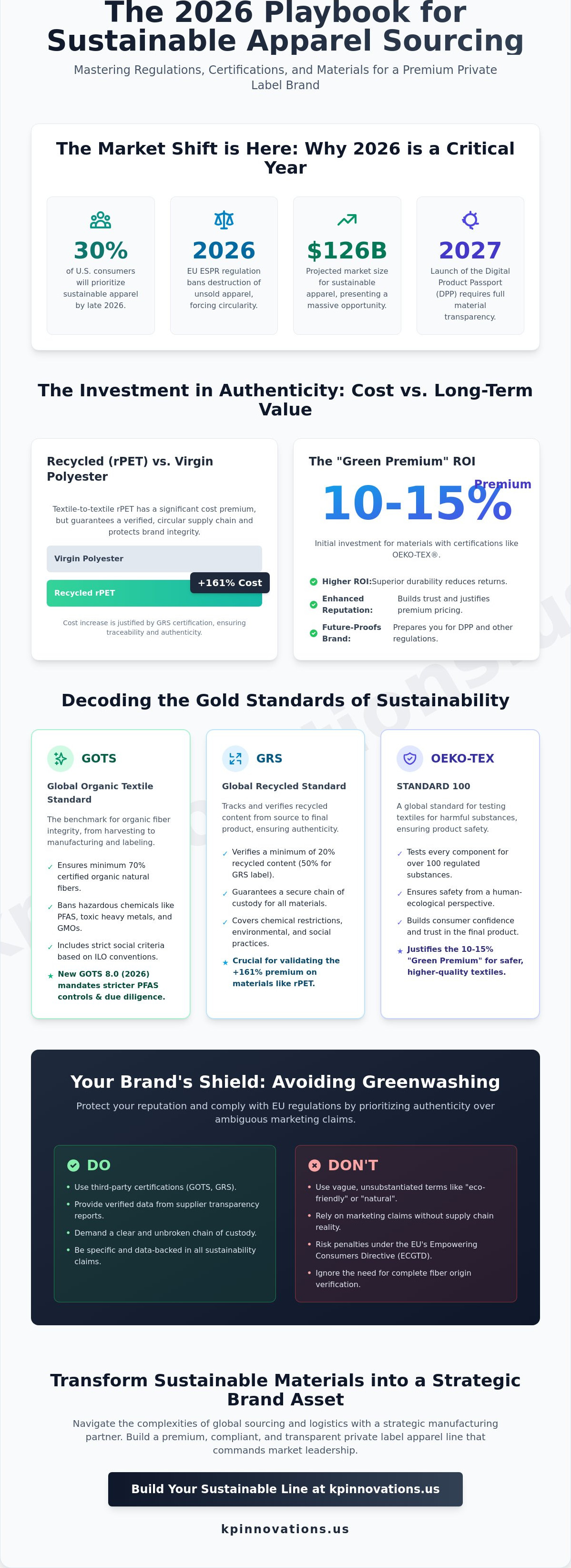
By late 2026, approximately 30% of U.S. apparel consumers will actively prioritize sustainable labels, making eco-conscious production a requirement for market relevance. Sourcing for sustainable private label apparel has shifted from a moral preference to a high-stakes strategic operation. You’re likely facing the frustration of navigating GOTS 8.0 updates and the looming EU ban on unsubstantiated green claims. It’s exhausting to verify the true origin of recycled fibers when textile-to-textile rPET costs 161% more than virgin alternatives.
We understand that building a premium brand requires more than just “green” marketing; it requires a transparent, traceable supply chain. This guide will help you master the complexities of eco-friendly textile procurement to build a high-quality private label line that withstands global scrutiny. You’ll gain a clear framework for selecting textiles and learn which certifications actually matter for your brand’s longevity. We’ll also explore how a strategic partner manages the global sourcing and logistics needed to turn these sustainable materials into a competitive advantage.
Key Takeaways
- Understand how to align your brand with the 2026 shift toward circularity and radical supply chain transparency to secure a premium market position.
- Master the technical differences between GOTS, GRS, and OEKO-TEX certifications to protect your brand from greenwashing risks and regulatory penalties.
- Compare the durability and performance of next-generation fibers specifically engineered for high-quality sustainable private label apparel.
- Implement a structured five-step sourcing process that integrates fiber origin verification with efficient global logistics management.
- Discover how a strategic manufacturing partner provides the deep-level customization and scale needed to transform physical items into strategic brand assets.
The Strategic Shift to Sustainable Fabric Sourcing in 2026
The global textile market has reached a critical inflection point where circularity is no longer a buzzword; it’s a regulatory mandate. Effective July 19, 2026, the EU’s Ecodesign for Sustainable Products Regulation (ESPR) prohibits the destruction of unsold apparel, accessories, and footwear. This shift forces brands to move away from the “take-make-waste” model toward a regenerative approach. For leaders in sustainable private label apparel, this transition represents a massive opportunity to capture a market projected to reach $126 billion by the end of this year.
Supply chain transparency has become the new standard for premium brand identity. Modern clients don’t just buy a product; they invest in the integrity of its origin. This transparency acts as a strategic asset, separating high-tier brands from those relying on outdated, opaque sourcing methods. By integrating data-backed sustainability, you mitigate the risks of supply chain disruptions and build a foundation of trust that justifies premium pricing. This Sustainable Fashion Overview illustrates how the movement has evolved into a sophisticated framework for corporate responsibility.
The long-term ROI of investing in higher-quality materials is undeniable. While there’s a “Green Premium” of 10% to 15% for OEKO-TEX® certified materials, these textiles offer superior durability and lower environmental impact. High-quality fibers ensure your custom garments maintain their shape and finish, reducing return rates and enhancing your reputation for excellence. Investing in the right materials now prepares your brand for the 2027 launch of the Digital Product Passport (DPP), which will require full disclosure of material composition.
Beyond the Trend: Sustainability as Brand Equity
Eco-conscious sourcing is your best defense against shifting global regulations. By adopting GOTS 8.0 standards early, you stay ahead of mandatory due diligence requirements. This proactive stance creates a powerful emotional connection with consumers who demand ethical supply chains. Positioning your brand as a leader in the premium promotional products space requires a commitment to these values. It’s about proving that your sustainable private label apparel is built on a foundation of genuine environmental performance.
Avoiding the Pitfalls of Greenwashing
Authenticity requires more than just a “recycled” label. To ensure your brand remains compliant with the EU’s Empowering Consumers for the Green Transition Directive (ECGTD), you must use verified data from supplier transparency reports. Avoid vague terms like “natural” or “eco-friendly” that lack third-party substantiation. Greenwashing is the gap between marketing claims and supply chain reality. Look for certifications that provide a clear chain of custody, ensuring that every fiber in your collection meets the high standards your clients expect.
Decoding Sustainability: Key Certifications and Standards
In 2026, a simple “eco-friendly” tag doesn’t cut it. Third-party verification has become non-negotiable for corporate brands aiming to avoid the legal and reputational fallout of greenwashing. To build a legitimate line of sustainable private label apparel, you must rely on rigorous industrial standards that offer a clear chain of custody. Organizations like Cascale (formerly Sustainable Apparel Coalition) emphasize the importance of using standardized tools to measure and share sustainability performance across the industry. Without these benchmarks, your brand’s claims lack the data-backed authority required by modern procurement departments.
The Gold Standards: GOTS and GRS
The Global Organic Textile Standard (GOTS) remains the benchmark for organic fiber integrity. With the release of GOTS 8.0 in March 2026, the standard now includes strengthened controls for PFAS and mandatory due diligence aligned with OECD guidelines. If your fabric isn’t GOTS certified, you can’t legally claim it’s organic in many jurisdictions. Meanwhile, the Global Recycled Standard (GRS) tracks recycled content from the source to the final product. It ensures that the recycled polyester you’re paying a premium for, which can cost 161% more than virgin PET, is actually what it claims to be. Your manufacturer must hold these certifications to maintain the chain of custody from the fiber origin to the finished garment.
Safety and Social Responsibility
Environmental certifications are only half the battle; social and labor audits ensure the people making your clothes are treated fairly. OEKO-TEX Standard 100 is a global testing system for raw textile materials. It guarantees that every component, from the fabric to the zippers and threads, is free from harmful chemicals. Beyond chemical safety, certifications like Fair Trade and B Corp status integrate social ethics into your procurement process. This holistic approach transforms standard promotional products into strategic assets that reflect your brand’s core values and commitment to global citizenship.
Don’t take a vendor’s word for it. Always verify certificate numbers through official industrial databases like the GOTS Public Database or the OEKO-TEX Label Check. This level of due diligence protects your brand from fraudulent suppliers and ensures your sustainable private label apparel meets the high standards your clients expect. If you’re looking to simplify this complex process, partnering with a team that offers expert sustainable sourcing management can ensure your supply chain remains transparent and compliant.
Top Sustainable Fabrics for Private Label Apparel
Selecting the right textile is the most critical decision for your brand’s physical identity. In 2026, premium clients expect a sophisticated “hand-feel” that doesn’t compromise on ethical standards. Building high-quality private label apparel requires a deep understanding of how different fibers perform under daily wear and repeated laundering. You aren’t just choosing a material; you’re selecting the foundation of your brand’s reputation for excellence.
Natural Fibers: Organic Cotton and Hemp
Organic cotton remains the industry standard for soft, breathable basics. It’s expected to represent 38.0% of the sustainable apparel market by fiber composition this year. For brands targeting the luxury market, organic Pima cotton offers extra-long staple fibers that result in a smoother, more durable finish. Hemp is the rising star of 2026, prized for its incredible strength and low environmental impact. It requires very little water and no pesticides, making it a favorite for rugged, long-lasting collections. When blended with organic cotton or Tencel, hemp loses its natural stiffness, creating a garment that’s both soft and nearly indestructible. Linen and Tencel provide moisture-wicking properties and a luxury drape that’s perfect for high-end resort wear.
Recycled and Synthetic Alternatives
Recycled Polyester (rPET) has transformed the performance wear sector by turning post-consumer plastic waste into high-performance textiles. While it carries a price premium, its ability to wick sweat and maintain shape makes it indispensable for activewear lines. Recycled nylon offers similar benefits for outerwear and swimwear, providing the durability of virgin synthetics without the same carbon footprint. For small-batch sustainable private label apparel, deadstock fabric is a brilliant strategic choice. Using existing surplus from high-tier mills allows you to create exclusive, limited-run pieces while actively reducing industry waste. This approach appeals to the modern consumer’s desire for both uniqueness and radical waste reduction.
Premium garment construction also depends on fabric weight, measured in grams per square meter (GSM). A higher GSM provides the “heavyweight” feel often associated with luxury streetwear and high-end basics. It ensures the garment keeps its structure over time, which is a key indicator of quality for discerning buyers. Balancing GSM with the specific fiber’s properties allows you to engineer clothing that looks, feels, and performs exactly as intended for your target market.
The Sourcing Process: From Fiber Origin to Global Logistics
The journey from a raw fiber to a finished garment is a high-stakes operation that requires precision at every stage. For brands developing sustainable private label apparel, the process is significantly more complex than traditional manufacturing. You aren’t just buying fabric; you’re managing a certified chain of custody that must remain unbroken from the farm to the final delivery. Success in 2026 depends on a structured, five-step sourcing framework:
- Material Specification: Defining the exact GSM, fiber blend, and performance requirements.
- Certification Audit: Verifying the GOTS or GRS credentials of the specific mill.
- Prototyping: Developing samples to test “hand-feel” and durability before bulk commitment.
- Production Oversight: Managing dye lot consistency and eco-standard compliance during the run.
- Global Logistics: Navigating international shipping, customs duties, and final fulfillment.
Your choice of an apparel factory is the most critical link in this chain. A strategic partner does more than sew garments; they act as your primary procurement officer. They manage the volatile pricing of organic cotton, which currently ranges from $3 to $5 per yard, and ensure that recycled polyester shipments aren’t contaminated with virgin fibers. This level of white-glove project management reduces your operational stress and protects your brand’s integrity.
Tech-Driven Sourcing and Traceability
Modern sourcing relies on digital transparency. As the 2027 Digital Product Passport (DPP) mandate approaches, integrating scannable traceability codes has become a standard practice. This integration typically adds between $0.05 and $0.15 per garment, but it provides the data-backed proof consumers demand. Technology also helps manage dye lot consistency across large production runs. It ensures that the specific “eco-friendly” dyes used in your collection maintain a uniform aesthetic, regardless of the batch size.
Scaling Your Sustainable Collection
Moving from a limited prototype to bulk production requires a sophisticated approach to Minimum Order Quantities (MOQs). High-tier sustainable mills often have strict MOQs due to the specialized nature of their production lines. We help brands manage these requirements through strategic inventory planning, ensuring you don’t overproduce while maintaining a competitive price per unit. Integrated fulfillment completes the cycle. By combining manufacturing with dedicated warehousing and global distribution, you eliminate the logistical gaps that often lead to delays and increased carbon footprints. This end-to-end control is what transforms a simple clothing line into a resilient, scalable brand asset.
Ready to streamline your supply chain? Partner with our strategic sourcing experts to manage every detail of your international logistics and production.
Elevating Your Brand with KP Innovations Sustainable Solutions
KP Innovations isn’t just a vendor; we’re a strategic partner dedicated to your brand’s elevation. While standard suppliers often limit you to off-the-shelf blanks, we specialize in building sustainable private label apparel from the ground up. This deep-level customization ensures that your physical assets align perfectly with your corporate identity. We provide access to over 1.2 million products, giving you the scale of a global entity with the precision of a boutique agency.
Our white-glove service manages the entire lifecycle of your project, from initial design to final delivery. We handle the complexities of eco-friendly textile procurement and international logistics so you don’t have to. We handle the details. This managed process reduces client stress and ensures that every garment meets the high standards your audience expects. We turn the challenge of global sourcing into a seamless, proactive experience that focuses on your brand’s growth and lasting impact.
Custom Private Label Expertise
Creating a unique clothing line requires more than just a logo; it requires a commitment to quality control and ethical manufacturing. We help you move beyond generic merchandise to create high-impact brand experiences. Our expertise in sustainable private label apparel allows us to source the best materials while maintaining a transparent supply chain. We take pride in our ability to manufacture from the ground up, ensuring that your brand’s reputation for excellence is woven into every piece.
Global Fulfillment and Dedicated Support
Efficiency and reliability are the cornerstones of our fulfillment and logistics services. We streamline your brand’s reach through custom company stores and team store platforms, providing a centralized hub for your branded assets. Based in Horsham, Pennsylvania, we offer global distribution capabilities that don’t sacrifice localized precision. Our dedicated support roles ensure that every phase of your project is managed with a service-first philosophy. It’s time to move beyond standard vendors and initiate a strategic partnership that treats your merchandise as a powerful tool for elevation.
Elevate your brand with KP Innovations today.
Secure Your Brand’s Future through Strategic Sourcing
The transition toward circularity isn’t just a moral choice; it’s a strategic requirement for market relevance in 2026. Success in this new landscape requires a sophisticated blend of certified fiber integrity, rigorous supply chain transparency, and precise logistics management. By mastering these complexities, you transform simple garments into strategic brand assets that resonate with an increasingly conscious consumer base. Mastering the procurement of sustainable private label apparel positions your brand as a premium leader in a competitive global landscape.
We invite you to move beyond standard vendor relationships to a true strategic partnership. With access to over 1.2 million premium products and end-to-end white-glove project management, KP Innovations handles every intricate detail of global fulfillment and logistics. Our expertise ensures your vision is executed with absolute precision from the ground up, reducing your operational stress while maximizing your brand’s impact. Your journey toward a more sustainable and successful legacy begins with a single, strategic choice. Partner with KP Innovations for Sustainable Private Label Apparel and let’s build something extraordinary together.
Frequently Asked Questions
How do I know if a fabric is actually sustainable?
You verify a fabric’s sustainability by requesting third-party certifications and checking the supplier’s chain of custody. Authentic materials will have a valid certificate number from organizations like GOTS or OEKO-TEX. You can verify these numbers directly in industrial databases. This level of due diligence is essential for brands developing sustainable private label apparel to avoid greenwashing. It ensures the environmental claims you make are backed by rigorous, verified data.
What is the most sustainable fabric for t-shirts in 2026?
In 2026, the most sustainable choices for t-shirts are organic cotton and hemp blends. Organic cotton is expected to represent 38.0% of the sustainable fiber market this year, offering superior softness and breathability. Hemp provides incredible durability and requires significantly less water than traditional crops. Combining these fibers creates a high-quality, long-lasting garment. This blend represents a premium standard for modern clothing lines that prioritize both comfort and ecological impact.
Are sustainable fabrics more expensive than traditional materials?
Sustainable materials generally command a higher price due to more rigorous manufacturing and labor standards. Industry data indicates a “Green Premium” of 10% to 15% for OEKO-TEX certified materials. Organic cotton can cost between $3 and $5 per yard, while conventional cotton remains lower. These costs reflect the investment in soil health, chemical safety, and fair wages. High-tier brands view this as a strategic investment in quality and risk mitigation.
What certifications should I look for when sourcing eco-friendly textiles?
You should prioritize GOTS, GRS, and OEKO-TEX Standard 100. GOTS ensures the organic integrity of fibers, while GRS tracks recycled content from the source to the shelf. OEKO-TEX focuses on chemical safety, guaranteeing the fabric is free from harmful substances. These certifications are the baseline requirements for any reputable collection of sustainable private label apparel. They provide the transparency needed to meet new global transparency regulations and build lasting consumer trust.
Can sustainable fabrics be used for high-performance athletic wear?
Yes, recycled synthetics like rPET and recycled nylon are ideal for high-performance athletic wear. They provide the same moisture-wicking and durability properties as virgin synthetics but with a much lower environmental footprint. Recycled polyester is specifically engineered to handle intense physical activity while maintaining its structure. Many luxury and performance brands now use these materials as their primary choice for outerwear, swimwear, and compression gear to meet sustainability goals.
How do Minimum Order Quantities (MOQs) work for sustainable fabrics?
Minimum Order Quantities (MOQs) for sustainable fabrics are typically determined by the specialized nature of the production run. Because eco-friendly mills often run smaller, dedicated batches to prevent contamination, their MOQs can be higher than mass-produced conventional fabrics. We manage these requirements through strategic inventory planning and long-term production schedules. This approach allows brands to access premium textiles without the risk of overproduction or excessive deadstock.
What is the difference between recycled polyester and virgin polyester?
The primary difference lies in the source and environmental impact of the fiber. Virgin polyester is a petroleum-based synthetic, whereas recycled polyester (rPET) is made from post-consumer plastic waste. In Q2 2025, textile-to-textile rPET reached a price of €2,479 per tonne, reflecting its complex processing requirements. Despite the cost, rPET significantly reduces energy consumption and diverts plastic from landfills. It’s a critical component for brands focusing on circular economy principles.
Is organic cotton really better for the environment?
Organic cotton is significantly better for the environment because it prohibits synthetic pesticides and fertilizers. This practice protects local water systems and improves soil biodiversity over time. Conventional cotton farming is one of the most chemically intensive processes in the textile industry. By choosing organic, you support regenerative farming practices that actively restore ecosystems. It’s a foundational choice for any brand committed to a low-impact, ethical supply chain.