
A launch giveaway can make a product easier to forget if it feels disconnected from the story. The strongest swag for product launch events doesn’t compete with the reveal. It gives guests a useful way to carry the product experience beyond the room. That takes more than choosing an item and adding a logo.
It’s understandable to want merchandise that makes an event memorable without adding another layer of logistics. The key is to treat merchandise as media: a physical part of the brand experience, chosen to reinforce what the product stands for and how people encounter it.
This article explores how to connect launch merchandise to the product story, create a coherent experience before, during, and after the event, and choose items with a purpose beyond the day itself. It also explains why strategy, creative development, sourcing, production management, and fulfillment work best as one coordinated program, rather than a series of disconnected handoffs.
Key Takeaways
- Use swag for product launch events to reinforce the product’s message, not compete with the reveal.
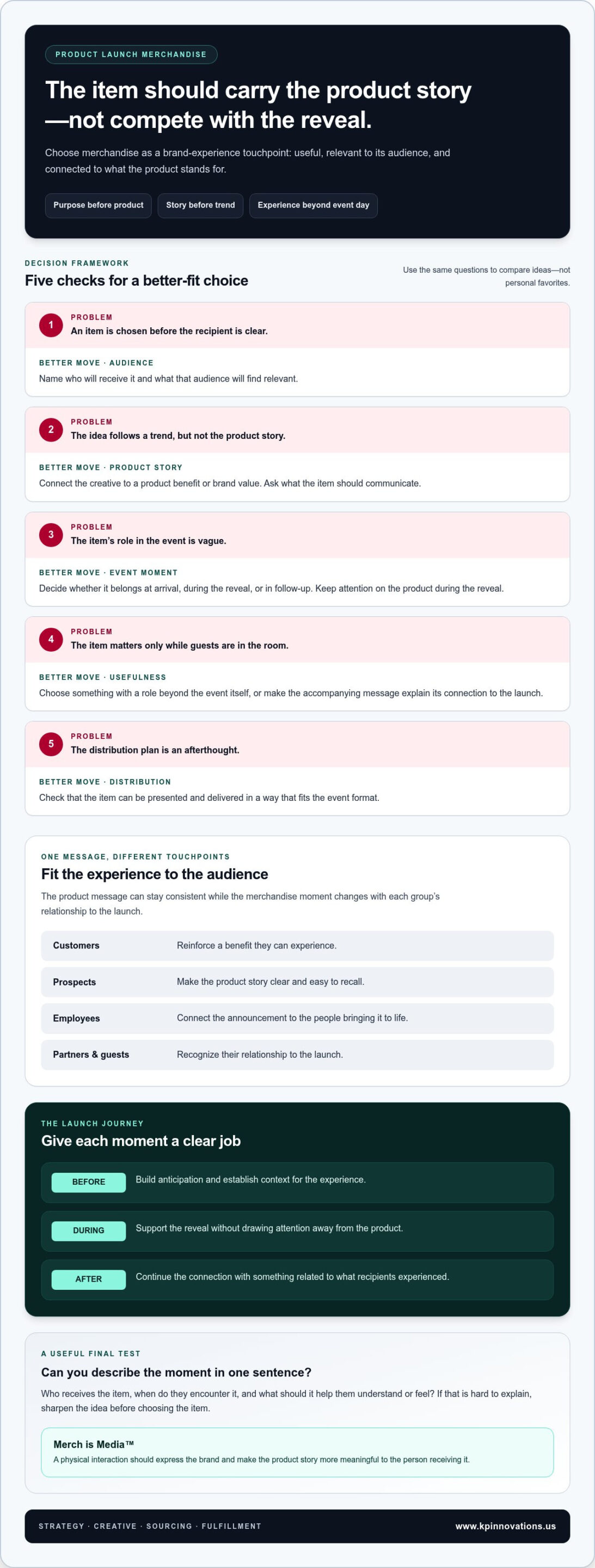
- Choose merchandise by weighing the audience, product story, event moment, usefulness, and distribution plan.
- Plan for pre-event anticipation, the live reveal, and post-event continuity so the experience doesn’t end when guests leave.
- Align ownership, creative approvals, audience counts, and delivery destinations to reduce event-day friction.
- Evaluate whether launch merchandise supports a broader brand program, not only whether items were distributed.
Why Swag for Product Launch Events Should Support the Reveal
A product reveal gives people a reason to pay attention. Merchandise can extend that moment into a lasting brand experience, but only when it belongs to the story being told. Start by understanding the purpose and key considerations of a product launch, then decide what role a physical item should play in the experience.
Launch-event merchandise is a brand-experience touchpoint that gives people a useful, tangible connection to the product story.
This is the difference between thoughtful merchandise and a generic giveaway. The question isn’t whether an item is practical or simple. It’s whether the choice feels intentional for this audience and this launch. A familiar, useful item can be right if its design, message, or role connects to the product. An item that draws attention away from the reveal, or could belong to any event, adds clutter instead of meaning.
What should product-launch merchandise accomplish?
Start by defining the job the merchandise needs to do. Connect it to a product benefit, brand value, or launch theme, then clarify what guests should experience in that moment. Is the item there to welcome them, make a key idea easier to understand, thank them for being part of the launch, or maintain a connection afterward? A clear purpose keeps the item in service of the story.
Consider the audience, too. An object that’s useful to a customer may not be the clearest way to introduce a product to a prospect. If the item needs to communicate, its accompanying message or presentation can explain the connection. If it’s meant to express appreciation, it should feel relevant to the recipient, not simply carry a logo. The product is the tool; the intended experience is the measure of fit.
Which audiences should the launch experience include?
Customers, prospects, employees, partners, and other invited guests may share a room but have different relationships to the product. Customers may value a relevant reminder of what’s new. Prospects may need context that makes the product’s benefit clear. Employees may want to feel connected to the announcement, while partners may be recognized for their role in bringing it to market.
- Customers: Reinforce a benefit they can experience.
- Prospects: Make the product story clear and easy to recall.
- Employees: Connect the announcement to the people bringing it to life.
- Partners and other guests: Recognize their relationship to the launch.
The message can stay consistent while the touchpoint changes. That distinction matters when planning event experiences for different audiences. A considered merchandise strategy treats each item as media: it expresses the brand through a physical interaction, not just a mark on an object. That’s the principle behind Merch Is Media™. For swag for product launch events, ask one simple question: does this choice make the reveal more meaningful for the person receiving it?
How to Choose Product Launch Event Swag That Fits the Story
Choosing merchandise is easier when the team compares ideas against the same criteria instead of debating personal favorites. Start with the experience the launch needs to create, then assess each option against five practical questions:
- Audience: Who will receive the item, and what will they find relevant?
- Product story: Which product benefit or brand value should the creative express?
- Event moment: Is the item for arrival, the reveal, or follow-up?
- Usefulness: Does it have a role beyond the event itself?
- Distribution: Can it be presented and delivered in a way that fits the event format?
Use these questions to compare product categories before narrowing down individual items. For example, custom apparel may fit an employee-facing launch where the team is part of the presentation. Another promotional product category may suit an audience that needs a practical reminder after attending. Neither choice is automatically right. Compare how well each option serves the launch’s purpose, not how closely it follows a trend.
Match the merchandise to the audience and launch moment
Separate items intended for attendees from those meant for employees or partners. Then consider where each item belongs in the event journey. An arrival touchpoint can establish context. Something introduced during the reveal should leave attention on the product. A follow-up item can relate to what recipients experienced. The same category can serve different purposes depending on when and how people receive it.
Before choosing, describe the moment in one sentence: who receives the item, when they encounter it, and what it should help them understand or feel. If that description is hard to write, the idea may need sharper definition.
Use the product story to guide creative development
Translate the product’s positioning into a creative brief that gives designers direction without dictating every detail. Identify the central message, tone, and visual cues that belong to the launch. For a product positioned around simplicity, for instance, the creative direction might favor clear language and uncluttered design. Creative Development connects that direction to the item’s design and presentation.
Use the Merch Is Media™ principle to guide specific creative decisions: what should the item communicate, and how will its design support that message? Keep the intended audience in view as the creative takes shape. With the direction clear, Product Sourcing for launch merchandise can follow the brief rather than a passing trend.
Is Product-Launch Swag Just a Giveaway? Design the Full Experience
No. An item alone can’t create a memorable launch experience. Its meaning comes from how it fits into the moments around the reveal: the invitation, the event, and the follow-up. For swag for product launch events to feel connected rather than incidental, plan its role alongside the communication and logistics that shape each touchpoint.
Packaging, presentation, and timing all contribute. A thoughtfully prepared kit can introduce the launch theme before the event without giving away the announcement. At the reveal, a carefully timed item can help guests connect the moment to the product story without competing for attention. Afterward, a relevant follow-up can extend the experience rather than arrive as an unrelated shipment.
Connect pre-event, event-day, and post-event touchpoints
Map the recipient’s journey before deciding what goes into a package. Each touchpoint should meet a different need while the overall experience remains recognizable. This framework can help teams define the role of merchandise at each stage:
Pre-event anticipation
Audience need: A reason to look forward to the event, with room for discovery.
Merchandise role: Offer a small, relevant introduction to the theme without revealing the full product story.
Live reveal
Audience need: Attention on the announcement and a clear connection to what’s being launched.
Merchandise role: Complement the reveal through its timing, presentation, or connection to the product, rather than drawing focus away from it.
Post-event continuity
Audience need: A follow-up that feels related to the experience they just had.
Merchandise role: Extend the launch story with an item or package that makes sense in context, paired with relevant follow-up communication.
Consistency doesn’t mean every audience receives an identical package. It means each touchpoint feels like part of the same launch. A short note, intentional packaging, and coordination between the reveal and delivery can make the connection easier to understand. Avoid adding layers just to make a package feel fuller. Each element should have a reason to be there.
Keep the experience consistent across formats
In-person guests encounter merchandise in the room, while remote recipients experience the launch through delivery and digital communication. The formats differ, so the details may need to differ too. A kit assembled for remote participants can align its contents and presentation with the event’s key moment. For attendees, distribution should fit the flow of arrival or the reveal, not interrupt it.
Kitting and distribution are part of experience design, not back-office details. Clear plans for what goes together, who receives it, and when it arrives help preserve the intended sequence. A coordinated event merchandise plan can connect these decisions to the wider event program, so physical touchpoints support the same story as the event itself.
How to Plan Product Launch Swag Without Creating Event-Day Chaos
Event-day problems often start earlier: the objective is unclear, approvals are scattered, or no one owns the handoff from production to delivery. A defined sequence helps teams make decisions in the right order and keep the guest experience connected to the launch story. For swag for product launch events, coordinate the work as one program rather than a chain of disconnected tasks.
Move from strategy to delivery in a clear sequence, with an owner and approval point at every handoff.
Build a launch merchandise brief before sourcing
Before considering individual items, create a brief that records the launch objective, intended audiences, event format, central message, and desired experience. Include audience counts and delivery destinations, even if some details are still being finalized. Naming a decision owner and approver up front helps prevent unclear feedback or last-minute changes from disrupting the work.
- Set the objective. Define what the merchandise should support, such as welcoming guests, helping employees connect with the launch, or continuing the experience after the event.
- Establish the audience and distribution plan. Separate attendees, employees, partners, and remote recipients as needed. Record expected quantities and where items or kits need to go.
- Complete Merchandise Strategy. Use the brief to identify product categories that fit the audience, message, and event format. Decide what the merchandise needs to accomplish before narrowing down item choices.
- Develop the creative direction. Through Creative Development, translate the product positioning and launch message into design and presentation choices. Set a clear review path so the right stakeholders can approve the work.
- Coordinate Product Sourcing and Production Management. Once the direction is approved, align sourcing with the selected categories and manage production against the approved creative. Keep one accountable owner connected to decisions, status, and next steps.
- Plan Fulfillment and final delivery. Confirm what needs warehousing, kitting, and shipping, along with delivery destinations and tracking needs. Align the distribution plan with how and when each audience will receive the merchandise.
Coordinate production and delivery around the event
Production Management and Program Management connect approved creative, production activity, and event requirements. They make ownership visible across handoffs, so teams can address questions about approvals, audience counts, or destinations before those details become event-day obstacles. The goal isn’t simply to move items through stages. It’s to preserve the experience defined in the brief.
Fulfillment covers warehousing, kitting, shipping, and tracking. These functions matter when attendees receive items on-site while employees, partners, or remote guests need separate shipments. The more clearly the team defines what goes into each kit and where it needs to go, the easier it is to keep distribution aligned with the launch plan.
Bring Product Sourcing into the lifecycle after the brief establishes the purpose and category, then connect it to creative, production, and delivery decisions. Coordinate Product Sourcing for your launch as part of a managed merchandise program, not as an isolated purchase.
Make Product Launch Swag Part of a Measurable Brand Program
A launch may be a single event, but its merchandise decisions can inform a broader brand program. Treating delivery as the finish line makes it harder to assess whether the experience matched the original intent or what the team should adjust next time. Connect the program to clear goals, consistent ownership, and a review process that carries learning forward.
Measurement starts by defining what the merchandise was meant to do, then reviewing available evidence against that purpose. It doesn’t require claiming that merchandise caused a sale or changed someone’s behavior. If the goal was to help employees feel included in a product announcement, for example, ask whether they received the intended experience and what feedback they shared.
Evaluate the launch experience against its original purpose
Compare the plan with what recipients actually encountered. Did the right audiences receive the merchandise? Did its presentation support the launch story? Were there gaps in distribution, timing, or communication? These questions help distinguish an effective idea from an execution issue without attributing business outcomes to merchandise alone.
Capture feedback from attendees, remote recipients, employees, and the teams who managed the program. Note what felt relevant, what caused friction, and what should change next time. A post-launch review can turn those observations into practical adjustments to the audience plan, creative direction, or fulfillment approach.
Reporting and ongoing optimization give the program continuity. Track decisions, audiences served, distribution details, and qualitative feedback alongside the original objective. That record helps teams compare launches and make more informed choices about future merchandise programs.
Give the merchandise program a strategic owner
A traditional vendor may focus on selecting products and delivering an order. Strategic ownership connects those tasks to the broader program: why merchandise is being used, how decisions are coordinated, and what the team learns afterward. KP Innovations’ Chief Swag Officer model provides outsourced ownership across the merchandise lifecycle, rather than treating each launch as a standalone transaction.
That ownership brings distinct services into one coordinated program. Merchandise Strategy defines the role merchandise should play. Product Sourcing connects the brief to appropriate categories. Fulfillment supports distribution. Together, they help teams maintain accountability from the original objective through review and future planning.
Use these questions to guide the next program review:
- Did the experience match the intended purpose for each audience?
- What feedback or distribution observations should shape the next program?
- Who owns the decisions and learning across the merchandise lifecycle?
A Chief Swag Officer model gives the program a strategic owner beyond the event itself. Build a product-launch merchandise program with Product Sourcing connected to clear ownership and ongoing evaluation.
Make the Next Launch More Intentional
Your next launch can build on what this one taught you. Carry forward audience feedback and planning lessons, then use them to shape merchandise that feels specific to the product and the people experiencing it. That turns swag for product launch events into a more deliberate part of how your brand plans future moments.
Start the next brief with the experience you want to create. From there, make Product Sourcing decisions that support the product story and fit the way recipients will encounter the merchandise.
Plan a launch merchandise program with KP Innovations and give your next reveal a thoughtful foundation. A clear direction can help your team move forward with confidence.
Frequently Asked Questions
What is the best swag for a product launch event?
There’s no universally best item for a product launch event. The right choice depends on who will receive it, what the product story needs to convey, the event format, and the touchpoint it should support. Start with the launch objective, then select a useful category that fits the experience. For example, merchandise for an employee-focused reveal may serve a different purpose than merchandise prepared for customer attendees.
How do you choose swag for a product launch?
Start by defining the audience and goal of the launch, then identify the central product message. Next, decide which moment the merchandise should support, such as guest arrival or post-event follow-up. From there, develop the creative direction and plan how recipients will receive it. This sequence keeps swag for product launch events connected to the launch strategy instead of letting a trend list dictate the choice.
Is swag necessary for a product launch event?
No. Merchandise is optional, and it should have a clear purpose within the experience. If an item doesn’t support the product story, strengthen an audience relationship, or fit a meaningful event moment, leaving it out may be the better decision. A purposeful item can complement the launch, but merchandise alone doesn’t drive sales. The goal is to add something relevant, not provide an item simply because an event is taking place.
What should go in a product launch swag bag?
Choose contents based on the audience, event purpose, product story, and format rather than following a fixed kit formula. Before adding an item, ask what role it plays and whether it belongs with the other contents. A coherent selection feels considered; unrelated additions can make the package harder to understand. Plan creative direction, kitting, and distribution together so the contents arrive as one connected experience.
How can companies make event swag feel less generic?
Give the merchandise a specific connection to the product message, recipient need, or moment in the launch journey. For example, an item prepared for an early event touchpoint can introduce a theme, while a follow-up piece can relate to what guests learned at the reveal. Creative direction and presentation can make that connection clear without relying on excessive branding. The aim is relevance, not a promise of recall or business results.
How do you distribute swag after a product launch event?
Begin by identifying who should receive merchandise, where each recipient is located, and what role the follow-up touchpoint serves. Then coordinate the contents and destinations so recipients receive the intended package. Fulfillment includes warehousing, kitting, shipping, and tracking. Treat these as connected parts of the distribution plan, with clear ownership and recipient information, rather than waiting until after the event to decide how remaining merchandise should be sent.