
Sticker packs are a clear starting point for swag for software developers, but a sticker alone won’t suit every audience or occasion. Pair a playful, code-inspired design with something useful, such as a vocabulary mug, apparel, or a tech accessory, when you want the gift to serve a broader purpose.
Stickers stand out because they’re easy to personalize with developer humor, team references, or familiar symbols. A stronger approach is to choose items based on how people will use them, whether at a desk, on the go, or as part of a team welcome.
This guide explores developer sticker packs, vocabulary mugs, useful apparel and tech accessories, and Docker-themed gear. You’ll see how each option can express team culture and create a more considered brand experience, helping you choose merchandise that feels relevant rather than interchangeable.
Key Takeaways
- Choose sticker designs that reflect real team language and culture, so they feel personal rather than generic.
- Match apparel and tech accessories to how recipients will use them, not just how they look in a gift box.
- Use a vocabulary mug to turn developer humor and shared references into a practical, everyday reminder of team identity.
- Make shirts and hoodies wearable by treating the design, comfort, and relevance as parts of the same decision.
- Use Docker-themed gear to speak to a specific developer community, while keeping the overall merchandise experience connected to your brand.
1. Developer sticker packs
A sticker pack is a flexible starting point for developer gifts because each design can feature a different team reference. For example, combine a simple company mark with a terminal prompt, a branching diagram, or a playful bug icon. Recipients can choose what suits their laptop, notebook, or water bottle. A thoughtful pack feels like a small collection, not several copies of one logo.
Build the designs around recognizable moments in software work. A line such as “works on my machine” speaks to a familiar frustration, while a clean code bracket or command prompt can feel more understated. The loopback address 127.0.0.1, commonly called localhost, offers another precise reference for a developer audience. Use technical jokes selectively, so the meaning stays clear to the intended team.
Next, define the audience before choosing the artwork. A pack for new engineering hires might include references to the team’s tools or working principles. Conference handouts may need designs that make sense without inside knowledge. This distinction matters at events: tech companies may waste up to 30% of event budgets on swag left behind at conference hotels. Compact, relevant pieces are easier to carry than an assortment recipients don’t recognize.
Give the pack a deliberate visual system. Choose a consistent color palette, then vary the illustration, phrase, or icon across designs. For example, a software team could pair a shared brand color with a small “debug” motif and a separate, more discreet logo sticker. Keep text legible at sticker size, and avoid cramming multiple jokes into one design. Clear artwork makes each piece more likely to be used.
Plan distribution as carefully as design. For a developer welcome kit, place the pack beside a note explaining a team reference. At a conference, offer it where attendees can pick up materials without interrupting a conversation. For remote onboarding, include stickers with other welcome items. Each setting changes what makes the pack useful, so tailor the quantity and presentation to the moment.
Finally, connect sticker choices to a broader brand experience. Playful references can signal a team’s culture, while a restrained design may suit customer-facing events. Review each phrase with people who understand its context, especially if it includes jargon or an internal joke. The strongest packs balance shared identity with personal choice, turning a small giveaway into a recognizable reminder of the team.
2. Choosing useful apparel and tech accessories
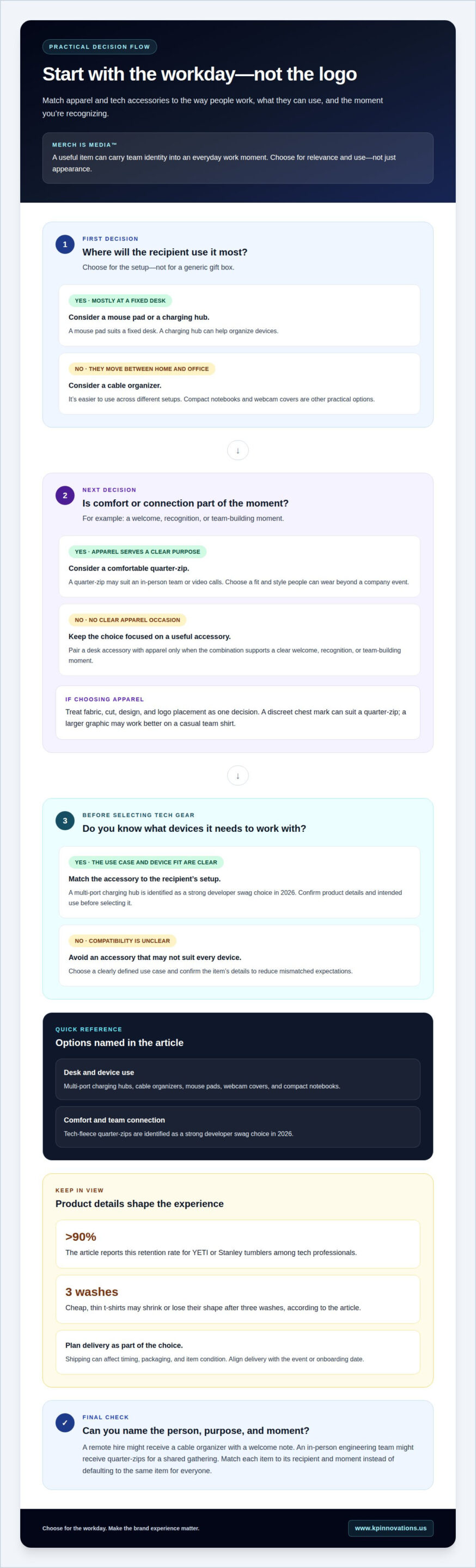
Start with the recipient’s workday, not the logo. A software engineer working remotely may value a multi-port charging hub, while a team meeting in person may appreciate a comfortable quarter-zip. In 2026, tech-fleece quarter-zips and multi-port charging hubs are identified as strong developer swag choices. The right fit depends on whether the item supports focus, comfort, or connection.
For a modest per-person budget, practical tech gifts include cable organizers, mouse pads, webcam covers, and compact notebooks. Choose one item people can use repeatedly, rather than several novelty pieces with little purpose. A mouse pad suits a fixed desk, while a cable organizer is easier to use across home and office setups. Keep the selected item useful without making a low price the main message.
For work-from-home setups, consider accessories that make a desk easier to use. A charging hub can help organize devices, and a cable organizer can reduce loose cords around a laptop. A comfortable quarter-zip can also suit video calls and changing room temperatures. Pair a desk accessory with apparel only when the combination serves a clear welcome, recognition, or team-building moment.
Apparel calls for a different decision process. Choose a fit and style recipients can wear beyond a company event, then make the logo placement feel intentional. A discreet chest mark can suit a quarter-zip, while a larger graphic may work better on a casual team shirt. With custom apparel, the fabric, cut, and design all affect whether the garment becomes part of someone’s regular rotation.
Branded tech gear comes with practical considerations. A charging accessory may not suit every device, and unclear product details can create mismatched expectations. Shipping can also affect timing, packaging, and the condition of items on arrival. Reduce friction by choosing a clearly defined use case, matching the item to recipients’ devices, and planning delivery around the event or onboarding date.
Before finalizing an assortment, match each item to a recipient and moment. For example, remote hires could receive a cable organizer with a welcome note, while an in-person engineering team might receive quarter-zips for a shared gathering. This simple pairing clarifies the purpose and avoids sending every employee the same item by default.
Thoughtful sourcing helps align product details, intended use, and delivery needs before an order moves forward. A structured merchandise sourcing process can help teams coordinate those decisions, especially when apparel and tech accessories need to work together as one experience.
Retain practical standards: the page reports a retention rate of more than 90% for YETI or Stanley tumblers among tech professionals. Cheap, thin t-shirts may shrink or lose their shape after three washes.
3. Developer vocabulary mug
A vocabulary mug works when its wording feels familiar to the people using it. Choose a term such as “merge conflict,” “undefined,” or “works on my machine,” then connect it to your team’s personality. One phrase gives the design a clear focus. Avoid stacking unrelated jokes, company slogans, and technical terms together. The mug should feel like a thoughtful nod to developer culture, not a glossary printed on ceramic.
Start with the audience’s shared language. A platform engineering team may recognize “localhost,” while a broader group may enjoy a simple “beep boop.” The phrase “beep boop” became widely familiar through the 1977 film Star Wars: A New Hope. A pop-culture reference can add recognition, but it should support the team’s voice rather than take it over. Choose wording people can understand without needing a long explanation.
Next, decide what the mug should communicate. A playful phrase can welcome new hires, while a short team motto can mark a project milestone. For example, a mug reading “Ship it” could accompany a software launch celebration. A phrase such as “It’s not a bug, it’s a feature” has a more humorous tone. Match the wording to the moment, especially when the mug is for customers or cross-functional colleagues.
Keep the design readable at a glance. Use one main phrase, then reserve smaller text for a name, team, or subtle brand mark. A line break can make a longer phrase feel intentional: place “works on” above “my machine” rather than shrinking the type until it becomes difficult to read. Contrast between the lettering and background matters, too. Review the layout as a mug design, not just as text on a screen.
Consider how the mug fits into the recipient’s day. A remote employee may use it during a morning stand-up, while an office team might keep matching mugs in a shared kitchen. For onboarding, include a brief card explaining an internal phrase, such as the team’s shorthand for a release process. That context turns an unfamiliar joke into a small introduction to how the group works.
Finally, connect the mug to a specific experience. For an engineering welcome kit, pair “Hello, world!” with a personal welcome note. For a project close, choose a phrase the team actually used during delivery. Avoid treating the mug as a standalone logo carrier. A clear reference, appropriate tone, and useful context connect this simple desk item to the people and work behind the brand.
4. Developer-themed shirts and hoodies
A shirt or hoodie can make team identity visible beyond a screen, but the design needs to feel wearable. First decide whether the garment marks an event, welcomes a new engineer, or celebrates shared team culture. For example, a restrained chest graphic may suit everyday wear, while a larger back print can identify a conference team. Match the visual scale to where recipients will wear it.
Developer references work best when the intended audience recognizes them quickly. A design built around 127.0.0.1, commonly called localhost, offers a specific wink for engineers. The line “I are programmer I make computer beep boop” uses a deliberately playful voice. Both concepts were scheduled for limited-edition release on February 1, 2023. Use references like these when their humor fits the group, not as decoration without context.
Choose between a shirt and hoodie based on the occasion and expected use. A T-shirt can work for a casual team event or conference, while a hoodie may suit a welcome kit or cooler office setting. Consider whether the design should convey internal team humor or communicate clearly to customers. A niche joke can build belonging among engineers, but a public-facing event may call for a more accessible graphic.
Fabric matters to the garment’s construction and the wearer’s experience. Fabric accounts for 50% of a garment’s manufacturing cost, as reported in May 2026. That makes fabric selection a central design decision, not a finishing touch. A shirt intended for frequent wear needs a feel and structure suited to regular use. A hoodie for a one-time event may serve a different purpose than apparel meant to represent the team throughout the year.
Before production, review the design on the actual garment shape. A graphic that reads well on a flat screen can feel crowded across a hoodie pocket or disappear beneath a quarter-zip layer. Check logo scale, placement, contrast, and text legibility together. For example, a small command-line prompt may need more space than a simple icon. A clear proof helps align the artwork with the intended wearer experience.
Plan distribution around how people will receive the apparel. At a team gathering, handing out shirts in person can make sizing exchanges easier to manage. For distributed hires, collect size choices through onboarding and organize delivery by recipient. Keep the message consistent across both approaches. A developer-themed garment has more meaning when its design, fit, and delivery all support the same moment.
Finally, treat apparel as a signal of culture, not just a surface for a logo. A “localhost” graphic may resonate with an engineering group, while a shared team phrase can feel more inclusive. Tie the design to a clear purpose, such as welcoming new colleagues or marking a product milestone. That connection helps a shirt or hoodie represent the people and work behind the code.
5. Docker-themed developer swag
Sustainable choices start with usefulness and repeat use. For a Docker-themed gift, consider a reusable mug, a durable notebook, or an item recipients already need. Choose a design connected to containers, deployment, or the Docker whale without making the theme feel disposable. An item that suits someone’s routine is a stronger choice than novelty packaging alone.
Docker references work best when they reflect shared engineering language. A container icon, a command-line joke, or a simple whale illustration can signal the theme without crowding the design. Docker gained widespread adoption around 2016, making it a recognizable reference for many software teams. Keep the company identity clear, but let the Docker idea lead when the gift celebrates a technical community or team milestone.
Survey preferences don’t point to one universal item for every software developer. One reported preference is that 75% of tech employees prefer working for companies that prioritize environmental responsibility, in early 2026. Use that signal to shape choices around practical use, durable design, and less unnecessary material. It speaks to company values, not a definitive ranking of favorite gifts.
For a Docker-themed assortment, connect each piece to a specific use. A reusable mug can carry a compact container graphic, while a notebook might feature a deployment-themed phrase. A subtle sticker can add a small visual accent to a larger welcome gift. Choose items that make sense together rather than assembling unrelated products around the same logo.
Design restraint matters. A large Docker whale may suit an internal engineering event, while a smaller mark can feel more appropriate for customer-facing occasions. Pair the graphic with a short phrase only if it adds meaning, such as a reference to “shipping” code. Avoid wording that depends on a joke recipients may not share. The design should make the connection clear without requiring a technical explanation.
Docker-themed merchandise was scheduled for limited-edition release on April 1, 2023. That date offers a reminder to treat themed pieces as tied to a particular moment, rather than assuming every design suits every audience. For a product launch, onboarding group, or developer event, connect the visual concept to that occasion. A clear purpose also helps determine whether the gift should be playful, practical, or more understated.
Build the final selection around the people receiving it. An engineering team may enjoy a container reference, while a mixed audience may respond better to a practical item with a small Docker detail. Thoughtful merchandise sourcing can align the product, artwork, and audience. Use that process to shape a Docker-themed gift that expresses the team’s culture and environmental priorities.
KP Innovations
KP Innovations is a long-term merchandise partner, owning programs from strategy and creative development through product sourcing and fulfillment. That continuity keeps each decision connected to the experience you want employees and customers to have.
“Merch Is Media™” reflects how merchandise can shape people’s experience of your brand, build team culture, and strengthen relationships. Products are the medium; the moments and meaning around them create the impact. KP Innovations brings this perspective to programs spanning Promotional Products, Custom Apparel, and Awards & Recognition Items.
To discuss a developer merchandise program built around your goals, contact KP Innovations.
Make the Next Developer Gift More Intentional
The next decision isn’t simply which item to order. It’s what you want the experience to communicate and how that choice fits the way your developers work and connect. Treat swag for software developers as part of the brand experience, not a disconnected giveaway. A clear purpose can guide the creative, product selection, and moment each item reaches its recipient.
Start by defining the audience and occasion. Is this for onboarding, a team milestone, or a developer event? Then decide what should feel distinctive about the experience. That focus gives your merchandise program a stronger foundation and keeps each choice connected to your broader brand.
KP Innovations can help shape the sourcing decisions behind that plan, from product direction to a cohesive experience. Talk with KP Innovations about sourcing developer merchandise and take the next step toward a program your team can stand behind.
Frequently Asked Questions
The ultimate and most popular branded developer swag item?
A developer sticker pack is a strong all-around choice, though no single item suits every team. Recipients can choose which designs to use and where to place them. To make a pack more distinctive, build it around a team principle, shared tool, or product launch instead of relying only on a company logo. Pairing it with another gift can make it better suited to a specific occasion.
What are popular swag items for software developers?
Popular options include themed stickers, mugs, apparel, and practical desk accessories. The occasion helps determine what fits: onboarding calls for a welcoming gesture, a hackathon can use event-specific gear, and employee recognition should connect to a meaningful achievement. For swag for software developers, a coordinated selection can feel more relevant than sending the same assortment to every audience.
Where can companies buy custom swag for software developers in the US?
US companies can work with KP Innovations on merchandise strategy and sourcing. Its offerings include Promotional Products, Custom Apparel, and Awards & Recognition Items. This is a good fit when a team wants merchandise tied to an occasion, such as onboarding, a developer event, or employee recognition. Defining the audience and purpose first helps shape a coordinated program rather than starting with a product alone.
How do you choose useful, high-quality developer swag?
Start with the intended recipient, use, and frequency. For apparel, consider comfort, sizing, and whether the design suits everyday wear. For tech accessories, prioritize a clear purpose and relevance to recipients’ devices. Review the artwork at its final size, too. The item and its decoration should express the same brand tone, with usefulness taking priority over logo visibility.
What are good developer swag ideas for conferences and hackathons?
For conferences, choose pieces attendees can carry easily and understand without explanation. At hackathons, connect merchandise to the event experience: a welcome item for participants and a distinct recognition piece for winning projects. Keep the visual style consistent across the event, but make the award meaningfully different. That distinction helps it mark an achievement rather than feel like another attendee giveaway.