
Most apparel brands fail not because they lack creative vision, but because they treat manufacturing as a simple transaction instead of a strategic engineering feat. You’ve likely felt the weight of global supply chain complexity or the sting of receiving a bulk order that misses the mark on quality. It’s frustrating to watch inventory headaches stall your growth when you should be scaling. Mastering the private label apparel production process is the definitive way to move from generic merchandise to a bespoke brand that commands a premium.
In this 2026 guide, we’ll provide the expert-led roadmap you need to engineer high-quality garments with confidence. You’ll learn how to navigate the latest industry shifts, including the July 2026 FTC labeling mandates and California’s new textile recovery framework. We’ll explore everything from building professional tech packs to establishing quality control standards that protect your reputation. This article breaks down the transition into manageable phases, giving you the tools to move from a simple vendor relationship to a high-touch manufacturing partnership. By the end, you’ll have a clear path toward scalable fulfillment and a brand that truly stands apart.
Key Takeaways
- Understand the 2026 shift toward lifestyle-first garments and why private label branding is essential for modern corporate identity.
- Master the private label apparel production process using a professional roadmap that covers everything from technical design to bulk manufacturing.
- Learn how to safeguard your brand’s reputation by utilizing AQL quality control standards to ensure consistent garment excellence.
- Discover how to scale your brand efficiently through proprietary company stores and high-touch global fulfillment logistics.
- Evolve your procurement strategy by moving beyond simple vendors to a strategic partnership that manages complex manufacturing from the ground up.
What is Private Label Apparel and Why It Matters in 2026
A private label product is manufactured by a specialized third-party partner but distributed under your unique brand identity. In 2026, this concept has evolved far beyond simple logo placement. It now represents a sophisticated methodology for building brand equity through custom engineering. The private label apparel production process allows organizations to move away from generic, off-the-shelf merchandise and toward bespoke garments that reflect their specific values and aesthetic standards. This shift is driven by a market that no longer accepts “disposable” promotional items; today’s audience demands retail-quality apparel that integrates into their daily lives.
The 2026 landscape is defined by “lifestyle-first” corporate apparel. Employees and clients expect garments they actually want to wear, featuring modern cuts and premium technical fabrics. By treating apparel as a strategic asset rather than a marketing expense, ambitious brands create a lasting impact. When a garment offers superior comfort and style, it remains in a person’s wardrobe for years, providing continuous brand exposure and a significantly higher perceived value than standard wholesale options. To explore how these elements of comfort and mindful presence define high-quality fashion, read more.
The Core Benefits of Private Labeling
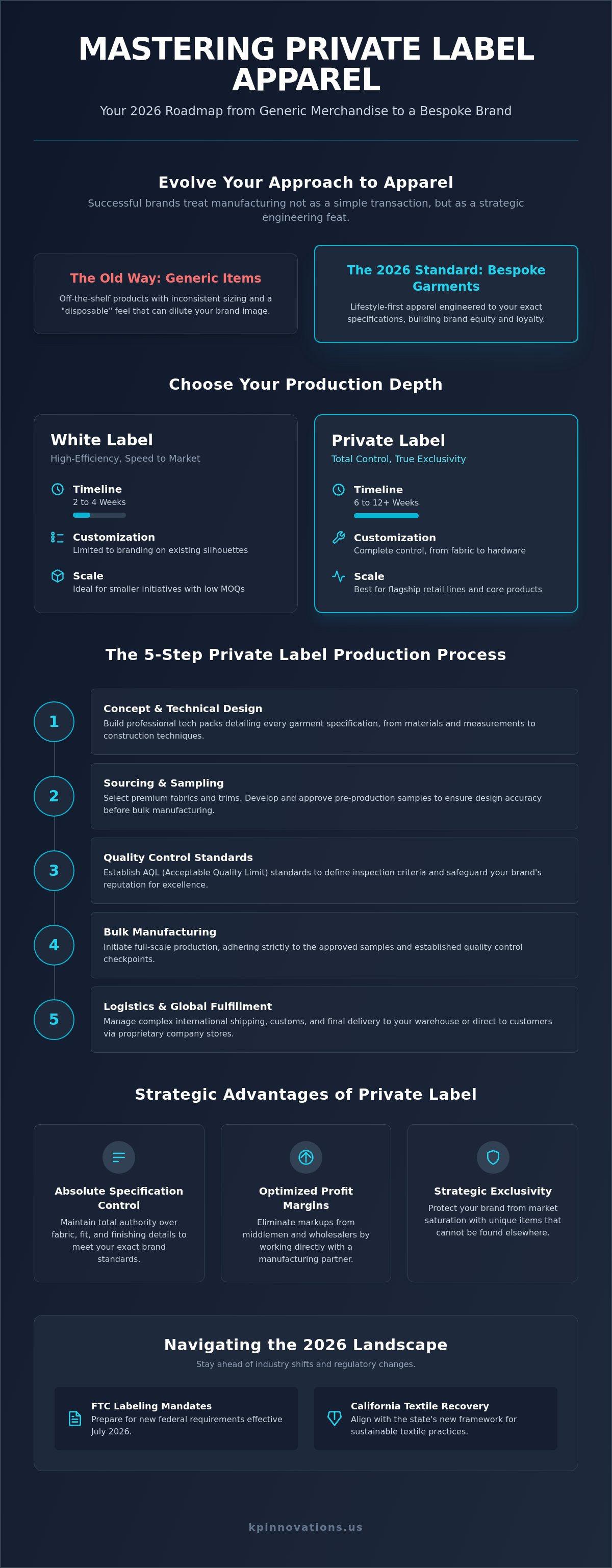
- Absolute Specification Control: You maintain total authority over fabric selection, fit, and finishing details to ensure every piece meets your exact brand standards.
- Optimized Profit Margins: By working directly with a manufacturing partner, you eliminate the markups associated with traditional retail middlemen and wholesalers.
- Strategic Exclusivity: Private label items cannot be found elsewhere, ensuring your brand remains distinct and protected from market saturation.
Private label is the ultimate expression of brand ownership in 2026.
Private Label vs. Standard Promotional Items
Standard “off-the-shelf” garments often suffer from inconsistent sizing and generic styling that can inadvertently dilute a premium brand’s image. High-tier organizations avoid these pitfalls by investing in the private label apparel production process to create a bespoke feel. There is a profound psychological impact when an employee receives retail-quality gear; it fosters a sense of belonging and professional pride that generic items simply cannot replicate. This investment in quality directly influences employee retention and brand loyalty, as the garment becomes a symbol of the company’s commitment to excellence rather than a cheap giveaway. Choosing private label ensures your physical assets match the high caliber of your professional services.
White Label vs. Private Label Apparel: Choosing Your Depth
Success in apparel depends on matching your production depth to your brand’s strategic goals. Selecting the right manufacturing path requires an honest assessment of your timeline, budget, and the level of exclusivity you desire. White label, or relabeling, involves applying your branding to existing garments that have already been designed and manufactured. It’s a high-efficiency model for organizations testing new markets or launching seasonal promotions. Conversely, a true private label approach involves building garments from the fiber up. This private label apparel production process requires a deeper commitment but yields a product that is entirely unique to your organization.
Deciding between these paths involves balancing three critical factors:
- Timeline: White label solutions can often be delivered in 2 to 4 weeks, while full custom production typically spans 6 to 12 weeks depending on sourcing location.
- Customization: Relabeling is limited to branding existing silhouettes. Full custom allows you to specify everything from fabric weight to specialized hardware.
- Scale: Smaller corporate initiatives often favor the lower minimum order quantities of white label, whereas flagship retail lines benefit from the exclusivity of custom builds.
Relabeling and Post-Production Customization
Relabeling is a powerful hybrid model that bridges the gap between generic wholesale and custom manufacturing. The process involves removing the manufacturer’s original tags and replacing them with your custom neck prints or woven labels. This simple change transforms a high-quality blank into a professional brand asset. It’s the fastest way to market without sacrificing a premium appearance. Many modern brands use sophisticated data to manage their apparel supply chain, choosing relabeling for limited-run items while reserving custom builds for core collections.
Full Custom ‘Cut and Sew’ Manufacturing
For brands seeking total market differentiation, cut and sew manufacturing is the gold standard. This process begins with a technical blueprint, or tech pack, which dictates every stitch, seam, and measurement. It’s the most intensive version of the private label apparel production process, but it ensures your garments don’t look like anything else on the market. You control the fabric blend, the specific pantone colors, and the fit of the garment. If you’re ready to elevate your brand to this level of precision, exploring our custom apparel solutions can help you navigate these complex manufacturing choices with confidence.
The 5-Step Roadmap: The Private Label Production Process
Transforming a creative vision into a tangible brand asset requires a disciplined, methodical approach. The private label apparel production process isn’t a single event but a series of interconnected phases that ensure quality, consistency, and scalability. Many entrepreneurs looking for a comprehensive guide to starting a business often underestimate the technical rigor required to move from a sketch to a finished garment. Navigating this journey alone can lead to expensive errors, which is why a high-touch, managed approach is essential for brands with high ambitions. This roadmap provides the structure necessary to manage that complexity with professional ease.
- Step 1: Design and Tech Pack Development – Creating the technical blueprint for your garment.
- Step 2: Prototyping and Sampling – Testing fit, function, and fabric before committing to bulk orders.
- Step 3: Strategic Sourcing – Selecting the right factory partner based on capacity, specialized equipment, and ethics.
- Step 4: Bulk Production and QC – Executing the full manufacturing run with rigorous, multi-stage quality checkpoints.
- Step 5: Fulfillment and Distribution – Getting the product to the end-user seamlessly through integrated logistics.
Phase 1: Design and Technical Specifications
Precision begins with the tech pack. This document serves as the absolute blueprint for your garment, detailing every measurement, fabric weight, and stitch type. Without a professional tech pack, manufacturing accuracy is impossible to maintain across bulk orders. With access to over 1.2 million customizable products as a starting point, the design phase allows for deep-level customization from the ground up. In 2026, material selection must also account for evolving sustainability standards and performance requirements like moisture-wicking or recycled fibers. Your tech pack is the binding contract between your brand and the factory; it leaves no room for interpretation or costly errors.
Phase 2: Sourcing and Production Management
Strategic sourcing in the 2026 economy requires balancing speed against cost. Domestic manufacturing offers shorter lead times and simplified logistics, which is ideal for high-velocity corporate needs. Conversely, international sourcing often provides better margins for massive retail runs but introduces more complex supply chain risks. Managing these variables requires specialized white-glove project management to bridge the gap between your design team and the factory floor. Every brand manager should demand specific quality control milestones, such as pre-production meetings and mid-run inspections, to ensure the private label apparel production process remains on track. This proactive oversight reduces stress and guarantees that the final delivery matches your initial prototype exactly. Finally, the process concludes with fulfillment, where proprietary company store platforms and global logistics networks ensure your products reach their destination with total precision.
Overcoming Logistics and Quality Control Objections
The primary anxiety within the private label apparel production process is the discrepancy between a pristine sample and a bulk shipment. It’s a risk that can paralyze a brand’s growth. Professional production management eliminates this uncertainty by implementing Acceptable Quality Limit (AQL) standards. These statistical benchmarks provide a clear, objective framework for what constitutes a successful run. By using AQL, we ensure that your final product meets the exact specifications established during the prototyping phase, leaving no room for subjective interpretation by the factory floor.
Managed logistics serves as the antidote to the “garage full of boxes” syndrome that plagues many growing brands. Instead of self-managing inventory in suboptimal conditions, a strategic partner integrates manufacturing with sophisticated distribution. This ensures that your garments move directly from the factory floor to a climate-controlled environment, ready for immediate fulfillment. In the 2026 economy, avoiding supply chain bottlenecks requires proactive lane management and real-time tracking, turning your physical inventory into a fluid, strategic asset rather than a stagnant liability.
Quality Assurance Frameworks for Brands
Rigorous quality assurance involves more than a final glance at the box. Every professional run should include third-party inspections at the factory site before the goods ever leave the country. Pre-shipment samples (PSS) act as the final gatekeeper; these are pulled directly from the finished bulk order to verify that the private label apparel production process was executed perfectly. For high-performance apparel, we also mandate material testing for colorfastness and durability to ensure the garment maintains its integrity after repeated laundering. A strategic partner manages these factory relationships, ensuring your brand receives priority status and adherence to these strict protocols.
Managing MOQs and Inventory Risk
Minimum Order Quantities (MOQs) often feel like a barrier to entry, but they exist to ensure manufacturing efficiency and fabric sourcing viability. Navigating these requirements requires a balance of foresight and flexibility. For brands not yet ready for massive custom runs, “blank stock” programs offer a powerful bridge. These programs utilize pre-manufactured, high-quality blanks that can be customized with private label branding, allowing for lower initial volumes while maintaining a premium feel. Effective inventory forecasting is the final piece of the puzzle. By analyzing seasonal demand and upcoming corporate events, you can prevent costly stockouts and ensure your brand is always represented. If you’re ready to streamline your distribution, explore our managed fulfillment and logistics services to see how we handle the complexities of global delivery.
Scaling with Corporate Stores and Global Fulfillment
Manufacturing excellence is only half the battle. The private label apparel production process reaches its full potential only when your finished garments reach their final destination with total precision. For many brands, the transition from production to distribution is where the most significant friction occurs. Scaling a brand requires moving beyond simple storage and toward a sophisticated, automated ecosystem. When you integrate custom manufacturing with global logistics, you transform physical inventory into a fluid, strategic asset that supports your brand’s growth without adding operational stress.
A turnkey solution allows your team to focus on high-level strategy while the complexities of warehousing and dispatch are managed by experts—a methodology utilized by Infinity Hotel Supplies to provide comprehensive procurement for the hospitality sector. This model is particularly effective for global workforces that require consistent outfitting across multiple regions.
The Power of Online Company Stores
A managed online store serves as the digital backbone of your distribution strategy. These platforms maintain absolute brand consistency by offering only pre-approved merchandise to your internal teams or external customers. Centralized ordering simplifies corporate outfitting and eliminates the need for fragmented, local procurement that often leads to brand dilution. Furthermore, these platforms provide robust data and reporting. You’ll gain real-time visibility into which items are performing best, allowing you to make data-driven decisions for your next production run. With access to over 1.2 million customizable products as a foundation, your store can evolve alongside your brand’s ambitions.
Global Fulfillment and Strategic Distribution
Warehousing your private label line for rapid dispatch is essential in a market that expects immediate results. Professional fulfillment goes beyond simple storage; it involves a meticulous process of picking, packing, and global shipping that reflects your brand’s high standards. “On-demand” fulfillment models allow your workforce to order exactly what they need, when they need it, reducing the risk of overstocking and waste. This high-touch approach ensures that your logistics are as polished as the garments themselves. If you’re ready to move beyond the limitations of standard vendors, it’s time to Partner with KP Innovations for your private label apparel launch and experience a managed process from design to delivery.
Engineering Your Brand’s Competitive Advantage
Building a premium brand requires a shift from transactional sourcing to strategic engineering. By navigating the private label apparel production process with a high-touch partner, you eliminate the risks of inconsistent quality and logistics headaches. You’ve seen how technical precision, rigorous quality control, and integrated company stores turn simple garments into powerful brand equity. This transition is about more than just physical items; it’s about creating strategic assets that resonate with your audience and drive long-term loyalty.
Success in 2026 demands a partner that offers more than just manufacturing. With access to 1.2 million strategic products and a global fulfillment network, we provide the infrastructure needed to scale your vision with ease. Our specialized white-glove project management ensures that every detail is handled so you can focus on high-level growth. Start your private label journey with KP Innovations today and transform your apparel into a lasting competitive advantage. Your brand deserves a roadmap as ambitious as your vision.
Frequently Asked Questions
What is the average cost to start a private label clothing line in 2026?
Production costs vary based on fabric quality and design complexity. Industry data shows that a basic sweatshirt typically costs between $8 and $22 per unit to produce, while premium styles often exceed $30. Domestic USA production for a basic T-shirt ranges from $15 to $25 per unit. You should also budget for technical development; professional blueprints generally cost between $300 and $650 per style.
To navigate these initial startup costs without sacrificing equity, many founders partner with Koval Investments to access 0% interest funding solutions and credit repair services that strengthen their brand’s financial foundation.
How long does the private label apparel production process typically take?
Your timeline depends heavily on your sourcing strategy and the complexity of the private label apparel production process. Domestic manufacturing in the USA offers a rapid turnaround of 2 to 4 weeks. International sourcing from regions like Vietnam or Portugal provides higher margins but requires a longer commitment of 6 to 12 weeks. These estimates include production and transit but exclude initial sampling.
Can I start a private label brand with low minimum order quantities (MOQs)?
You can launch with lower volumes by utilizing white label or relabeling models, which often feature minimums around 70 pieces. True custom private label production usually requires 250 units or more per style to remain cost-effective. We provide access to 1.2 million customizable products to help you find a starting point that balances your brand’s ambition with manageable inventory levels.
Do I need to be a fashion designer to start a private label line?
Professional design skills aren’t a prerequisite if you partner with a high-touch manufacturing expert. You provide the creative vision and brand standards, and we manage the technical execution. Our white-glove project management bridges the gap between your ideas and the technical requirements of the factory floor, ensuring your brand standards are met without you needing to master pattern making.
What is the difference between custom apparel and private label?
Custom apparel generally refers to applying logos or decorations to existing, pre-made garments. Private label involves the creation of a unique garment sold under your exclusive brand identity, often built from the fiber up. The private label apparel production process allows for deeper customization, such as specific fabric weights and custom hardware, which standard custom programs don’t offer.
How do I find a reliable private label clothing manufacturer in the USA?
Finding a reliable partner requires looking for entities that offer integrated, end-to-end services rather than fragmented vendors. Look for manufacturers that provide transparent communication and proven quality control standards like AQL. A strategic partner should offer a managed process that includes everything from technical design to global distribution, reducing the stress of managing multiple domestic suppliers yourself.
What are tech packs and why are they necessary for production?
Tech packs are detailed technical blueprints that include fabric specifications, fit measurements, and stitching details. They’re necessary because they serve as the binding contract between your brand and the factory, preventing costly errors during bulk production. A professional tech pack ensures that the final garment matches your prototype exactly, maintaining consistency across your entire product line as you scale.
How does global fulfillment work for private label apparel?
Global fulfillment involves storing your finished garments in strategic warehouses for rapid dispatch to your workforce or customers worldwide. We use proprietary company store platforms to centralize ordering and streamline the distribution of your private label line. This system allows you to scale your brand’s reach efficiently without ever having to manage physical inventory or shipping logistics yourself.