
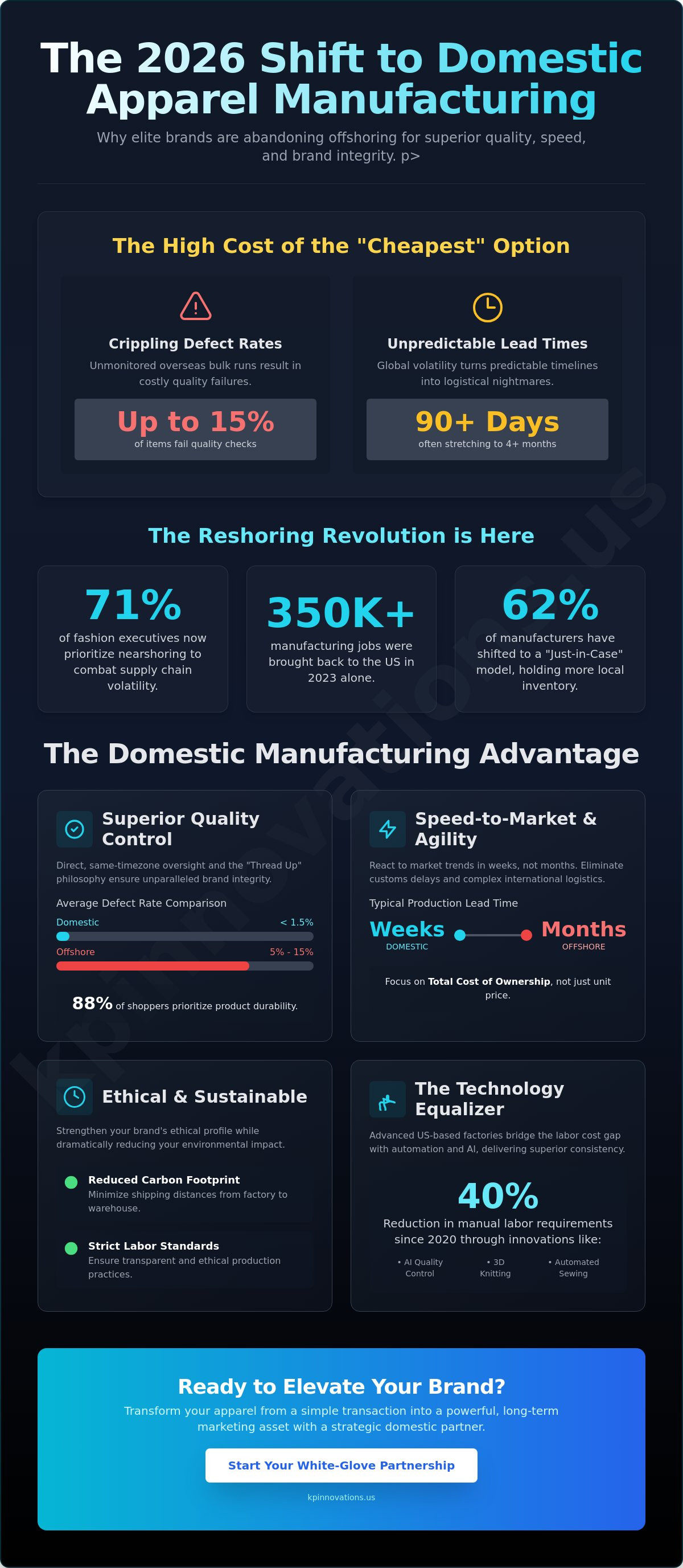
The era of chasing the cheapest offshore labor is officially over for brands that value their reputation. While a low unit cost looks good on a spreadsheet, it doesn’t account for the 71% of fashion executives who now prioritize nearshoring to combat supply chain volatility. You’ve likely experienced the stress of a 90 day lead time that stretches into four months or the disappointment of a bulk order where 15% of the items fail a quality check. Understanding the benefits of domestic apparel manufacturing is now the key to maintaining a competitive edge in 2026.
We agree that unpredictable logistics and ethical concerns are no longer acceptable risks for a growing business. This article promises to reveal how reshoring minimizes supply chain risk, ensures premium quality, and elevates your brand through a controlled production process. We’ll examine the specific shift toward a faster speed-to-market and a transparent supply chain that justifies your premium pricing. You’ll learn how to transition from standard promotional products to fully custom, private-label apparel that reflects your elite standards.
Key Takeaways
- Learn how shifting to a “just-in-case” supply chain model in 2026 protects your brand from global volatility and unpredictable shipping delays.
- Discover the “Thread Up” manufacturing process that ensures premium quality control and superior brand integrity through direct, same-timezone oversight.
- Analyze the true benefits of domestic apparel manufacturing by evaluating the Total Cost of Ownership beyond the initial unit price.
- Strengthen your brand’s ethical profile by meeting strict domestic labor standards while significantly reducing your total carbon footprint.
- Explore how a strategic, white-glove partnership transforms your apparel production from a simple transaction into a powerful, long-term marketing asset.
What is Domestic Apparel Manufacturing in 2026?
Domestic apparel manufacturing in 2026 refers to the strategic production of garments within the same national borders where a brand is headquartered and its primary market resides. This approach has transformed from a niche preference into a core pillar for elite brands that prioritize speed and quality. One of the primary benefits of domestic apparel manufacturing is the transition from “just-in-time” to “just-in-case” supply chain models. Since the global supply chain shocks of 2021 and 2022, 62% of manufacturers have shifted toward holding more local inventory to prevent stockouts and protect their reputation.
By 2026, the “Made in USA” label represents more than national pride. It’s a strategic asset for premium brands that demand total control over the Textile manufacturing process. Advanced technology now bridges the labor gap that once made domestic production cost-prohibitive. Automated cutting tables and AI-driven quality control systems allow US-based factories to compete with overseas labor while delivering superior consistency. Brands don’t just want a logo on a shirt; they want elite, private-label apparel built from the thread up, and domestic facilities are uniquely equipped to deliver that level of detail.
In 2026, technology is the great equalizer. Domestic factories utilize 3D knitting and automated sewing modules that reduce manual labor requirements by 40% compared to 2020 standards. These innovations allow brands to produce high-quality goods without the extreme lead times associated with international shipping. This shift ensures that premium quality isn’t just a baseline but a repeatable standard for every project.
The Reshoring Movement
Major brands are moving production back to North America to mitigate risks associated with geopolitical instability and rising fuel costs. Data from the Reshoring Initiative shows that over 350,000 jobs were brought back to the US in 2023 alone, a trend that has accelerated through 2026. Reshoring is the strategic reversal of offshoring to gain total control over the production cycle. Brands now prioritize stability over the lowest possible unit cost to ensure their service remains seamless. This movement allows companies to react to fashion trends in weeks rather than months, providing a significant benefits of domestic apparel manufacturing in a fast-moving market.
Domestic vs. Nearshore Production
While nearshore options in Mexico or Central America offer lower shipping costs than Asia, domestic production provides unmatched oversight and speed. Choosing a local apparel factory allows for same-day site visits and real-time adjustments to custom designs. This proximity is vital for brands building elite apparel that requires thoughtful project management. US-based facilities eliminate the complexities of international customs and language barriers. This ensures that every SKU meets the brand’s high standards before it ever reaches the fulfillment stage. Proximity doesn’t just save time; it builds trust between the brand and the manufacturer.
Superior Quality Control and Brand Integrity
Maintaining brand integrity requires more than just a logo on a shirt. It demands a level of oversight that is only possible when your production team operates in your own backyard. One of the primary benefits of domestic apparel manufacturing is the elimination of the distance gap that often leads to quality degradation. When you work with a local facility, your brand stays in the same time zone as the people actually sewing your garments. This proximity allows for real-time adjustments and immediate feedback cycles that prevent small errors from becoming expensive disasters. It’s about having total control over your vision from start to finish.
Elite brands understand that quality is controlled at every stitch. This “Thread Up” philosophy ensures that every component, from the fabric weight to the reinforced seams, meets a specific premium standard. Unmonitored overseas bulk runs frequently report defect rates between 5% and 10%. In contrast, domestic partners often maintain defect rates below 1.5% due to constant on-site inspections and rigorous testing. This precision directly correlates with long-term brand loyalty. According to a 2023 consumer study, 88% of shoppers prioritize product durability when deciding whether to return to a brand. High-quality construction isn’t just a manufacturing goal; it’s one of the most significant benefits of domestic apparel manufacturing for brands that value their reputation.
Technical Expertise and Craftsmanship
The local workforce brings technical mastery difficult to replicate in high-volume environments. These artisans specialize in complex construction and premium finishes. Whether developing retail lines or sophisticated promotional products, domestic expertise ensures consistency across every SKU. We don’t just put a logo on a product; we build it to reflect your brand’s elite status. This craftsmanship ensures your first production cycle matches your fiftieth.
Prototyping and Rapid Sampling
Speed to market is a competitive necessity. Domestic manufacturing offers 48-hour sample turnarounds, avoiding the 21-day wait times of international shipping. Rapid prototyping lets you feel the fabric drape and test the fit before committing to a full run. While digital sampling exists, physical samples prevent costly mistakes in large-scale production. You can consult with our project managers to see how this rapid feedback loop protects your investment and your brand’s image.
Economic Advantages: Lead Times, Tariffs, and Logistics
A low per-unit price on an overseas invoice rarely reflects the actual cost of bringing a product to market. To understand the true benefits of domestic apparel manufacturing, brands must look at the Total Cost of Ownership (TCO). This metric accounts for every expense from the initial design to the moment a customer opens their package. When you manufacture domestically, you eliminate the hidden “tax” of international logistics, which includes volatile shipping surcharges and the high cost of capital tied up in long-term transit.
Relying on international shipping means navigating the complexities of customs and duties. Section 301 tariffs on Chinese imports have consistently added between 7.5% and 25% to the cost of goods over the last several years. By producing within the United States, you bypass these unpredictable trade barriers entirely. You also remove the risk of port strikes or container shortages, like those seen in late 2024, which can stall a brand’s momentum for months. Domestic production offers a level of financial transparency and stability that global sourcing simply cannot match.
- Reduced Capital Risk: Smaller, more frequent production runs mean you don’t have to commit your entire yearly budget to a single massive shipment.
- Zero Customs Hassle: No brokers, no bond fees, and no surprise inspections at the border.
- Eliminated Freight Volatility: You pay for domestic trucking, not the fluctuating rates of trans-Pacific ocean carriers.
Speed-to-Market as a Competitive Edge
In 2026, consumer trends move at the speed of social media algorithms. A style that goes viral on a Tuesday can be irrelevant by the following month. Domestic manufacturing allows brands to respond to these shifts in 10 to 14 days, rather than the 90-day cycle typical of overseas production. This agility transforms how you plan your seasonal inventory. Instead of guessing what will be popular six months in advance, you can test small batches and scale up based on real-time sales data. Domestic speed allows for “on-demand” replenishment strategies that keep your high-performers in stock while minimizing the risk of dead inventory.
Fulfillment and Distribution Synergy
The efficiency of domestic production peaks when manufacturing and distribution live under one roof. At KP Innovations, we manage the entire transition from the factory floor to global fulfillment, ensuring a seamless “white glove” experience. This integration removes the need for multiple middle-man warehouses, which often add days to your timeline and increase the risk of SKU errors.
Localized distribution networks also provide a significant environmental advantage. By shortening the distance your products travel, you drastically reduce the carbon footprint associated with your brand’s logistics. This isn’t just a win for the planet; it’s a strategic move for your bottom line. Shorter shipping distances mean lower last-mile delivery costs and faster arrival times for your customers, helping you maintain a premium brand image from production to delivery.
Ethical Transparency and Sustainability Standards
By 2026, transparency is no longer an optional marketing perk. It’s a baseline requirement for any brand aiming for a premium market position. A report from First Insight indicates that 75% of consumers now prioritize sustainability over brand names when making purchase decisions. One of the primary benefits of domestic apparel manufacturing is the inherent trust built through strict US Department of Labor (DOL) compliance. When your production stays within the United States, you aren’t just buying clothes. You’re investing in a supply chain that guarantees fair wages and safe working environments under the Fair Labor Standards Act.
Compliance and Regulatory Peace of Mind
Operating domestically removes the need for expensive, third-party ethical audits that often fail to catch violations in overseas factories. Your brand gains immediate protection through OSHA safety standards and environmental regulations that are already baked into the manufacturing process. Domestic contracts provide a level of legal security that international agreements simply can’t match. If a dispute arises, you’re governed by US law, not an opaque foreign legal system. This reliability allows you to tell a brand story rooted in integrity, which is exactly what the modern, sophisticated consumer demands.
- Reduced Carbon Footprint: International shipping accounts for nearly 3% of global greenhouse gas emissions. Moving production to US soil eliminates the need for transoceanic freight, drastically cutting your brand’s carbon output.
- Waste Reduction: Domestic facilities often utilize advanced precision-cutting technology. This technology reduces fabric waste by as much as 15% to 20% compared to traditional bulk methods.
- Small Batch Agility: Smaller production runs prevent the massive inventory surpluses that typically end up in landfills, ensuring your brand remains lean and environmentally responsible.
Sustainable Fabric Sourcing
The US remains a global leader in high-quality textile innovation. Working locally gives you direct access to Texas-grown organic cotton and advanced recycled synthetic fibers. You can collaborate directly with local mills to develop custom, eco-friendly materials that set your private-label apparel apart from the competition. This proximity fosters a circular fashion model where scraps and returns are efficiently recycled back into new products. It’s a strategic move that transforms your merch into a powerful tool for environmental advocacy. The benefits of domestic apparel manufacturing extend far beyond the bottom line; they define your brand’s character in a crowded market.
Ready to build a brand that stands for more? Partner with KP Innovations for ethical apparel solutions and elevate your brand’s impact.
Strategic Partnership: Elevating Your Brand with KP Innovations
Most apparel suppliers function as simple vendors. They take an order, print a logo, and ship a box. KP Innovations operates differently. We serve as a strategic partner, moving beyond the transactional to provide a white-glove project management experience. Our team manages every detail from the initial design phase to the final delivery at your warehouse or fulfillment center. This comprehensive oversight removes the stress of production, allowing your leadership to focus on scaling the brand and engaging your audience.
We specialize in custom private-label solutions built from the thread up. This means we don’t just select a pre-made garment from a catalog. Instead, we source specific fabrics and develop custom patterns that reflect your brand identity. One of the core benefits of domestic apparel manufacturing is the ability to oversee these details in real time. By keeping production close to home, we ensure that the final product meets the “Premium Is Our Baseline” standard that Fortune 500 companies and luxury brands expect from us.
The Proven 6-Step Production Process
Our success is rooted in a methodical, structured approach. We guide every client through a 6-step journey: discovery, design, sourcing, sampling, production, and delivery. During the discovery phase, we identify your specific goals, whether you’re launching a boutique collection or managing a massive corporate program. Our account managers act as a seamless extension of your team; they’re not just order takers, but consultants who understand your brand’s voice.
Scalability is a cornerstone of our operations. We’ve built the infrastructure to handle projects of all sizes. We support boutique launches that require high-touch attention to detail, but we also possess the capacity to execute complex programs for global enterprises. According to recent industry data, 40% of North American companies have sought to reshore their production to improve reliability. We provide that reliability through a managed process that eliminates the guesswork often found in overseas manufacturing.
Beyond Apparel: A Holistic Brand Experience
We believe that merch becomes marketing when it’s part of a wider strategy. Apparel shouldn’t exist in a vacuum. It should integrate with your promotional efforts and company culture. To support this, we offer sophisticated tools like online company stores. These digital platforms allow you to manage domestic inventory efficiently, giving your employees or customers easy access to premium gear without the headache of manual distribution. This creates a holistic brand experience that feels elite and thoughtful.
The benefits of domestic apparel manufacturing in 2026 are clear: faster speed to market, superior quality control, and a reduced carbon footprint. We handle the complexity of the supply chain so you don’t have to. Whether you’re looking for high-end retail pieces or durable corporate wear, we deliver results that leave a lasting impression.
Ready to transform your brand’s physical presence? Start your domestic manufacturing project with KP Innovations today.
Secure Your Competitive Edge Through Domestic Excellence
By 2026, the landscape of retail and corporate branding demands more than just a logo on a shirt. You’ve seen how the benefits of domestic apparel manufacturing provide a clear path to market dominance through drastically reduced lead times and the elimination of complex international tariffs. Superior quality control isn’t a luxury; it’s the foundation of brand integrity. When you choose domestic production, you’re investing in ethical transparency and sustainability standards that resonate with modern consumers. This isn’t about simple sourcing; it’s about building a resilient supply chain that protects your reputation.
KP Innovations serves as your strategic partner to navigate this shift. We offer white-glove project management and access to a massive catalog of 1.2 million products. It’s why Fortune 500 companies trust us to handle their most critical projects from the thread up. Our team manages every technical detail, ensuring your merch becomes a powerful marketing engine. Don’t settle for the limitations of an average promotional vendor when you can have elite, end-to-end support.
Elevate your brand with premium, domestic-made apparel. Start your project today.
We’re ready to help you create a lasting impression that sets your brand apart.
Frequently Asked Questions
Is domestic apparel manufacturing always more expensive than overseas?
Domestic apparel manufacturing isn’t always more expensive when you analyze the total cost of ownership. While hourly labor rates in the US average $25 to $35 compared to lower rates abroad, you eliminate 15% to 25% import duties and high ocean freight costs. A 2023 report from the Reshoring Initiative found that 20% of companies see domestic production as cost-competitive. This strategic approach removes the hidden fees often found in international shipping.
How do lead times compare between US and international factories?
Domestic lead times typically range from 4 to 6 weeks, whereas international production often requires 12 to 16 weeks. You bypass the 30 day ocean transit time and potential port delays at hubs like Long Beach. This speed allows brands to react to market trends 60% faster than competitors waiting for overseas shipments. It’s a critical component of a responsive supply chain that prioritizes elite execution over waiting for cargo.
What is the minimum order quantity (MOQ) for domestic production?
Minimum order quantities for domestic production are usually much lower, often starting at 72 to 144 units per style. In contrast, international factories frequently demand 500 to 1,000 units to justify the logistics. These lower thresholds allow for thoughtful inventory management and reduced waste. One of the key benefits of domestic apparel manufacturing is the ability to test new designs without committing to thousands of units.
Can domestic manufacturers handle complex custom designs?
Domestic manufacturers excel at complex, private-label designs built from the thread up. Unlike average promotional vendors, elite US facilities use advanced technology like automated cutting and specialized stitching for technical garments. IBISWorld reported that US apparel manufacturing reached a $12 billion market value in 2022 by focusing on high-quality, specialized niches. This expertise ensures your custom merch becomes a strategic marketing asset rather than a generic product.
How does domestic manufacturing impact a brand’s sustainability goals?
Producing goods domestically reduces a brand’s carbon footprint by eliminating thousands of miles of ocean freight. Shipping a single container from Shanghai to Los Angeles generates approximately 3 tons of CO2 emissions according to industry logistics data. By manufacturing closer to the end user, you align with the 75% of consumers who prioritize sustainable practices. We help you deliver premium products that reflect your commitment to environmental responsibility.
What should I look for when choosing a domestic manufacturing partner?
Choose a partner that offers white glove project management and a proven 6-step process. You need a team that handles everything from sourcing to final delivery, not just a simple vendor. Research their history with Fortune 500 companies to ensure they can scale with your needs. A strategic partner acts as an extension of your brand, ensuring premium quality is the baseline for every single SKU produced.
Do domestic factories provide fulfillment and shipping services?
Premium domestic partners provide integrated fulfillment, kitting, and shipping services to streamline your operations. This end-to-end support removes the stress of managing multiple vendors for production and logistics. Industry data suggests that integrated fulfillment reduces shipping errors by 15% compared to using separate providers. We handle the details so you can focus on elevating your brand and leaving a lasting impression on your customers.