
What if your employee uniforms and client gifts weren’t just line items on a budget, but the most effective media channel your brand owns? Most marketing and operations leaders have felt the sting of receiving a shipment of poor quality garments that end up forgotten in a desk drawer. You’ve likely managed the inventory headaches and shipping delays that turn a simple project into an operational nightmare. It’s time to stop settling for vendors who act as mere order-takers.
Knowing the specific questions to ask a custom apparel manufacturer is the first step in identifying a partner who treats your merchandise as a strategic brand experience. This guide will show you how to move beyond simple logo placement to find a partner who manages everything from creative design to global fulfillment. We’ll explore how to vet for quality, ensure compliance with 2026 regulations like the CPSC eFiling mandate, and ultimately secure a measurable return on your apparel investment. By the end of this article, you’ll know how to hire a partner who protects your brand’s reputation at every touchpoint.
Key Takeaways
- Identify the specific questions to ask a custom apparel manufacturer to distinguish between a simple vendor and a strategic partner who owns the entire brand experience.
- Discover why the manufacturing process must begin with creative development and deep-level customization rather than choosing items from a pre-set catalog.
- Learn how to vet for supply chain transparency and proactive ethical management to protect your brand from reputational risks in 2026.
- Understand why global fulfillment and logistics are critical components of a successful apparel program, ensuring your merchandise reaches its destination without operational friction.
- Shift your perspective to view merchandise as a measurable media investment that influences culture and builds lasting relationships with employees and clients.
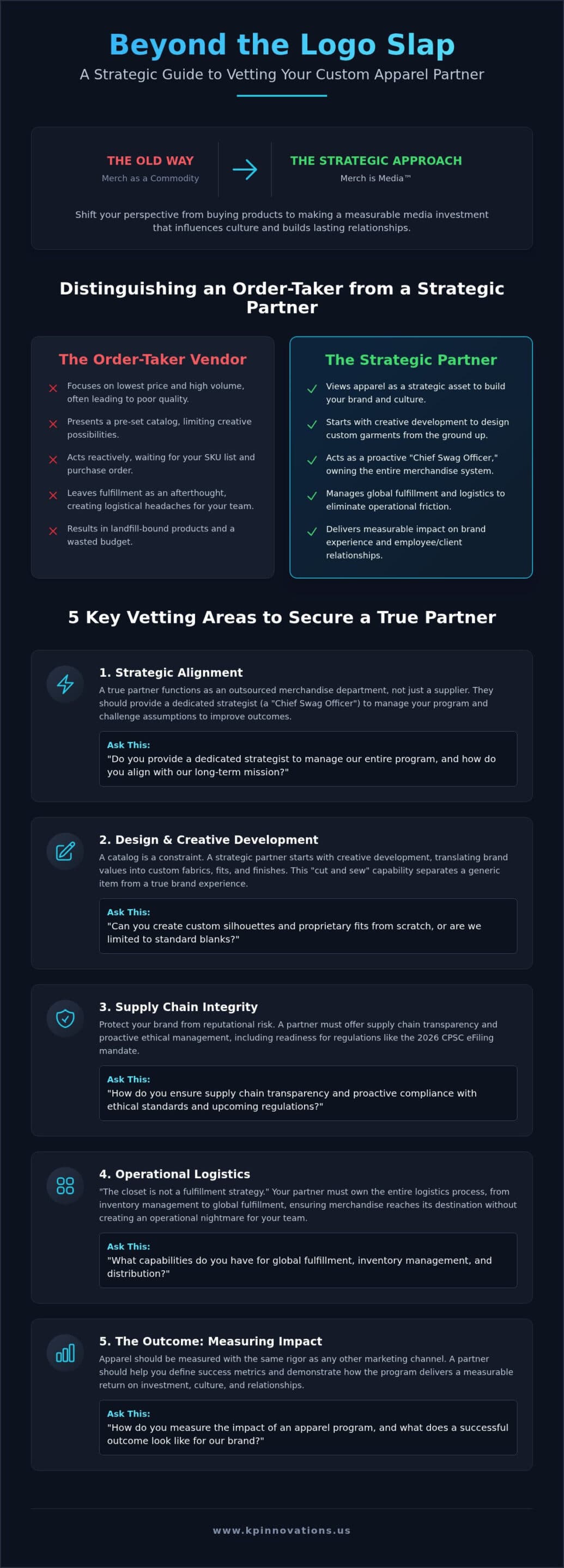
Vetting for Strategic Alignment: Does Your Manufacturer Understand “Merch is Media™”?
Choosing a manufacturer based on the lowest bid is a common mistake that leads to landfill-bound products. Your apparel is a physical extension of your brand’s voice. One of the most critical questions to ask a custom apparel manufacturer is how they align with your long-term mission. The global apparel manufacturing landscape is crowded with vendors who focus solely on throughput. You need a partner who views your apparel as a strategic asset rather than a commodity order. An order-taker waits for your SKU list; a strategic agency partner challenges your assumptions to improve the final outcome.
A true partner should own the entire merchandise system. This includes everything from the initial strategy and creative development to global fulfillment. When a manufacturer contributes to your brand culture, they stop being a vendor and start being an outsourced merchandise department. This shift in perspective ensures that every garment produced serves a specific purpose, whether that’s boosting employee morale or deepening client relationships.
The “Chief Swag Officer” Approach
Ask: “Do you provide a dedicated strategist to manage our entire program?”
Managing custom apparel often turns into an internal logistics nightmare for HR or marketing teams. A professional partner provides a Chief Swag Officer who acts as an extension of your team. This individual manages the strategy, creative development, and sourcing, ensuring every detail aligns with your high ambitions. This model reduces operational friction and ensures that your apparel isn’t just a one-off order, but a long-term asset that grows with your company.
Moving Beyond the Logo Slap
Ask: “How will this piece of apparel influence our customer or employee experience?”
If you choose products based on price alone, you’re likely buying items people won’t wear. This results in wasted investment and a diluted brand presence. Apparel should be measured with the same rigor as your digital marketing spend. A strategic partner helps you select materials and designs that people actually value and want to keep. For organizations seeking high-quality bulk merchandise, SwagStore.NET provides the type of premium corporate gifts that truly resonate with employees and clients. When your team wears your brand with pride, the impact on culture is measurable. Stop looking for a factory; start looking for a partner who understands that every garment is a media touchpoint.
A catalog is a constraint, not a strategy. Most vendors operate by placing a logo on a pre-existing garment, but a strategic partner begins with creative development. This phase ensures your apparel isn’t just another commodity, but a physical manifestation of your brand’s ambitions. One of the vital questions to ask a custom apparel manufacturer is how they translate abstract values like “innovation” or “reliability” into specific fabric weights, textures, and silhouettes. If a manufacturer can’t explain the “why” behind a design choice, they aren’t managing your brand; they’re just filling a purchase order.
Your apparel should be designed to be worn, not just distributed. When garments sit in a box because the fit is awkward or the material feels cheap, your investment is wasted. A partner who understands that “Merch is Media™” will prioritize the wearer’s experience. They should suggest modern trends that resonate in 2026, such as puff embroidery for a premium textured finish or mixed-media decoration that combines different techniques on a single piece. These details turn a simple shirt into a high-value asset that people actually want to incorporate into their daily lives.
Cut and Sew vs. Standard Blanks
Ask: “Can you create custom silhouettes and proprietary fits from scratch?”
Standard blanks serve a purpose for quick projects, but they rarely capture the unique essence of a premium brand. Investing in private label clothing allows you to control every detail, from the specific hemline to the interior neck label. This level of customization is what separates a generic item from a true brand experience. If your goal is to stand out in a saturated market, you need a partner capable of ground-up manufacturing who can develop proprietary fits that your competitors can’t simply buy off a shelf.
Tech Packs and Pre-Production Proofing
Ask: “What does your pre-production approval process look like?”
Consistency is the hallmark of professional manufacturing. You must verify that your partner uses detailed tech packs. These blueprints act as the master DNA for your garment, ensuring that a run produced today matches the exact specifications of a run six months from now. This technical precision is also where you can verify their adherence to ethical sourcing and manufacturing guidelines. A manufacturer who cannot provide a detailed breakdown of their production steps is likely hiding inefficiencies. Finding the right strategic sourcing partner ensures these technical details are managed with white-glove precision, protecting your brand’s reputation at every step of the process.
Supply Chain Integrity: Questions About Sourcing and Ethical Standards
Transparency is no longer a luxury; it’s a non-negotiable requirement for brand protection. When you place your logo on a garment, you’re tethering your reputation to every factory, fiber, and finishing house in that item’s history. By July 2026, the CPSC eFiling mandate requires importers of apparel into the U.S. to electronically transmit certificate of compliance data. This makes supply chain visibility a legal imperative. One of the most vital questions to ask a custom apparel manufacturer is how they proactively manage their ethical standards to ensure your brand remains beyond reproach.
A strategic partner doesn’t just check boxes; they implement strategic sourcing to prevent issues before they reach your loading dock. This includes vetting for garment longevity. A shirt that unravels after three washes isn’t just a waste of money; it’s a negative reflection of your brand’s quality. With organic cotton accounting for nearly 46% of sustainable material demand in the current market, your partner should be able to trace raw materials back to their origin without hesitation. Longevity is the ultimate sustainability metric.
Global Sourcing Capabilities
Ask: “Do you have a diverse network of factories to mitigate risk?”
Relying on a single factory creates dangerous bottlenecks. If a facility faces a localized disruption, your entire program halts. A sophisticated agency maintains a global network to ensure continuity and quality. Asking these specific questions to ask a custom apparel manufacturer reveals whether they are a reactive vendor or a proactive guardian of your brand. In 2026, approximately 58% of major brands use digital labels or QR codes for product transparency. Your manufacturer should offer similar tools to prove the sustainability of your fabrics, allowing you to tell a story of integrity to your stakeholders.
Quality Control and Multi-Point Inspection
Ask: “What is your specific QC process during the cut-and-sew phase?”
The manufacturing floor is where your vision is either realized or diluted. Effective production management requires multi-point inspections at every stage, from fabric cutting to final stitching. “Good enough” is a failure when your corporate identity is on the line. Your partner must ensure the final product matches the approved pre-production sample exactly. This level of rigor ensures that the apparel you distribute reinforces your brand’s premium market position rather than undermining it with sloppy execution.
Operational Logistics: “The Closet Is Not a Fulfillment Strategy”
Manufacturing a premium garment is only 50% of the journey. The remaining 50% is getting that garment into the hands of your team or clients without operational friction. One of the essential questions to ask a custom apparel manufacturer is how they handle the physical burden of distribution. If your marketing team is spending their Friday afternoons packing boxes in a storage closet, your merchandise program is failing. You need a partner who provides comprehensive fulfillment services to ensure your brand experience isn’t undermined by sloppy shipping or lost inventory. A strategic partner treats the unboxing as a critical media touchpoint, not just a delivery task.
Strategic distribution includes capabilities like individual desk-drops and custom kitting. These services allow you to send curated brand experiences directly to remote employees or top-tier clients. For global organizations, the stakes are even higher. Your partner must be able to navigate international customs and logistics to ensure a consistent experience for a remote employee in London as for one in New York. Without this global reach, your apparel program will remain localized and fragmented, missing the opportunity to build a unified company culture across borders.
Inventory and Program Management
Ask: “How do you help us manage inventory levels to avoid waste and stockouts?”
High-growth brands can’t afford to guess their stock needs or sit on thousands of dollars of dead inventory. An outsourced merchandise department monitors your usage patterns and automates reordering based on real-time data. This proactive program management is the secret to a stress-free system. It transforms apparel from a series of frantic, reactive orders into a predictable, managed asset. By offloading these operational details to a dedicated strategist, you free your internal teams to focus on high-level marketing goals rather than tracking box counts.
Integrated Company Stores
Ask: “Can you build a custom platform for our employees to order their own gear?”
Collecting sizes via manual spreadsheets is an outdated, error-prone process that wastes dozens of administrative hours. Custom company stores solve this by decentralizing the ordering process while maintaining strict brand control. Employees get the gear they actually want in the correct sizes, and you get a clear audit trail of every transaction. You should vet the technology behind these platforms to ensure they integrate with your existing single sign-on (SSO) or procurement workflows. To secure a partner that manages every detail from the ground up, start by finding a strategic sourcing partner who owns the entire logistics chain from production to porch.
The Outcome: Evaluating the Partnership and Measuring Impact
The final objective of any questions to ask a custom apparel manufacturer is to determine if you’re hiring a commodity vendor or a strategic ally. A vendor views your brand as a sequence of purchase orders. A partner views your brand as an evolving ecosystem that requires consistent, high-level support. You know you’ve found the right fit when they stop asking for your logo and start asking about your long-term growth targets. They should challenge your assumptions, steering you away from low-impact choices to ensure your apparel actually activates your brand community rather than just taking up space in a storage closet.
Defining success in 2026 requires looking beyond the delivery date. A delivered box is a logistical completion; an activated brand community is a strategic victory. When your apparel program is managed correctly, the garments become tools that influence culture, loyalty, and relationships. This shift in perspective transforms merchandise from an administrative burden into a high-performing media channel that delivers a measurable return on your investment.
Scalability and Long-Term Reliability
Ask: “How have you helped other brands scale from a single event to a global program?”
Scalability is about more than just factory capacity. It involves the ability to manage complex uniform programs across multiple territories or high-stakes client gifting during peak holiday windows. A reliable partner acts as your outsourced merchandise department, anticipating seasonal surges and ensuring your brand presence remains premium even under pressure. If a manufacturer can’t demonstrate a history of scaling alongside their clients, they’ll likely become a bottleneck as your business expands and your needs become more sophisticated.
Measuring the “Merch is Media™” ROI
Ask: “How do you help us track the effectiveness of our merchandise investment?”
You need to move from viewing apparel as a “spend” to viewing it as a strategic investment. This requires a partner who can provide insights into program engagement and garment longevity. When you treat your apparel as media, you expect it to perform with the same rigor as any other marketing channel. A partner who understands that “Merch is Media™” will help you analyze the impact on employee retention and customer sentiment. Use this final checklist to vet your next apparel factory partner: Do they own the strategy? Do they manage the global logistics? Do they prioritize the wearer’s experience over the factory’s output? If the answer is yes, you’ve found a partner capable of elevating your brand to its highest ambitions.
Elevate Your Apparel from Commodity to Strategic Asset
Transitioning from a vendor mindset to a strategic partnership is what separates average merchandise from a powerful brand experience. We’ve explored how ground-up design, ethical sourcing, and integrated logistics turn physical garments into measurable media assets. Knowing the right questions to ask a custom apparel manufacturer ensures you never settle for a factory that simply slaps a logo on a basic blank. It’s about finding a partner who understands that the unboxing experience is just as important as the stitch quality.
Your brand deserves a dedicated advocate that manages every detail with precision. Through our Chief Swag Officer model and a Merch is Media™ philosophy, we provide white-glove global fulfillment that removes the operational burden from your internal teams. This approach ensures your apparel program is a scalable investment rather than a recurring administrative headache. Let our sourcing experts build your strategic apparel program and transform your merchandise into a high-impact tool for culture and growth. You have the vision; we have the system to bring it to life across the globe with total reliability.
Frequently Asked Questions
What is the most important question to ask an apparel manufacturer before signing a contract?
Ask about their involvement in the creative and strategic process. A standard vendor just takes orders, but a strategic partner acts as an outsourced department. You need to know if they own the entire system from design to global fulfillment. This ensures your apparel serves a specific business purpose rather than just filling a storage closet. A partner who understands “Merch is Media™” will prioritize impact over volume.
How do I vet a clothing manufacturer for ethical labor practices?
Request proof of third-party audits and detailed supply chain transparency. Proactive ethical management goes beyond simple compliance checkboxes. Ask for documentation regarding raw material origins and factory certifications. In 2026, regulations like the CPSC eFiling mandate make this visibility a legal requirement. A reliable partner will provide these details without hesitation to protect your brand’s reputation and ensure every garment meets high ethical standards.
What is the difference between a manufacturer and a merchandise strategy agency?
A manufacturer focuses on the physical production of garments, whereas a merchandise strategy agency manages the entire brand experience. Agencies like KP Innovations utilize a “Chief Swag Officer” model to oversee creative development, sourcing, and logistics. While a factory is an order-taker, an agency acts as a strategic advisor. They ensure every item aligns with your culture and delivers a measurable return on your merchandise investment.
Do custom apparel manufacturers usually handle shipping and fulfillment?
Most traditional manufacturers stop at the loading dock, but strategic partners provide comprehensive fulfillment and logistics services. This includes warehousing, custom kitting, and global distribution. Integrated fulfillment ensures that your internal teams don’t become a mailroom. When vetting your options, these are critical questions to ask a custom apparel manufacturer to ensure your program operates without operational friction and maintains a consistent brand experience.
What should be included in a pre-production sample approval process?
The process should include a physical sample review, detailed tech packs, and multi-point inspections. You must verify that the fabric weight, fit, and decoration techniques match your approved digital proofs exactly. This phase is your final opportunity to ensure brand consistency before full production begins. A professional partner provides white-glove project management during this stage to catch errors and maintain high standards across the entire production run.
How can I ensure my brand colors are consistent across different types of apparel?
Utilize standardized color systems like Pantone and request strike-offs for every material type. Since dyes react differently to cotton, polyester, and recycled blends, you need a partner who understands textile science. A strategic agency manages these technical details by working closely with a diverse network of factories. This ensures your corporate identity remains uniform across hats, hoodies, and professional uniforms—as well as professional ID badges from Printwell Canada—regardless of the manufacturing source.
MOQs vary significantly based on the level of customization and the specific factory. Standard blanks often have lower requirements, but ground-up manufacturing or proprietary fits usually require larger runs to be cost-effective. A strategic partner helps you navigate these requirements by aligning your inventory needs with production capabilities. They monitor your usage to automate reordering and avoid the waste associated with overstocking your internal storage closets.
How do I know if a manufacturer can scale with my company’s growth?
Evaluate their global fulfillment capabilities and their history of managing multi-territory programs. Scaling requires more than just factory space; it requires sophisticated technology like integrated company stores. These are essential questions to ask a custom apparel manufacturer to confirm they can handle a transition from localized events to global recognition initiatives. A true partner provides the infrastructure needed to support your brand’s highest ambitions.