
The most expensive giveaway you’ll ever buy is the one that ends up in a convention center trash can. You’ve likely felt the frustration of watching a significant portion of your marketing budget disappear into low-quality trade show giveaways for businesses that provide zero measurable impact. It’s exhausting to manage the logistical nightmares of shipping and storage only to see your booth traffic stall while competitors thrive. We believe your merchandise should work as hard as your sales team does.
This guide will show you how to transform event merchandise from a simple expense into a strategic media channel that drives measurable loyalty. We’ll move past the vendor mindset and introduce the “Merch is Media™” philosophy to your event strategy. You’ll discover how to handle the 2026 CPSC eFiling requirements and FTC standards while utilizing a tiered giveaway system. We’re going to break down the exact framework for selecting high-utility items that customers actually keep, ensuring your brand stays top-of-mind long after the exhibit hall closes.
Key Takeaways
- Stop viewing merchandise as a disposable booth expense and start treating it as a strategic media channel that creates lasting brand impressions.
- Master the tiered giveaway framework to align the value of your items with the quality of your leads for maximum ROI.
- Navigate the 2026 regulatory landscape, including new CPSC eFiling rules, to ensure your trade show giveaways for businesses remain compliant and high-status.
- Learn why a “Chief Swag Officer” model outperforms traditional vendor relationships by solving logistical headaches and operational bottlenecks.
- Shift your focus from per-unit costs to the cost per meaningful brand impression to drive genuine, long-term customer loyalty.
Beyond the Booth: Why Most Trade Show Giveaways Fail Businesses
The trade show floor is often a graveyard of forgotten plastic. For many companies, the process of selecting trade show giveaways for businesses is a rushed, last-minute decision based on unit price rather than brand impact. This cycle of “swag trash” creates a significant disconnect between your high-level service offerings and the physical items you hand to potential clients. In 2026, sustainability and quality aren’t just preferences; they’re requirements for maintaining brand authority.
Low-quality items do more than just waste budget. They actively dilute your brand. If your company prides itself on precision and premium service, handing out a flimsy pen that fails after two uses sends a contradictory message. You’re essentially telling a prospect that your attention to detail is as disposable as the item in their hand. It’s a missed opportunity to build trust at the very first touchpoint.
Many marketing teams fall into the “closet fulfillment” trap. They spend valuable hours counting inventory, packing boxes, and managing shipping logistics from a cramped back room. This operational drain pulls talent away from high-level strategy and lead conversion. It’s a symptom of a vendor-based mindset where you’re buying products instead of investing in a managed system. A strategic partner removes these headaches by owning the entire fulfillment lifecycle.
The True Cost of Commodity Merchandise
The real expense of promotional merchandise isn’t the price on the invoice. It’s the total cost of ownership, which includes shipping, storage, and the missed opportunity of a failed impression. When an item is discarded within minutes of leaving your booth, your shipping costs per meaningful brand impression skyrocket. You’ve paid to ship trash across the country.
Our proprietary “Merch is Media™” philosophy reframes these items as strategic assets. Every piece of merchandise is a physical billboard for your brand values. A high-quality gift creates a positive psychological anchor with the recipient. It fosters a sense of reciprocity and long-term recall that cheap commodities simply can’t match. When you view merchandise as media, you start measuring its success by the quality of the relationship it builds.
Moving Past the ‘One-Size-Fits-All’ Giveaway
To move beyond the vendor model, you need a partner who understands the nuance of your goals. You can learn more about our strategy services to see how we help brands transition from buying products to building integrated merchandise programs that drive measurable loyalty.
Merch is Media™: Turning Physical Items into Strategic Brand Assets
Most marketing leaders view merchandise as a line item. We view it as a broadcast medium. When you invest in trade show giveaways for businesses, you aren’t just buying “swag.” You’re buying impressions. Unlike a digital ad that disappears in a millisecond, a physical asset lives in the recipient’s world for months or years. It’s a persistent brand reminder that doesn’t require a monthly ad spend to maintain its visibility. This is the core of our “Merch is Media™” philosophy: physical items are powerful tools to improve your business marketing strategy by securing permanent real estate on a prospect’s desk or in their wardrobe.
High-quality merchandise also plays a critical role in shaping company culture and long-term customer loyalty. When an attendee receives an item that feels intentional and valuable, it shifts their perception of your brand from “another vendor” to a “premium partner.” This impact extends far beyond the three-day event. A well-chosen asset becomes a “walking billboard,” especially when dealing with high-end apparel. When your brand is associated with a piece of clothing that someone actually wants to wear, you’ve successfully integrated your identity into their lifestyle.
The Science of Brand Recall Through Physical Touch
Tactile experiences create stronger neurological connections than digital visuals. When a prospect interacts with a physical object, it engages multiple senses, leading to higher brand recall. The key is selecting items that integrate into the recipient’s daily workflow. For example, understanding the nuances of private label clothing can elevate your brand’s perception from a commodity to a lifestyle choice. If the item solves a problem or provides comfort, your brand is credited with that positive experience every time the item is used.
Strategic Sourcing: Beyond the Catalog
A strategic approach requires moving past the generic “top 10” lists found in standard catalogs. We provide access to over 1.2 million strategic products, ensuring we find the exact tool to solve your specific business problem. In 2026, custom-built items are significantly more effective than off-the-shelf options. A custom asset allows you to build a cohesive story through your trade show kit, ensuring every element aligns with your brand’s narrative. To achieve this level of precision, most ambitious brands find it’s more efficient to work with a strategic sourcing partner who can manage the complexities of global logistics and quality control.
Quantity vs. Quality: A Comparison Framework for 2026
Selecting trade show giveaways for businesses requires a shift from a “how many” to a “how meaningful” mindset. In 2026, the most successful brands utilize a tiered giveaway strategy. This approach matches the value of the item to the potential value of the lead. You don’t need 5,000 plastic pens to make an impact. Instead, you need high-impact assets for the 81% of attendees who actually hold purchasing authority. We find that 50 intentional items generate a significantly higher ROI than 500 generic ones because they survive the post-show purge. If an item won’t be in use six months from now, it isn’t a strategic asset; it’s an expense.
Sustainability is now a non-negotiable brand requirement. With the FTC actively enforcing “Made in USA” standards and new CPSC eFiling rules for imports, your sourcing choices carry regulatory weight. Choosing eco-conscious materials and high-status products signals that your brand is forward-thinking and responsible. This alignment with modern values is what turns a simple gift into a tool for long-term loyalty.
High-Volume vs. High-Impact: Which Wins?
The cost-per-impression of a high-impact item is often lower over its lifetime than a cheap commodity. A budget-friendly item that is thrown away instantly has an infinite cost-per-impression. Conversely, branded drinkware remains a top-tier choice because of its daily utility. It lives on a prospect’s desk, providing thousands of impressions for a one-time investment. Use budget-friendly items only for general booth traffic to increase flow, but reserve your quality assets for qualified leads who book follow-up meetings.
Sourcing for Longevity and Utility
The B2B space is moving toward “Retail-Quality” merchandise. People want items they would actually buy for themselves. This means sourcing tech essentials that solve real problems, such as portable chargers that keep them connected during long event days. To avoid the “junk” category, use this checklist before approving any item:
- Utility: Does this solve a specific, recurring problem for my target audience?
- Quality: Would a retail store sell this product at its current build quality?
- Branding: Is the branding permanent and integrated, or will it peel off after one wash?
- Tax Strategy: Does the item meet the $4 exception or the $25 business gift limit for optimal deductibility?
When you prioritize these factors, your merchandise stops being a giveaway and starts being an investment. You aren’t just filling a bag; you’re solving a problem and earning a place in your customer’s daily routine.
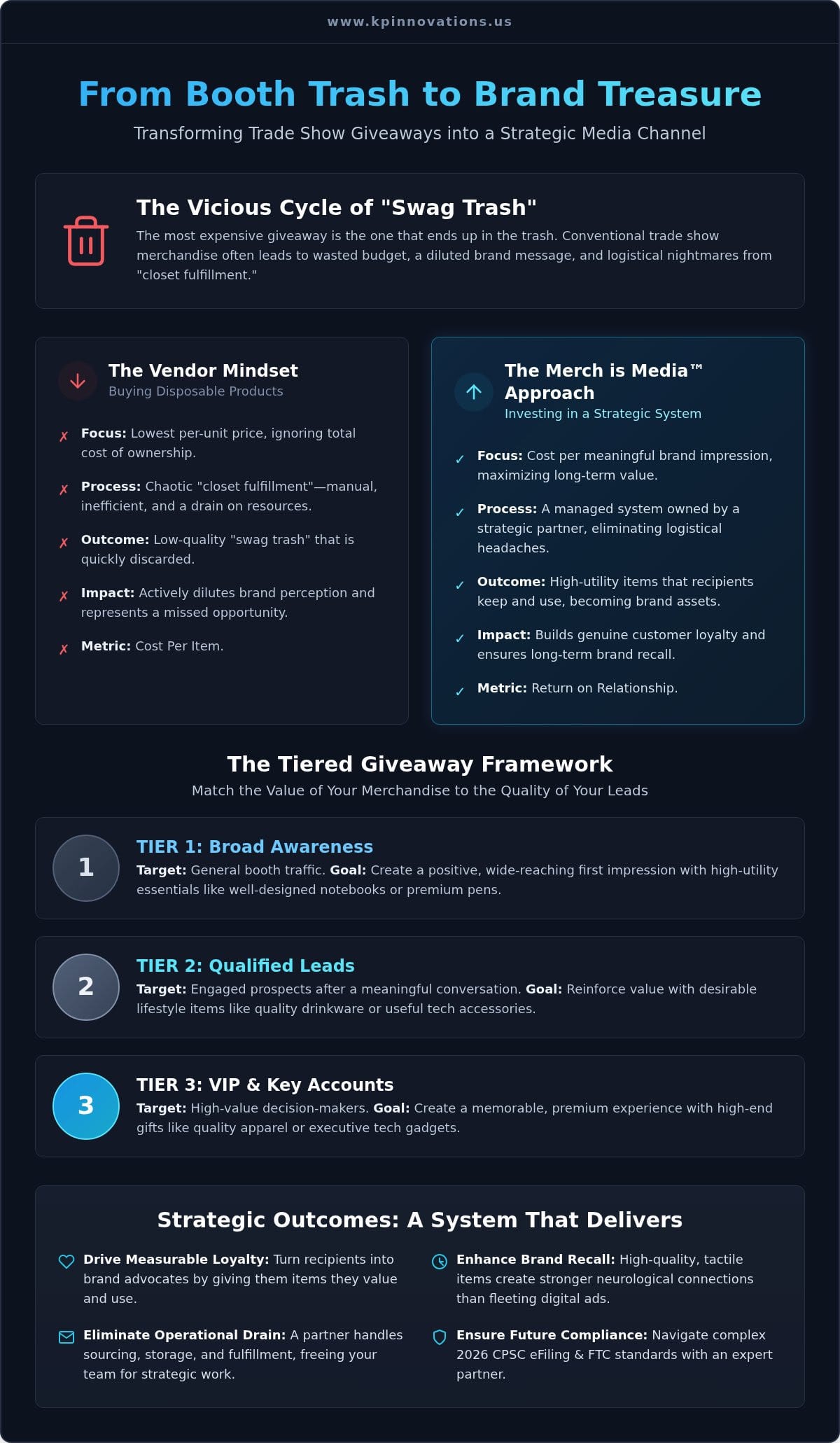
How to Build a Trade Show Merchandise System That Actually Scales
Scaling trade show giveaways for businesses requires moving from a transactional mindset to a systems-based approach. If your marketing team spends their time in a storage closet counting inventory or taping boxes, your current system is failing you. A truly scalable model treats merchandise as a vital marketing channel that requires the same operational rigor as your digital advertising or sales pipeline.
The process begins by defining the specific business problem. Are you trying to increase booth traffic or qualify high-value leads? Once the objective is set, you design and source items that align with the “Merch is Media™” philosophy. Implementing a global fulfillment strategy ensures your gear arrives on time without your team lifting a single box. Utilizing company stores centralizes inventory, allowing regional teams to order exactly what they need for local events. Finally, measure the impact of every asset to optimize your spend for the next exhibit hall.
Eliminating the Logistical Headache
Shipping and storage are where most merchandise programs collapse under their own weight. Professional fulfillment and warehousing are critical for nationwide events where timing and brand consistency are paramount. You cannot scale if your brand’s physical identity is at the mercy of individual office managers or local couriers. By implementing company stores, you streamline the booth setup process. This ensures every team member has immediate access to the same high-status trade show giveaways for businesses that represent your brand authority.
The Chief Swag Officer Model
Ambitious brands don’t just hire a vendor; they outsource their entire merchandise department to a strategic partner. This is the “Chief Swag Officer” model. It moves the burden of project management, vendor compliance, and quality control away from your internal marketing team. This dedicated support ensures every item is brand-aligned from the initial design phase to final delivery. When you have a partner owning the system, you’re free to focus on the relationships that actually grow your business. If you’re ready to stop managing boxes and start managing strategy, you can partner with our strategic sourcing team to build a system that scales.
Sourcing Success: Why Your Business Needs a Strategic Partner
A vendor sells you a product. A partner sells you a result. When you’re selecting trade show giveaways for businesses, the difference between these two models determines whether your budget is an expense or an investment. Traditional vendors leave you to navigate a sea of 1.2 million products alone. They don’t care if the item aligns with your brand’s voice or if it survives the logistical journey to the convention center. We act as your outsourced merchandise department, managing every detail to protect your brand integrity. This white-glove approach ensures that your assets are high-status, compliant, and ready to perform. By owning the entire lifecycle, we eliminate the stress of vendor management and quality control failures.
The KP Innovations Difference
Physical items should influence culture and reinforce relationships. Our creative development process goes beyond simply slapping a logo on a product. We provide strategic oversight from the initial design phase through to final fulfillment. This ensures that every asset is a tool for brand elevation rather than a generic handout. You don’t have to worry about the complexities of global supply chains, CPSC compliance, or inventory tracking. We manage the process so you can focus on building the relationships that drive your revenue. We treat your physical brand assets with the same precision you apply to your core services. Start building your strategic merchandise program today.
Next Steps for Your 2026 Trade Show Season
Transformation starts with an honest assessment of your current status. Audit your merchandise closet today. If you find items collecting dust or gear that doesn’t reflect your current brand authority, it’s time for a change. Your next step is to schedule a strategy session. This is where we define your “Merch is Media™” goals and build a tiered system that works for your specific audience. We’ll help you move away from the “swag trash” cycle and toward a managed department model that yields measurable results. Don’t let another event season pass with a vendor-based approach to trade show giveaways for businesses that drains your team’s time and budget. Learn about our Chief Swag Officer approach to see how we can take the entire weight of merchandise management off your shoulders.
Elevate Your Event Strategy for 2026
The transition from a vendor-based ordering model to a strategy-first merchandise department is the most significant competitive advantage you can build for the 2026 trade show season. By moving away from disposable commodities and embracing the “Merch is Media™” philosophy, you transform your physical brand touchpoints into high-impact assets that drive long-term loyalty. Every item you distribute should be a tool for solving a business problem, not just another piece of clutter in a prospect’s bag.
Stop managing the logistical headaches of storage closets and shipping labels. High-status trade show giveaways for businesses require a managed system that includes global fulfillment and creative oversight. We provide access to 1.2 million strategic products, ensuring your brand story remains consistent from design to delivery. It’s time to measure your merchandise impact with the same rigor as any other marketing investment. You can partner with a Chief Swag Officer for your next event to secure a strategic advantage that outlasts the exhibit hall. We’re ready to help you turn your merchandise into your most powerful media channel yet.
Frequently Asked Questions
What are the most effective trade show giveaways for businesses in 2026?
In 2026, the most effective trade show giveaways for businesses are high-utility, retail-quality items that solve immediate problems. Insulated drinkware, high-capacity power banks, and wireless chargers currently lead the market. These products succeed because they integrate into the recipient’s daily workflow. When you prioritize items that attendees would actually buy for themselves, you earn a permanent place in their routine and ensure your brand remains visible long after the event ends.
How do I calculate the ROI of my trade show merchandise?
ROI should be measured by the cost per meaningful brand impression rather than just the unit price. While the average ROI for trade show participation is 4:1, your merchandise impact is tracked through lead quality and brand recall. 83% of consumers remember the advertiser on a promotional product. By treating your assets as media, you calculate success based on long-term relationship growth and the conversion rate of those who received high-tier gifts.
How much should a business spend on trade show giveaways per person?
We recommend a tiered spending strategy based on lead value. Use the IRS $4 exception for high-volume items to maximize tax deductibility for general booth traffic. For qualified leads, invest in mid-tier items. Reserve premium gifts for VIPs, staying within the $25 business gift deduction limit for optimal fiscal efficiency. This structured approach ensures you aren’t overspending on unqualified traffic while still providing high-status items to your most valuable prospects.
What are the best eco-friendly trade show giveaway options?
Effective eco-friendly options focus on durability and sustainable materials like recycled rPET or organic cotton. High-quality tote bags and reusable drinkware are excellent choices because they replace single-use plastics. Consumers and business leaders are increasingly environmentally conscious. Providing giveaways that reflect these values enhances your brand’s image. Strategic sourcing ensures these items meet the rigorous 2026 FTC standards and other environmental compliance requirements.
How far in advance should I order custom merchandise for a major event?
Order your custom merchandise at least 8 to 12 weeks before a major event. This lead time allows for deep-level customization, manufacturing from the ground up, and rigorous quality control. It also accounts for the July 2026 CPSC eFiling requirements for imported goods. Starting early ensures your strategy isn’t compromised by last-minute shipping delays or limited off-the-shelf inventory. A managed approach requires time for creative development and strategic sourcing.
Can I ship my trade show giveaways directly to the event venue?
You can ship directly to the venue, but it requires professional fulfillment and logistics management to avoid headaches. We manage the entire fulfillment lifecycle for trade show giveaways for businesses, removing the burden from your internal marketing team. This eliminates the “closet fulfillment” strategy that drains operational resources. By using a managed system, you ensure your gear arrives safely and is organized for immediate booth setup, regardless of the event location.
What is the ‘Chief Swag Officer’ model and how does it help my business?
The “Chief Swag Officer” model is an outsourced merchandise department that manages your entire program. We move your business away from transactional vendor ordering to a strategic partnership. This model covers everything from initial strategy and creative development to global fulfillment. It helps your business by reducing administrative stress and ensuring that every item distributed is a strategic asset that aligns with your high-level brand ambitions and culture.
How do I avoid my trade show items being thrown away by attendees?
To prevent items from being discarded, you must prioritize utility and quality over quantity. Giveaways that solve a real problem or provide significant comfort are more likely to be kept. 81% of trade show attendees have purchasing authority, and they value items that reflect a premium market position. By selecting retail-quality merchandise through a tiered system, you ensure your brand occupies physical space in their lives instead of ending up in a trash can.