
What if the warehouse were part of your brand experience, not just a place to keep boxes? When merchandise is purchased for a program, the work doesn’t end when it reaches storage. Inventory still needs to be tracked, requests coordinated, and products delivered to the right people in a way that reflects your brand. That’s the real challenge of warehousing and distribution for merchandise.
If your team is juggling spreadsheets, storage locations, and one-off requests across departments, you already know shipping is only one piece of the puzzle. Merchandise is media. How it’s selected, stored, and delivered can shape how employees and customers experience your brand.
This guide explains how to assess the capabilities your program needs, make inventory easier to manage, and create a more consistent delivery experience. You’ll see how storage, fulfillment, and company stores can work together as part of a managed merchandise program, with a Chief Swag Officer overseeing the details from strategy through distribution.
Key Takeaways
- Match storage and fulfillment to how your merchandise program operates, not just how much inventory you hold.
- Use warehousing and distribution for merchandise to support clear inventory decisions, simpler ordering, and a consistent recipient experience.
- Compare storage-only, fulfillment-led, and integrated approaches to identify where coordination and brand consistency may be getting lost.
- Plan distribution around distinct audiences and purposes, including employee programs, recognition, client gifting, and uniforms.
- Give strategy, creative, sourcing, and fulfillment clear ownership so merchandise works as media for your brand.
Warehousing and Distribution for Merchandise Is a Brand Experience Decision
Merchandise can welcome a new employee, recognize a milestone, or strengthen a customer relationship. Once items are selected, someone still needs to decide where they go, who can request them, and how they reach the intended recipients. Warehousing and distribution for merchandise covers the storage, inventory management, order preparation, and delivery that keep a brand program moving.
Storage is only the physical part. The larger decisions are about access and purpose: which items are reserved for a specific program, how requests are approved, and how orders reach different audiences. A distribution center is one part of the broader process of moving goods from storage toward delivery. For merchandise programs, that process also needs to support the experience the brand intends to create.
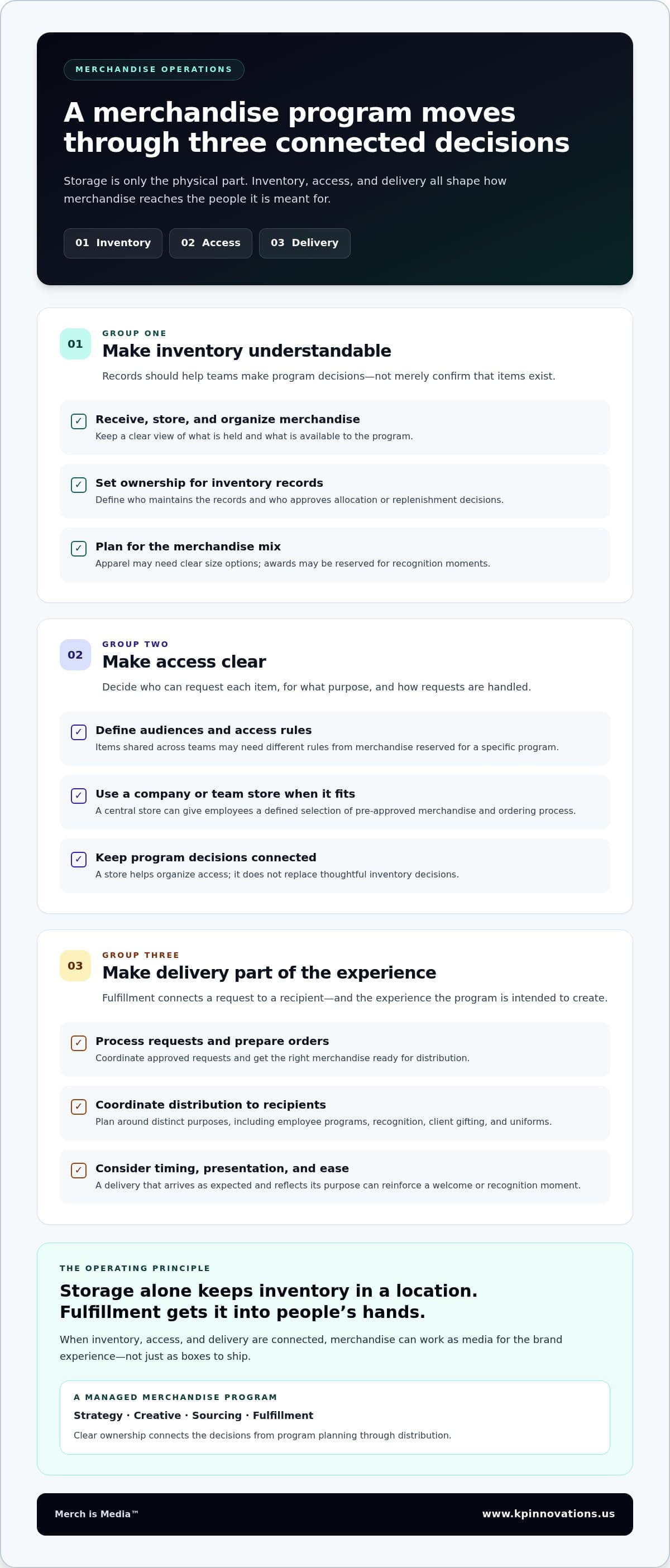
Merchandise fulfillment is the managed process of tracking, preparing, and distributing items for a brand program. Storage alone simply keeps inventory in a location.
What does merchandise warehousing and distribution cover?
The practical scope can include receiving and organizing items, maintaining an accurate view of inventory, preparing orders, and coordinating distribution. The right mix depends on the program and its audiences. A team ordering approved items through a company store has different access needs from a recognition program that reserves merchandise for specific occasions.
A shelf can hold inventory, but it can’t decide which audience should receive an item or how a request should be handled. Those choices affect how useful the inventory is and how much follow-up falls to internal teams. Integrated merchandise fulfillment connects storage with the decisions and work required to get items into people’s hands.
Why is merchandise logistics more than a shipping problem?
When inventory and requests are managed separately, teams may have to piece together what’s available, where it’s held, and who is responsible for sending it. That coordination can slow employee and customer programs, especially when every request becomes a separate task. A defined ordering process gives people a dependable way to access approved merchandise while helping the business manage distribution.
Recipients experience the process, too. Timing, presentation, and ease of ordering all influence how a delivery feels. A package that arrives as expected and reflects the purpose of the program can reinforce a welcome or recognition moment. A confusing process can distract from it.
That’s why KP Innovations’ “Merch is Media™” philosophy treats merchandise as a brand touchpoint, not simply an item to ship. The goal is to align inventory decisions and fulfillment with the culture, loyalty, and relationships the program is meant to support.
The Merchandise Fulfillment Capabilities That Keep a Program Moving
A merchandise program needs more than a place to hold items. Its fulfillment process should connect what’s in inventory with who can request it and how orders reach recipients. Merchandise fulfillment works when inventory, access, and delivery are managed as one connected process.
That process can include receiving and storing merchandise, organizing inventory so teams can understand what’s available, processing requests, preparing orders, and distributing them. The right capabilities depend on what the program holds and how people use it. Apparel may require clear size options and audience rules, while awards may be reserved for recognition moments. Inventory information should support program decisions, not merely record that items exist.
How should storage and inventory management support merchandise?
Clear inventory records help teams see which items are available and make informed decisions about allocation and replenishment. Before launch, define who maintains those records and who approves decisions such as reserving items for a program or making them available to a broader audience. The principles in Logistics & Supply Chain Management offer useful context for connecting logistics with service needs.
Plan around the merchandise mix, intended audiences, and distribution patterns. Items going to several teams may need different access rules from merchandise reserved for a specific program. Clear ownership gives internal teams a shared basis for coordinating requests and resolving questions about stock.
When do company stores improve merchandise distribution?
A company or team store gives employees a central place to order pre-approved merchandise. Rather than fielding separate requests and interpreting preferences one by one, program owners can direct people to a defined selection and ordering process. Shared guidelines help keep choices aligned with the program and brand.
Company and team stores can connect approved merchandise with the people who need access to it. They don’t replace thoughtful inventory decisions: teams still need to know what’s available and how ordering fits the program.
For a coordinated merchandise plan, merchandise sourcing can align item selection with the audiences, access rules, and distribution needs the fulfillment process must support.
Warehouse-Only Storage vs. Integrated Merchandise Distribution
Choosing an operating model means deciding not only where merchandise sits, but who owns the decisions that move it through your program. The right fit depends on the number of audiences, the variety of merchandise, and how often items are distributed. Start by comparing what each model covers and what remains with your team.
| Operating model | Scope | Internal coordination | Inventory decisions | Ordering experience | Brand consistency |
|---|---|---|---|---|---|
| Storage-only | Holds physical inventory. | Your team coordinates requests and distribution priorities. | Internal owners decide access and allocation. | Often shaped by your existing process. | Depends on instructions managed by your team. |
| Fulfillment-led | Combines inventory handling with order preparation and distribution. | Some shipping tasks move into the fulfillment process; program decisions may remain internal. | Your team sets what is available and how it is allocated. | Can follow a defined process for submitting orders. | Relies on shared direction for how orders should reflect the brand. |
| Integrated merchandise program | Connects strategy, creative, sourcing, and fulfillment. | Shared ownership can reduce handoffs across merchandise activities. | Inventory choices align with program goals and audience needs. | Can connect approved selections with a clear ordering path. | Brand intent informs decisions from item selection through delivery. |
These are operating approaches, not a ranking. The broader principles of supply chain distribution connect warehousing and inventory decisions with the movement of products. A merchandise program adds another question: does that movement support the experience you want recipients to have?
What does a storage-only model solve, and what remains with your team?
Storage-only can fit when the main need is to hold inventory and internal teams already have clear processes for managing it. But physical storage doesn’t establish who can request items, which programs take priority, or how merchandise should be distributed. Those responsibilities still need an owner. This model works best when that ownership is clear and the coordination involved is manageable.
What changes when merchandise is managed as a program?
An integrated approach connects merchandise strategy with creative development, sourcing, and fulfillment. That connection helps teams make item and inventory decisions with the intended audience and use in view, rather than treating each order as a separate logistics task.
For organizations with multiple audiences or recurring programs, shared ownership can make the handoffs between decisions and delivery easier to manage. A sourcing plan informed by audience, purpose, and distribution needs gives fulfillment a clearer foundation. Merchandise sourcing can support those program decisions.
How to Plan Merchandise Warehousing Around Your Business Needs
Start with the program, not the warehouse. The right warehousing and distribution for merchandise depends on who the items are for, what role they play, and how recipients should access them. A welcome program, recognition moment, client gift, and uniform program may all involve merchandise, but each can call for different inventory and distribution decisions.
Use this sequence to shape an operating plan:
- Define audiences. Identify who will request, approve, receive, and manage merchandise. Clarify whether you’re supporting employees, teams, customers, or several groups.
- Map merchandise to purpose. Connect each item to an ongoing program, campaign, recognition moment, gifting purpose, or uniform need.
- Plan access. Decide who can request items, who approves requests, and whether ordering should happen through a shared store or another defined process.
- Set distribution needs. Determine how items should be allocated and delivered to each audience, and what the recipient experience should feel like.
- Review outcomes. Agree on what information will help you assess inventory use, internal effort, and the experience of ordering and receiving merchandise.
Which questions define the right merchandise operating model?
Make ownership explicit before the program begins. Who maintains inventory information? Who approves access or allocation? Who handles requests, and who receives the orders? Then consider whether merchandise serves one recurring program or several audiences with different needs. The answers help shape an operating model that reflects how your organization works and how you want each interaction to feel.
For example, recognition items may be allocated for specific milestones, while uniforms support a continuing team need. Client gifts may call for a more personal distribution approach. Treating these as identical workflows can create unnecessary friction or a less considered experience.
How can teams evaluate whether the program is working?
Choose measures that connect to the program’s purpose, not just the number of shipments. Review whether inventory information supports decisions, whether orders are prepared accurately, how much coordination falls to internal teams, and whether ordering patterns match the intended audiences. When available, include recipients’ perspectives on ordering and delivery.
Use what you learn to adjust the program. If an item is difficult to allocate or a process creates repeated follow-up, revisit the inventory plan, access rules, or distribution approach. Measures help guide better decisions, but they don’t guarantee a particular result.
As you build the plan around your merchandise and audiences, strategic merchandise sourcing can be part of the process.
How KP Innovations Connects Merchandise Warehousing to Brand Experience
Warehousing is more useful when it serves a clear program purpose. KP Innovations is a Merchandise Strategy & Brand Experience Agency, not simply a place to store and ship items. Its approach connects merchandise decisions across strategy, creative, sourcing, and fulfillment so the operating plan reflects what the program is meant to do.
A welcome item, recognition award, uniform, or client gift isn’t an isolated order. Each is part of a wider interaction with employees or customers. Warehousing and distribution for merchandise can support that interaction when inventory, access, and delivery are planned alongside the program’s goals.
What does the Chief Swag Officer approach change?
The Chief Swag Officer model brings a dedicated merchandise perspective to decisions that might otherwise be split across teams or handled through separate requests. Strategy defines the program’s purpose. Creative shapes how merchandise expresses it. Sourcing connects those goals to item selection, while fulfillment supports the movement of items to their intended audiences.
Rather than treating each shipment as a standalone task, this approach considers how decisions fit together. A change in audience or program purpose can inform what is sourced and how inventory is managed. That creates a more connected way to plan merchandise activity and coordinate the work behind it.
How does “Merch is Media™” apply to fulfillment?
Fulfillment is part of the message because recipients experience more than the physical item. How merchandise is made available, ordered, and delivered can express care, recognition, belonging, or appreciation. Thoughtful distribution gives those moments a more intentional role in the relationship between a brand and its people.
KP Innovations’ Merch is Media™ philosophy treats merchandise as a brand touchpoint with the potential to influence culture, loyalty, and relationships. Warehousing and global distribution connect the program’s intent with the practical work of getting merchandise to its audience. Company and team stores can provide an ordering path for pre-approved merchandise when they fit the program’s needs.
With the Chief Swag Officer model, merchandise is managed as an ongoing program, not a series of disconnected transactions. Strategy, creative, sourcing, and fulfillment stay connected to the experience the organization wants to create. Strategic merchandise sourcing begins with your audiences and program goals.
Make Merchandise Operations Work for the Brand
Warehousing and distribution for merchandise work best when planned as part of the program, not treated as a final shipping step. Clear inventory ownership, defined access, and distribution decisions shaped around each audience can make merchandise easier to manage and more consistent to receive.
KP Innovations connects warehousing and global distribution for promotional items with project management from design through global fulfillment. Company and team stores give employees a structured way to order pre-approved merchandise. Together, these capabilities support a connected approach, guided by the Chief Swag Officer model and the belief that Merch is Media™.
Build a merchandise program around the people it serves and the experience you want to create. Talk with KP Innovations about strategic merchandise sourcing and make your merchandise interactions more intentional.
Frequently Asked Questions
Is merchandise warehousing different from ecommerce fulfillment?
Yes. Merchandise warehousing focuses on storing and managing items used in a brand’s programs, while fulfillment covers preparing and distributing orders. The activities can overlap, but merchandise may serve employees, customers, teams, or events rather than direct online sales alone. The useful distinction is whether the operation supports the program’s audiences and brand experience, not simply whether it can pack and ship orders.
What should warehousing and distribution for merchandise include?
The right scope depends on the program, but it commonly includes storage, inventory visibility, order access, order preparation, and delivery. Teams should define who can request and approve items, how inventory is allocated, and how merchandise reaches employees, customers, or other audiences. A considered plan connects these tasks to each item’s purpose, so the process supports the experience the program is designed to create.
Can merchandise distribution support employees in multiple locations?
Yes. A distribution plan can be organized around employee audiences and locations, with a defined process for accessing approved merchandise, managing requests, and coordinating delivery. KP Innovations provides warehousing and global distribution for promotional items. Clear ownership helps teams coordinate the experience and account for different audience needs.
How do company stores help manage branded merchandise?
Company and team stores give employees or team members an organized way to order pre-approved merchandise. A central ordering interface can make approved selections easier to access and help reduce scattered requests or inconsistent choices. A store is one part of the operating plan, not a substitute for it. Teams still need clear inventory ownership, approval rules, and decisions about how orders are distributed.
How much does merchandise warehousing and distribution cost?
There isn’t one useful figure for every merchandise program. The approach depends on the inventory, ordering patterns, distribution needs, and services involved. Rather than relying on generic price ranges, define what the program needs to accomplish and how merchandise will be sourced, managed, and delivered. Strategic merchandise sourcing is one part of planning that scope.
How can a company tell whether its merchandise fulfillment is working?
Measure the parts of the process that connect to your program’s goals. Useful indicators can include how clearly teams can see inventory, whether orders are prepared accurately, how much internal coordination fulfillment requires, and recipient feedback when available. Shipment counts alone won’t show whether merchandise reached the intended audience or supported the desired experience. Review the information regularly and use it to guide practical program adjustments.
Should merchandise warehousing be managed separately from sourcing?
It can be treated as a distinct operational task, but separating it entirely from sourcing may create extra handoffs. Sourcing decisions affect what enters inventory, while fulfillment planning shapes how items are accessed and distributed. Connecting the work helps teams consider those needs together, from selection through delivery. KP Innovations frames sourcing and fulfillment within a broader merchandise program, guided by the intended audience and brand experience.