
What if the custom apparel your team just ordered is actually doing more damage to your brand than a negative review? Most leaders assume that as long as the logo is visible, the job is done. However, when your marketing department orders navy hoodies that arrive looking purple and your sales team hands out pens that leak, your brand equity bleeds out. We know the struggle of ensuring brand consistency on merch when departments work in silos and quality varies by vendor. It’s a common operational headache that reflects poorly on the brand you’ve worked so hard to build.
You deserve a unified brand appearance across every physical touchpoint without the operational burden of managing dozens of orders. This guide will teach you how to move beyond vendor-led chaos toward a managed system where your merchandise functions as a high-impact media channel. We’ll explore how a “Chief Swag Officer” model transforms physical items into strategic assets that people actually value and keep. It’s time to stop thinking about products and start thinking about the total brand experience. By the end of this article, you’ll understand how to turn your physical touchpoints into a powerful engine for brand growth.
Key Takeaways
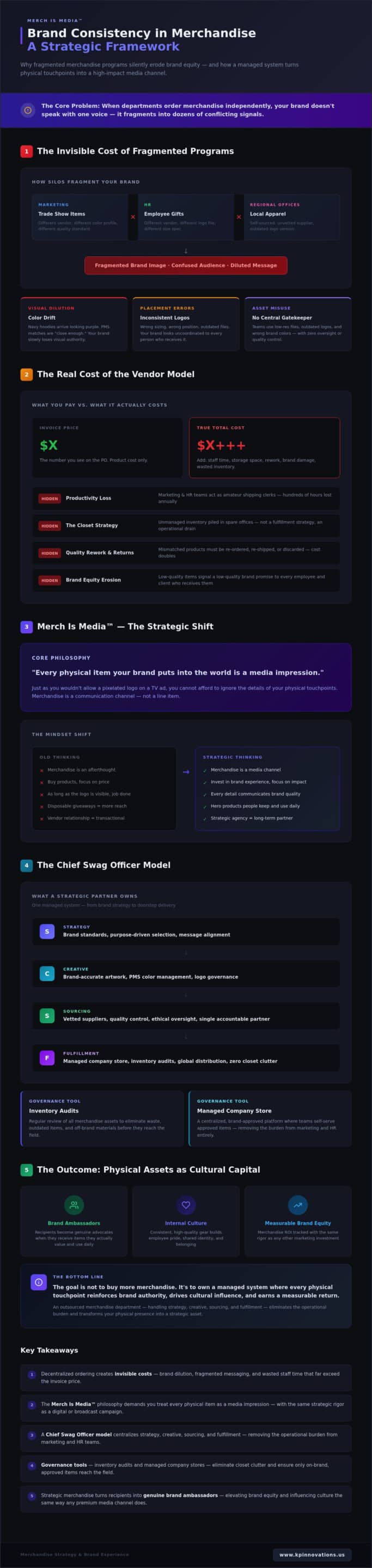
- Identify how decentralized ordering creates “invisible costs” through brand dilution and fragmented messaging across different departments.
- Adopt the “Merch is Media™” philosophy to treat your physical assets with the same strategic rigor as high-stakes digital or broadcast campaigns.
- Master the operational framework for ensuring brand consistency on merch by utilizing a “Chief Swag Officer” model to own the entire system from strategy to fulfillment.
- Learn how to implement governance through inventory audits and managed company store platforms to remove the operational burden from your internal teams.
- Transform your merchandise program into a tool for cultural influence that elevates brand equity and turns recipients into genuine brand ambassadors.
The Invisible Cost of Fragmented Merchandise Programs
Brand consistency on merchandise is the unified execution of visual and emotional standards across every physical touchpoint. It’s about treating a hoodie or a notebook with the same strategic reverence as a national ad campaign. When organizations fail at ensuring brand consistency on merch, the failure usually stems from departmental silos. Marketing orders trade show items, HR buys employee gifts, and regional offices source their own apparel. This decentralized approach creates a fragmented brand image that confuses your audience and dilutes your message.
The psychological impact of this fragmentation is profound. When a client receives a low-quality product or an item with a distorted logo, it communicates a low-quality brand promise. It suggests that your organization doesn’t value the details. For employees, inconsistent or cheap gear erodes pride and internal culture. If the physical representation of your brand is disposable, your recipients will assume your relationship is too.
Visual Dilution: When Your Logo Loses Its Identity
Every material reacts to ink and thread differently. Achieving a perfect PMS color match on a heavy cotton sweatshirt requires a different technical process than printing on a matte plastic water bottle. Most traditional vendors settle for “close enough,” but these slight color shifts and inconsistent logo placements slowly destroy your brand authority. Visual consistency is the non-negotiable foundation of brand trust.
- Substrate Challenges: Different materials absorb pigments at varying rates, leading to “color drift.”
- Placement Errors: Inconsistent logo sizing and positioning make your brand look uncoordinated and amateur.
- Asset Misuse: Without a central gatekeeper, teams often use outdated logos or low-resolution files.
The Operational Chaos of the Vendor Model
Managing fifteen different vendors for fifteen product categories is a recipe for friction. Each vendor has different lead times, shipping policies, and quality standards. This fragmented sourcing creates massive gaps in quality control and ethical oversight. It also leads to the “Closet Strategy,” where unmanaged inventory is stacked in a spare office room. This is not a fulfillment strategy; it’s an operational drain.
The hidden costs of this model are staggering. You’re losing hundreds of hours of productivity as marketing and HR teams act as amateur shipping clerks. Between wasted storage space and the “time tax” of coordinating multiple shipments, the true cost of unmanaged merchandise is far higher than the invoice price. High-tier brands recognize that Merch is Media™ and requires a managed, professional system to protect their investment.
Merch is Media™: Why Consistency Is a Strategic Investment
Traditional marketing often views physical products as an afterthought. At KP Innovations, we challenge this assumption through our Merch is Media™ philosophy. We believe that every physical item your brand puts into the world is a media impression. Just as you wouldn’t allow a pixelated logo on a television ad, you can’t afford to ignore the details of your physical touchpoints. Treating merchandise with the same rigor as a digital campaign is the only way to protect your brand equity. It requires a shift in perspective from buying “stuff” to investing in a communication channel.
Ensuring brand consistency on merch turns simple products into tools for cultural influence. When your team wears high-quality, consistent apparel, it builds a sense of community and shared identity. This isn’t just about a logo; it’s about a feeling of belonging. A strategic brand experience agency understands this nuance, whereas a standard promotional products distributor only sees a transaction. We focus on the long-term relationship between the recipient and the brand. This agency-led approach ensures that every item serves a specific purpose within your broader marketing narrative.
Moving Beyond the Giveaway Mentality
Consistency is not just an aesthetic choice; it’s a financial one. You can measure brand impact through the longevity and frequency of use. Every time an employee wears a consistent, well-made company hoodie, they become a walking billboard for your values. This frequency of use reduces the long-term cost of customer and employee acquisition by reinforcing trust at every turn. Merchandise is a strategic asset that influences loyalty through repeated, positive physical interactions. By maintaining strict standards, you ensure that every impression is a high-quality one. This disciplined approach transforms a fragmented expense into a measurable marketing investment that pays dividends in brand recognition and cultural alignment.
The Anatomy of a Brand-Consistent Merchandise System
Building a resilient brand requires more than just a high-resolution logo file. It requires a governance structure that spans every department and every product category. This is why we advocate for the “Chief Swag Officer” model. Instead of treating merchandise as a series of disconnected transactions, you partner with a dedicated agency that owns the entire system. This partner manages everything from initial strategy to global fulfillment, acting as an outsourced merchandise department. It’s the only reliable way of ensuring brand consistency on merch across a complex, multi-location organization.
A managed system replaces vendor-led chaos with strategic oversight. When one entity owns the creative development, sourcing, and distribution, the “color drift” and quality gaps mentioned earlier disappear. You move from being a reactive buyer to a proactive brand builder. To see how this works in practice, you can explore our strategic sourcing services and see the difference between a vendor and a partner.
Creative Development and Brand Guardrails
Consistency starts long before a product hits the production line. We help brands establish a “Product Bible” that serves as a master blueprint for all physical media. This document goes beyond a standard style guide; it includes technical specifications for various production methods like embroidery, screen printing, and debossing. Managing these art files with precision ensures that your logo looks identical whether it’s stitched into a premium jacket or laser-etched onto a metal bottle. For a deeper look at how these items fit into your marketing mix, read our guide on what promotional products are and how they function.
Manufacturing vs. Simple Sourcing
True brand distinction is rarely found in a catalog. While off-the-shelf products have their place, manufacturing from the ground up offers a level of control that standard distributors can’t match. Private label apparel allows you to customize every detail, from the fabric weight and pantone-matched dye to the custom neck labels and hem tags. This “ground-up” approach is essential for ensuring brand consistency on merch when your goal is to create retail-quality items that people actually want to wear.
- Quality Assurance: We implement strict protocols, including factory audits and multi-stage inspections, to ensure every piece meets your standards.
- Ethical Oversight: Manufacturing your own line gives you direct visibility into the supply chain, protecting your brand from reputational risks.
- Unique Identity: Custom silhouettes and proprietary materials ensure your brand isn’t just another logo on a generic shirt.
If you’re ready to move beyond basic customization, our private label clothing starter guide explains how to build a custom apparel line that truly reflects your brand’s premium position.
Implementing Governance: From Creative to Global Fulfillment
Governance isn’t just a set of rules; it’s an operational framework that protects your brand’s physical presence. Transitioning from a vendor-based model to an agency-led system requires a methodical approach. We follow a structured process to move your organization from fragmented ordering to a managed system. This four-step framework is the most effective way of ensuring brand consistency on merch across a complex organization.
- Step 1: Audit existing inventory. We identify brand dilution points where colors have drifted, materials have failed, or logos are outdated.
- Step 2: Centralize procurement. We move all ordering into a single managed platform to stop the “closet strategy” and ensure every item meets your standards.
- Step 3: Establish global fulfillment hubs. We create a network that guarantees the same quality and experience across every region.
- Step 4: Continuous optimization. We refine your program based on performance data and recipient feedback to maximize ROI.
This centralized approach removes the guesswork for department heads while maintaining your total visual integrity. It reveals the hidden costs of decentralized ordering and sets a baseline for ensuring brand consistency on merch at every level of your business.
The Managed Company Store Solution
A managed company store acts as a digital gatekeeper for your brand. It allows you to offer on-demand, pre-approved merchandise to your teams without the overhead of local storage. Departmental leaders can maintain their budget autonomy while you maintain total control over the creative output. This system eliminates the risk of a well-meaning employee ordering off-brand items from a local shop. You can streamline your program with Company Stores to provide a seamless experience for your entire staff.
Global Fulfillment and Logistics
True governance must extend across borders. A team member in London should receive the same premium experience as a team member in Philadelphia. Achieving this level of consistency requires a network of global fulfillment hubs that understand local nuances. Managing international customs and duties is a complex task that shouldn’t fall on your marketing or operations teams. Our approach ensures that the brand experience remains intact, regardless of where the recipient is located. You can leverage professional fulfillment and logistics to handle the heavy lifting of global distribution.
If you’re ready to fix your broken procurement process and protect your brand’s reputation, start by upgrading your strategic sourcing today.
The Outcome: Turning Physical Assets into Cultural Capital
When you successfully execute a program focused on ensuring brand consistency on merch, you stop collecting products and start building cultural capital. The ultimate goal of our “Chief Swag Officer” model is to move your organization beyond the role of a passive buyer. We function as your outsourced merchandise department, managing the complexities of global logistics and creative development so you can focus on your core business. This shift transforms physical assets into strategic tools that drive real, measurable results for your brand.
Success in this model is measured through the same rigor as any other marketing investment. We look at brand sentiment, employee retention, and client engagement levels. To complement physical touchpoints, many brands explore B2B Customer Incentive and Reward Programs that provide exclusive dining experiences. When your merchandise is consistent and high-quality, it becomes a physical manifestation of your brand promise. It’s no longer just a giveaway; it’s a tangible part of your brand’s story that recipients value and keep for years. This longevity is the hallmark of a program that prioritizes strategy over transaction.
Building Belief Through Quality
The employee experience begins with the items your team interacts with every day. If you provide a cheap, ill-fitting shirt with a crooked logo, you’re communicating a lack of care. Conversely, a unified, retail-quality uniform program changes how employees perceive their role and how clients perceive your authority. Professional strategic uniform programs build internal belief by providing gear that people are actually proud to wear. This pride translates into better performance and a more cohesive brand identity in the field. When your team looks like a unified force, they act like one.
The Future of Branded Media
The next era of physical media is defined by sustainability and ethical sourcing. Ensuring brand consistency on merch now requires a commitment to responsible manufacturing that aligns with modern corporate values. Strategy-first brands outlast trendy giveaway fads because they prioritize longevity and utility over disposable novelty. By focusing on items that serve a genuine purpose, you ensure your brand remains relevant in the recipient’s lifestyle long after the initial interaction. A managed, consistent brand system is the only way to turn physical touchpoints into lasting relationships.
Ready to transform your merchandise program into a high-impact media channel? Contact our team to begin your strategic sourcing journey and see how a dedicated partner can elevate your brand equity.
Elevate Your Physical Media Strategy
Stop settling for fragmented giveaways that dilute your hard-earned brand equity. By adopting a “Chief Swag Officer” model, you transition from managing vendor chaos to leading a strategic, high-impact media channel. You’ve learned that quality control and operational governance are the true keys to ensuring brand consistency on merch across every global touchpoint. Whether it’s through managed company stores or deep-level manufacturing, your merchandise should reflect the same premium standards as your digital presence.
Our team provides the white-glove project management and global fulfillment expertise needed to protect your brand identity. With access to over 1.2 million premium products and a focus on strategic sourcing, we manage the entire system so you don’t have to. It’s time to turn your physical assets into cultural capital that drives real loyalty and internal pride. Your brand is too valuable to leave to chance.
Partner with a strategic agency to master your brand consistency. Let’s build a consistent, high-impact program that elevates your brand for the long term.
Frequently Asked Questions
What is the ‘Chief Swag Officer’ model and how does it help brand consistency?
The Chief Swag Officer model is a strategic, agency-led approach where a dedicated partner owns your entire merchandise system. Instead of managing dozens of vendors, you work with a partner who oversees strategy, creative development, and fulfillment. This model ensures every physical item aligns with your broader marketing narrative. It removes the operational burden from your internal teams while maintaining strict governance over your brand standards at every level.
How do I ensure logo colors match across different types of merchandise?
Ensuring brand consistency on merch requires using technical specifications and Pantone Matching System codes tailored to specific materials. Printing on heavy cotton requires different ink adjustments than laser etching on metal or screen printing on plastic. We manage these substrate-specific variables to prevent color drift. This level of precision ensures your logo looks identical regardless of the production method or the factory used for manufacturing.
Why is centralized fulfillment better than each office ordering their own merch?
Centralized fulfillment eliminates the “closet strategy” where unmanaged inventory sits in spare rooms across multiple locations. When offices order independently, you lose visibility into quality control and total spend. A managed system ensures every order meets the same high standards before it ships. This approach provides white-glove project management and guarantees every recipient receives a high-quality brand impression that reflects your actual market position.
Can we maintain brand consistency if we have international offices?
Yes, by utilizing global fulfillment hubs and standardized creative blueprints. We ensure a team member in London receives the same premium experience as someone in Philadelphia. This requires navigating international customs and duties without compromising the recipient’s experience. Our network manages these complex logistics to maintain a unified brand appearance across all borders, treating your physical assets with the same rigor as global digital campaigns.
What are the most common mistakes companies make with branded merchandise?
The most frequent errors include decentralized ordering, prioritizing low cost over quality, and treating merchandise as a disposable giveaway. Many companies fail at ensuring brand consistency on merch because they lack a central gatekeeper to review production proofs. This leads to logo misuse and fragmented messaging. Another mistake is ignoring the employee experience by providing items people don’t actually value, use, or want to keep.
How does private label apparel differ from standard branded clothing?
Standard branded clothing uses catalog blanks, while private label apparel is manufactured from the ground up. Private label allows for deep-level customization, including pantone-matched dyes, custom silhouettes, and proprietary fabric weights. This approach provides true brand distinction and a retail-quality feel that standard catalog items cannot match. It’s the difference between a generic shirt and a strategic brand asset that recipients will value for years.
What role does a company store play in brand governance?
A company store acts as a digital gatekeeper for your physical media. It allows you to offer on-demand, pre-approved merchandise to your teams without the overhead of local storage. This platform simplifies the process of outfitting a global team or managing corporate merchandise distribution while maintaining total control over creative standards. It eliminates the risk of departments sourcing off-brand items from local vendors who don’t understand your brand guidelines.
How do we measure the ROI of a consistent merchandise program?
ROI is measured through brand sentiment, employee retention, and the longevity of the items. Unlike digital ads with immediate clicks, merchandise is a long-term investment in brand equity. We track how often items are used and whether they successfully turn recipients into genuine brand ambassadors. By treating merch as media, you can evaluate the impact of these physical impressions with the same discipline as any other marketing channel.